
I’m always a little jazzed when someone (or, more accurately, some machines) plow through exorbitant amounts of data to conclusively show that it corroborates what has otherwise been asserted as gospel truth that heretofore had been given the same sort of attitude that Bill Maher often references in his monologues. I don’t know it for a fact, I just know it’s true.
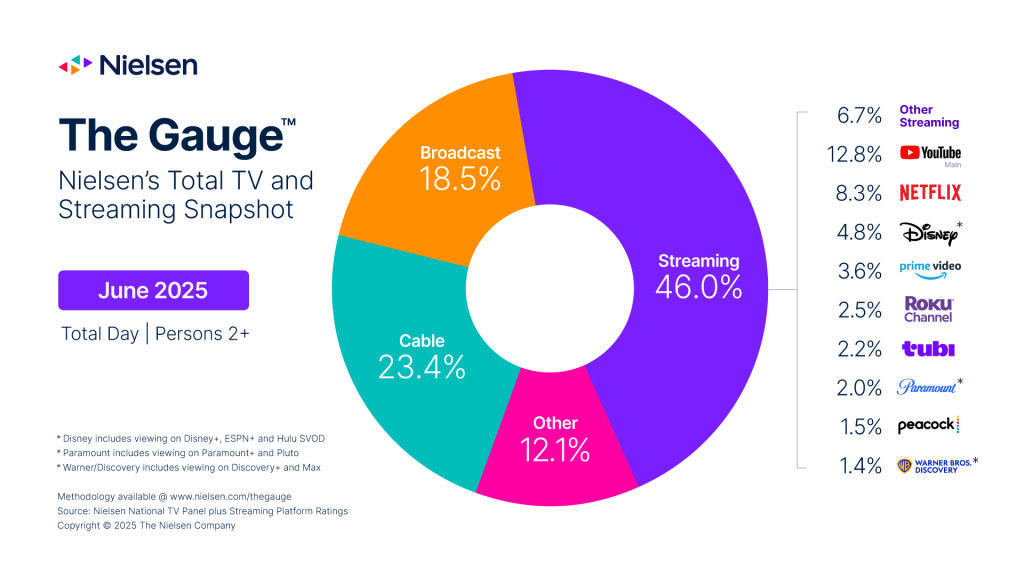 It’s not like we haven’t been given–and ourselves give–cautionary advice when we’re given a new set of data from Nielsen’s THE GAUGE when inevitably YouTube TV emerges far and away as the most-viewed measured destination. Its June report showed YT ahead of its nearest streaming “rival”, Netflix, by a full +54% and many multiples ahead of the offerings from traditional media conglomerates. But we’re reminded that that reflects an aggregate of literally millions of different content sources, both professional and user-generated, that contributes to that number–by a service that doesn’t use Nielsen as an official transactional currency. It may be why the entire release that accompanied this chart made not a single mention of anythings that might have helped spiked YT to yet another viewership record but did extensively gush over what Netflix and Peacock did to make their gains. After all, for what these guys are paying, they need some sort of validation to make their aggressive advertiser presentations a tad more credible.
The task of attempting to discern what in more traditional parlance translates to viewING versus a view is therefore gargantuan, especially so in the U.S. where we’re dealing with multiple time zones, tens of thousands of panel measurement points and a still incomplete lens on the total viewing landscape. But across the pond, where it’s a somewhat more controlled environment, there’s been some exciting advances in attempting to answer the billion dollar question of what may actually be working on YouTube, as VIDEOWEEK’s Dan Meier reported on July 31:
Barb, the UK TV measurement body, has started measuring TV viewing of select YouTube channels. From today, the joint industry committee (JIC) will report viewing figures for 200 channels on the video sharing service, as part of its regular audience reporting. Barb says this development makes it the first JIC in the world to measure viewing for specific YouTube channels.
The measurement body already reported YouTube viewership on TV sets at the service level, but did not track what content viewers were watching on the service. The new initiative, developed alongside Barb’s research partner Kantar Media, involved selecting 200 of the most-watched YouTube channels across a range of genres, including kids content, sports properties and news channels. The new data sets can be accessed in a new weekly YouTube report in Barb’s client portal. The report shows the weekly reach, share of total identified viewing on TV sets, and total minutes viewed for each channel. It also provides a demographic profile for each channel, according to Barb, with information about the age and sex of viewers.
And it’s the last line that’s particularly important, because even if one accepts the currency of YouTube views as truly representative of someone stopping long enough to at least sample a show–a fact of life I learned the hard way wasn’t necessarily true when I was attempting to figure out if COBRA KAI was actually a hit when Sony launched the series and had no way to otherwise verify any metrics beyond view counts–we’ve never had even a hint of demographic profiles anywhere until now.
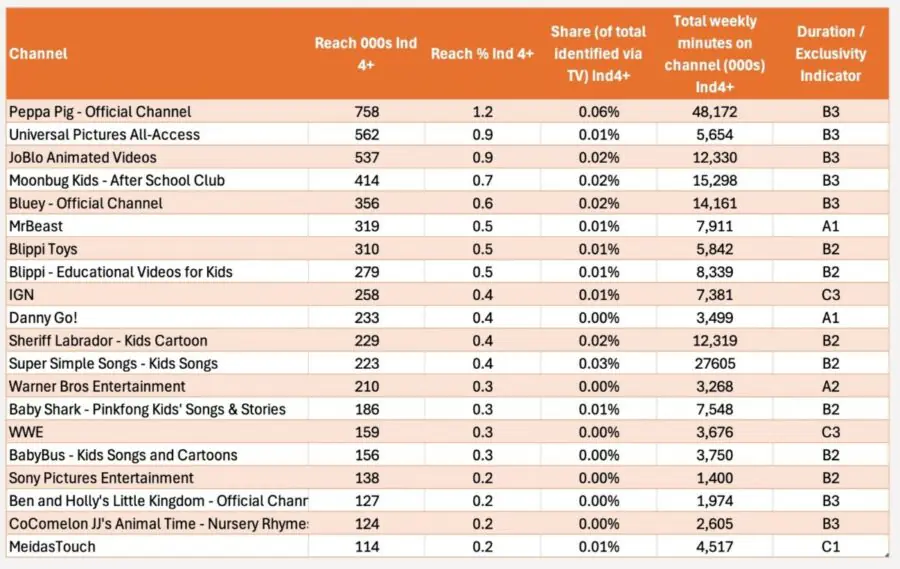 Not that the first report BARB issued which BROADBAND TV NEWS’ Julian Clover reported on concurrent to Meier’s story contained any truly shocking news. As this chart details, even when one attempts to include the sites that tend to show up in more of our autoplays and even with a stratified sample set. kids rule. Per Clover:
The selected channels span a variety of interests and topics, including kids’ content such as Bluey and Peppa Pig; sports like FIFA and WWE; UK and international news and politics such as Fox News and Times News; entertainment like Doctor Who and Warner Bros. Entertainment and popular YouTubers such as MrBeast, Sidemen and Topper Guild. Peppa tops the list that skews towards children’s content, though the Universal Pictures All Access channel is 2nd, though Bluey knocks Mr Beast into 6th place.
Still, as that killjoy Meier was quick to note, it’s the definition of a qualified win:
 More than half of the top 20 are kids channels, including Peppa Pig and Bluey – both of whom were more popular than MrBeast and the WWE last week. Individually the channels’ share of total viewing is relatively (some parents might say enviably) low, led by Peppa Pig’s 0.06 percent share.
You’ll also note that six of those top 20 channels–including WWE and Sony Pictures Entertainment’s broader-appeal comedy/drama aggregat0r–don’t even break the Blutarsky Line even at two decimal places. Yeah, being number one in this world is an even more pyrrhic win that topping broadcast late night these days.
This said, these insights do sync with what we’ve seen in this continent. As Meier concluded:
Collectively however, YouTube accounted for 14 percent of total video consumption in 2024, making measurement of viewing to brand-safe channels of growing interest to advertisers.
That’s in the statistically acceptable wheelhouse of spot on to what The Gauge reported. And the kids’ skew narrative was also echoed:
Kids and teens were the other main driver of streaming’s share shift, as well as for the overall increase in total television usage, which was up 3% over May. With more time to spend in front of the TV, total usage among 6-17 year-olds was up 27% versus last month, and streaming accounted for two-thirds (66%) of their total time spent with TV in June.
Certainly, one week in summer does not constitute a definitive narrative. I suspect there will be seasonal fluctuations with kids back in school, the start of football both American and European and somewhat stronger broadcast competition. But this does underscore that even when media cartologist Evan Shapiro declares that we’re inescapably in the “creator economy” era there’s still a grain of salt or two to put that into some perspective.
At least he’s doing his part to help those seeking fame, fortune and career stability. His most recent podcast is now available on YouTube. That’s gotta add something to their haul, no?
Until next time…
1 thought on “Yes, You Tubers, You CAN Put Lipstick On A Pig”
For the first time in a decade, the majority of the family sat down to watch broadcast TV together. Only it was the Australian version of “Survivor” as they take on the world. We had all but given up on the watered down U.S. version, but the Australian and South African versions are still akin to the early seasons we’re the U.S. version actually traversed the world. But even when we sit in front of the TV, most are still engrossed in social apps or games on their phones. And the youngest generation is taking to YouTube, twitch, kick, etc. in hopes of striking it rich.