
Whenever I see sobering statistics on how shows what were once seen as saviors turning quickly into afterthoughts and write-offs I pay attention; when you’ve been as empowered and as enriched as I have been to react to such stimuli for as long as I was old habits die hard.
 The latest example of that was brought to light earlier this week when it was revealed earlier this week that my one-time comrade-in-arms Shawn Ryan’s Netflix thriller THE NIGHT AGENT was sunsetting–news so surprising that even US WEEKLY’s Kaitlin Simpson felt compelled to attempt to give her type of readers an education into the nuances of streaming metrics:
The Night Agent will be embarking on its final mission — and a slew of dedicated fans are wondering why…The first season of the series was an unequivocal success, becoming the third most-viewed show on the streamer after its debut. It went on to reach number one in 87 countries….However, viewership slowly declined during both follow-up seasons.
And as she so typically does with shows and companies she personally likes, DEADLINE’s intrepid Nellie Andreeva attempted to raise a few more questions as to how in Gawd’s name this could have happened:
According to sources, Netflix data showed that there was still solid interest among fans in getting another chapter of Peter’s (Gabriel Basso) heroics as a Night Agent, which led to the series landing a Season 4 renewal. Additionally, Season 3 was well liked creatively by Netflix executives, some considering it the best in the series so far.
I have generally fallen in line with those Netflix executives’ opinions; when THE NIGHT AGENT show debuted I mused optimistically about how deserving and necessary this was for Ryan–and yes, unlike these other journos I openly confessed to a bias. The undertone of these respective obituaries was “how could this happen?”. Their explanations were focused on the what. And they fell in line with the even more sobering reality check that the newly liberated but still anonymous Entertainment Strategy Guy offered up to his Substack readers yesterday that Netflix’s cavalier attitude may be as attributable to having not only a wealth of riches, but indeed a business model that one could describe as aloof:
(D)espite having eighteen of the top 25 new shows, Netflix only has six coming back in future years, because most of their hits were limited series(…)Netflix already cancelled two of their top 25 shows! The second-biggest new show of the year, The Residence, got the axe, most likely due to its large budget and lack of global viewership. The Waterfront also got cancelled.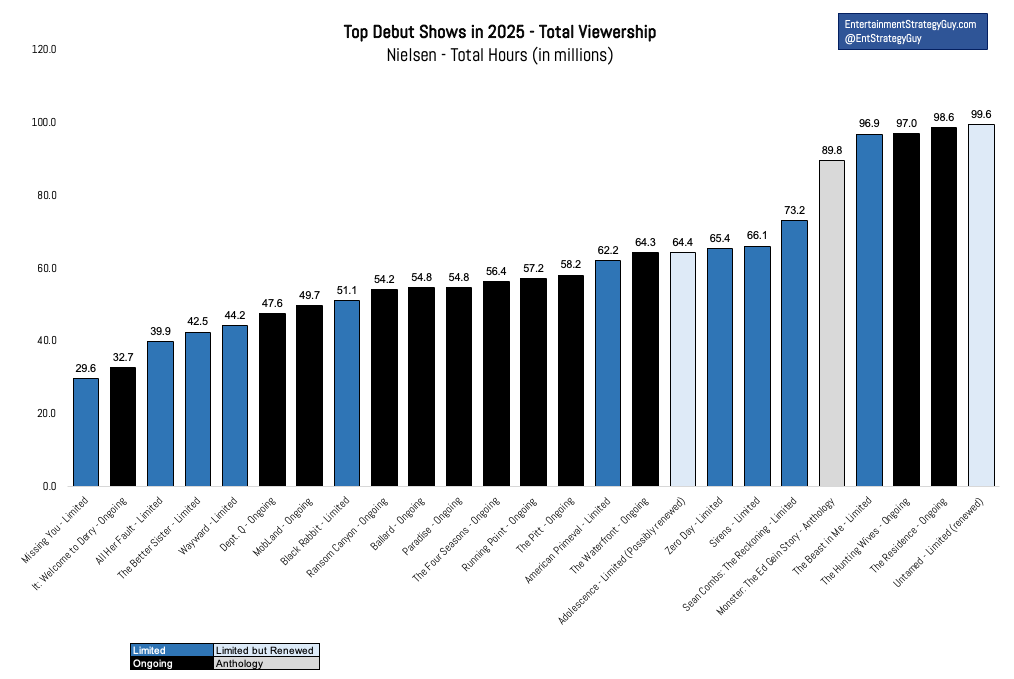
Once again, The Unknown Comic of “research” chose a surgical approach to attacking this issue, as is the charge of those responsible for streaming metrics these days. They generally answer into unapolgetically detached superiors who are often detached from any creative processes. That’s especially true at the platforms whose roots are in the tech cultures of Seattle and Silicon Valley, and with the advent of the Ellison bro culture is now becoming the order of the day at what will eventually become Warnermount. But it doesn’t address what I would contend is the more pressing question. Why are the rejections and unmet expectations occurring in the first place?
I know that when I was empowered and appropriately supported I would want to at least explore those issues–if for no other reason than to better handle creative executives who simply were incapable of grasping why their baby was suddenly ugly. To his credit, Ryan was one of the few who embraced the desire to want to know the whys–and not merely just what plot lines and guest stars clicked or didn’t. When THE SHIELD began to shed audience we asked both current and lapsed viewers how the advent of new technology such as DVRs and recent events (do remember the show debuted shortly after 9/11 and while Operation Desert Storm was top of mind) was shaping their decision-making trees of what, when and where to watch anything at all. What we learned was priority was being given to what they saw as fresh and relatable rather than disposable and escapist. It eventually drove decisions to attack future seasons as de facto premiere events, complete with revised key art and the emergence of new and increasingly more threatening guest characters. And it extended the shelf life, and ultimately the long-term value, exponentially longer than what we typically see from streaming platforms today.
But that may be as much of a function as to how their most desired audiences treat their consumption of many other things these days besides TV. Take for example their relationship with restaurants–a phenemenon THE FOOD INSTITUTE’s George Hajjar addressed in detail earlier this year:
Gen Z diners want their dinner experiences to mean more. A YouGov report found that, despite being more likely to eat at home, the generation is adventurous, liking to “travel with their tastebuds” to experience new cuisines. Restaurants are well-suited to cater to this need by showing these diners proper flavor profiles of unfamiliar foods…The report also found that diners are more likely to view dining out as an experience reserved for special occasions…Roughly 58% of Americans consider a restaurant’s “Instagram/TikTok worthiness” as important, according to a recent OpenTable report. This is an important consideration for restaurants endeavoring to appeal to social media-oriented customers.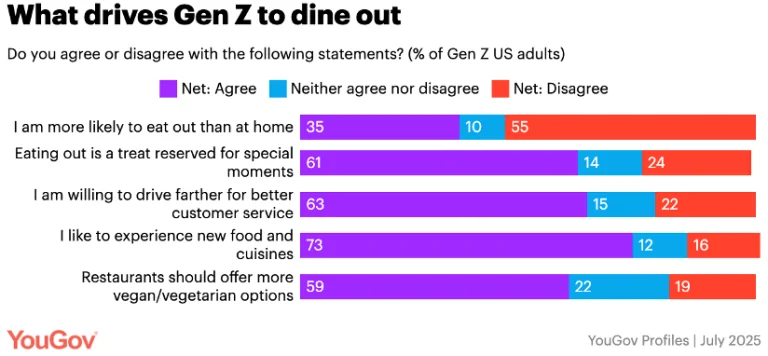
Or how they consume music, as our trusty Copilot companion revealed:
Gen Z spends an average of 27–30 hours per week listening to music often while multitasking. This constant exposure means even songs that aren’t top-of-the-chart hits can be revisited multiple times a month. On-demand streaming platforms like Spotify dominate their listening, with 83% of teens using Spotify… Spotify’s algorithmic playlists and TikTok-driven discovery often push songs with high repeated listens, and about 30% of Spotify plays come from these algorithmic playlists…While TikTok drives 51% of Gen Z music discovery much of that exposure is short-lived. Many viral hits see rapid drop-offs, but the ones that stick tend to be repeated often.
Should it then be a surprise that the thought of committing long-term to a new series may be as antithetical as committing to a new entree or a new song? Add that to the fact that the business model of having a monetizable back end is increasingly impossible to achieve, especially for scripted TV series. Now toss onto the pyre the increasing corporate devaluation of marketing in general, as evidenced by the thousands of such positions that have been eliminated this year alone.
Perhaps there’s simply just a fear of commitment that’s pervasive well beyond merely how receptive and sticky people are to a silly little TV show?
If one is looking for a ray of hope, it might be found in how there may be a generational shift in how people are consuming each other, as a report from FOR EVERY WOMAN’s Julian Savard that dropped last August conveyed:
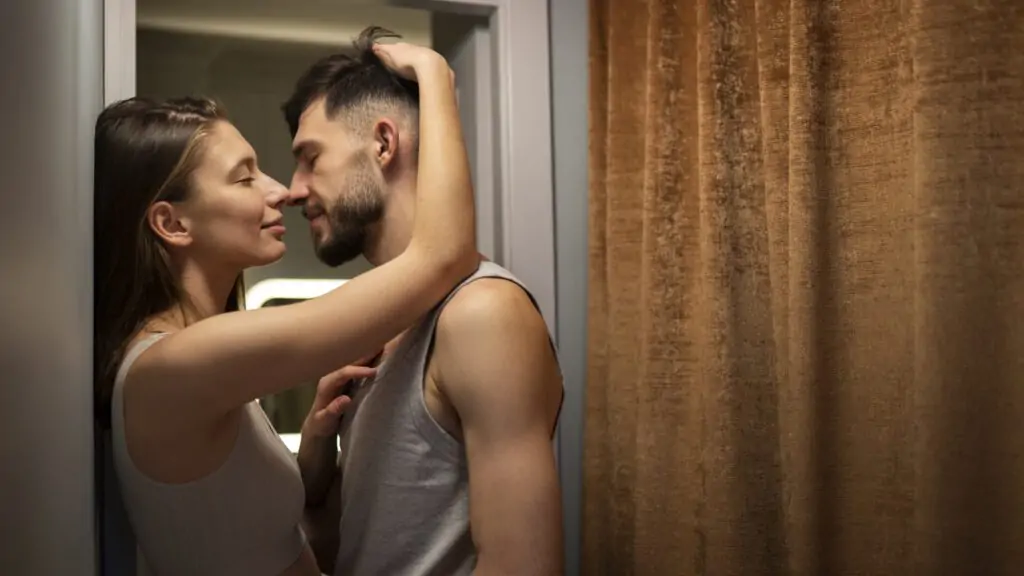 For years, hookup culture was framed as the quintessential youth experience—a glittering rite-of-passage full of fleeting flings and digital dalliances. But a cultural shift is underway. Gen Z is quietly redefining intimacy, turning away from casual encounters and gravitating toward deeper emotional connection, authenticity, and intentionality.
A YouGov–Times poll found that 62% of Gen Zers say one-night stands are uncommon in their social circles. Just 23% admit to casual hookups, a dramatic drop compared to millennials, of whom 78% reported sex on a first date. For Gen Z, relationships aren’t just about now—they’re about meaning. Surveys show 52% of Gen Z dating app users are seeking long-term relationships, more than any other generation.
If I’m a creator, especially if I’m trying to have my show renewed by a bunch of otherwise detached millennials, I might want to think about incorporating some of the kinds of touchpoints that would appeal to its viewers, who are ultimately a platform’s subscribers. As Savard enumerated, those include emotional connection…honesty…(and) the freedom to define your own terms for connection.
Does this all sound a tad too abstract for your tastes? I know that’s my knee-jerk reaction. But I’ve learned enough to know what I think matters scant little, and in order to stay ahead of any curve one has to at least try and figure out what others think–and why. I’ll hope against hope that those in a position to do so–especially those who actually have reasonable budgets–might at least be inclined to desire to. Or at bare minimum the reporters that cover them.
Until next time…