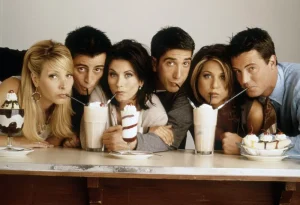
I have slightly more than a passing intrigue with FRIENDS. My ex was an unapologetic addict who attended many tapings while quasi-working on the Warner Brothers lot, becoming a familiar enough presence to gain floor access and knew exactly where to sit in the bleachers so her distinct laughter would be easily identified by even a casual viewer. When I was fortunate enough to get tickets from an NBC executive for one of the final tapings in its history she was blase and jaundiced, criticizing how much better it was for her during what she considered to be the funnier years. I recall not laughing much on my own on that tape night, and even less in recent years whenever I would stumble upon it in reruns.
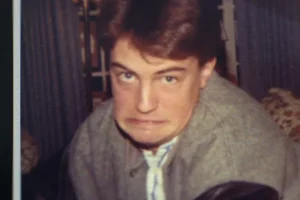 I also didn’t laugh much at the Netflix documentary THE ONE ABOUT MATTHEW PERRY which dropped onto the beleaguered platform last night. Given the tragic nature of its subject, who died three years ago this week as a result of a ketamine overdose at a mere 54 years of age, I wasn’t expecting all that much opportunity to do so in the first place. Perry’s struggles with addiction and relapse were well-documented and known to those who were involved with FRIENDS’ productions long before they became regular fodder for entertainment news magazines. And those that I knew who got to know him while he was not quietly dating ABC president Jamie Tarses in one of the more Shakespearean romances in recent memory confirmed that he exhibited pretty much every telling sign of an addictive personality–fluctuating at the drop of a hat–or, more accurately, of a dime bag–between life of the party and rage monster. For as much as I was entertained by Chandler Bing and to a lesser extent the roles he played on less successful follow-up series like MR. SUNSHINE and STUDIO 60, I was much less favorably moved by the real-life Perry.
 So I probably wasn’t as disappointed as many of the reviewers who perhaps expected a more sympathetic lens into his life than the one that director Mary Robertson chose to shine in the three hours I endured that felt a lot longer while digesting. Those familiar with Robertson’s pedigree would have been even less surprised. As a showrunner of THE NEW YORK TIMES PRESENTS, she delved into the similarly consternating life of Britney Spears not once but twice, deservedly winning several awards for her brutal but accurate showcasing of how she is simutaneously victim and antagonist as she battles her own outsized demons. More recently, she was responsible for QUIET ON SET, the equally honored Investigative Discovery multi-parter that exposed the underbelly of kids’ TV and led showrunner (and himself a former child star) Dan Schneider to file a noisy defamation lawsuit that only last month finally got tossed out. The threads that connect her works are brutal honesty and emotional investing–she’s after what she perceives as the truth, and it’s up to you the viewer to be able to handle it.
With that sort of framing, Robertson at least delivers to an extent on the promise. VARIETY’s Alison Herman kinda got that point:
(W)hether a matter of intention or circumstance, what emerges in place of star power is a more intimate portrait of Perry and his decadeslong struggle with substance abuse, leading to his death from a ketamine overdose in the fall of 2023. Through friends, family, fellow addicts and former partners, what emerges is a straightforwardly told, crushingly sad story of a man whose talent, humor and success were not enough to overcome a chronic disease.
But as THE HOLLYWOOD REPORTER’s far less understanding resident snide Daniel Fienberg observed, we get those stories through a decidedly less familiar sea of names and faces:
Literally none of Perry’s Friends co-stars appear in the documentary — nope, not even Janice or Gunther — nor do any of the key creative forces from the show. Unless you count Warren Littlefield, NBC’s entertainment president at the time, as a creative force from the show. Otherwise, one writer from the first season (Jeff Strauss) is included, but nobody with a high enough profile is there to say anything that might be interpreted as sensational or sensationalistic. The same is roughly true of the rest of the A-listers whom Perry worked with over the years. Fools Rush In is represented by producer Doug Draizin, Studio 60 on the Sunset Strip (and Mr. Sunshine) by Nate Torrence, The Whole Nine Yards by director Jonathan Lynn.
What we do get is the undeniable roller coaster that his real support group felt while being taken on this ride. Herman took this executional decision in the most even-handed light:
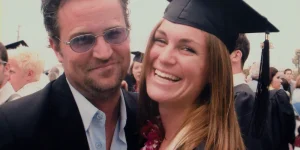 The unofficial protagonist of “The One About Matthew Perry” is Perry’s younger half-sister Mia Perry Bowick, a therapist who narrates what it’s like to share a loved one with the world at the peak of the monoculture. Bowick is joined by Perry’s close friends Roger Castillo and David Pressman, who recall frequent pre-fame nights with Perry and Azaria at West Hollywood’s Formosa Cafe, as well as multiple ex-girlfriends and even a member of Gen Z who met Perry in one of his many rehab stints. (She says they partly bonded because, not in spite, of their age gap: “I was born in 1997; you’re not that big a deal to me.”) Some of these voices, like “The Whole Nine Yards” director Jonathan Lynn, can speak to Perry’s artistic ability. Most, however, are there to testify to what the public didn’t see, at least until Perry chose to share his start-and-stop road to recovery in venues like his 2022 memoir.
 It is the fact that Robertson’s narrative draws heavily from that book–which in the rear-view mirror proved to be little more than a Marc Anthony work (the king of, ahem, De Nile)–as well as far too familiar and rehashed coverage of his death and the subsequent trials of those who contributed to it that makes this as unsatisfying to me as it apparently did to DEADLINE’s Dominic Patten:
I was at court hearings and sentencing hearing on Perry’s death right up until this year. Before that, I was on the story of Perry’s death within an hour or so of his body being discovered in late October 2023 by authorities in his Pacific Palisades home. As more details came out, the sad truth of Perry’s relapses and drug hustle emerged. What also emerged was the fast one the actor played on those around him — pronouncing himself clean and sober when he kept going back to using made his death look inevitable. Like the cast of Friends, you won’t find a lot of that in The One About Mathew Perry – it doesn’t fit the narrative they’ve constructed, true or not.
And taking this full circle, Patten takes out his own enhanced frustration by delivering a not-so-thinly veiled message to the incoming team of new decision-makers:
In many ways, the whole series is a juiced up version of Netflix’s recently introduced InstaDocs series and their insta-take on a large event like the OpenAI Hugging Face cyberattack. In another sense, The One About Matthew Perry seems to exist in no small measure to get the streamer’s algorithm to pump you over to more easily digestible programming that you’ll lose interest in fairly quickly…if you want to know, Ted and Greg, why Netflix subscribers are spending less time on the service, it is air-filled content like The One About Matthew Perry. Content that is truly much ado about nothing.
I’m not quite as eager to toss our favorite Teddy Bear and his sidekick under a bus for this as is Patten; arguably, I’ve done that more than enough in recent days. There is a far more upbeat and already well-reviewed documentary on the history of SCTV that’s dropping Friday night that I vow I will contribute a QDP toward. Don’t you worry none, gents, I’ll be there for you.
Until next time…