
On their first official day on the job, most new hires typically go through an onboarding process and sometimes a pizza party to celebrate their arrival. I’d like to think Peter Rice got slightly better cuisine from Netflix yesterday commensurate with his position.
But he also got to deal with the public reaction to what BLOOMBERG’s tenacious self-described “professional party pooper” dropped on his LinkedIn page yesterday:
Netflix users aren’t opening the app as many days a month as they used to. We broke some news over the weekend thanks to sources who shared a couple internal metrics that underscore the company’s engagement challenge.
 1. The company uses a metric known as QPD, or qualified play days, to measure how often customers use the app. It started to drop after Netflix cracked down on password sharing in 2022. At first, executives assumed it would be short-term, because fewer people were using each account. But the trend has continued, raising the risk that people are finding less value in the service or spending more time with rivals.
2. Related: The average customer is spending less time watching. While the total time on the app increased by a couple of percentage points in the first half of the year, that’s because more customers have been added. Each individual is watching less.
The decline in those metrics has worried Netflix leadership. The declines are modest. But Netflix’s business model and stock price are predicated on increasing viewership.
Modest or not, these are real receipts that what had been a default destination for the “Netflix and chill” generation is less the case than it once was. For a business where the goal has always be to keep people as long as possible within a particular walled garden there’s tangible evidence that they’re less likely to be even in the garden to be hocked to.
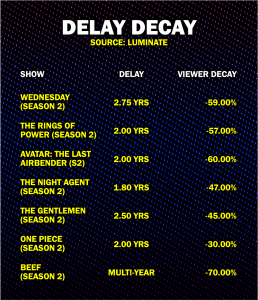 Naturally, this provoked an outsized amount of Monday afternoon quarterbacking among pundits and experts as to why this is happening. The immediate pivot was to put blame on the decline in season/season retention for nichier binge-release series which was among the many SIGNIFICANT points that Evan Shapiro made in his piece from yesterday with Luminate data that hopefully will pass muster with the nit-pickers that seemed to miss the point that having anyone pay attention to any objective data at all is in itself a victory in today’s arrogant boardrooms. The early returns on the supposedly big return of NOBODY WANTS THIS provided still more evidence of the problem at hand. Per SCREEN RANT’s Matthew Rudoy:
 On Rotten Tomatoes, Nobody Wants This season 3 has debuted with a 72% audience score…72% is a significant improvement from season 2’s “Rotten” 57% audience score, but still below season 1’s 84% score. As for the Tomatometer scores, season 3 is also higher than season 2, but season 1 still holds the record for the show’s best result…Along with the largely positive responses to season 3, it is performing well on streaming, as it is Netflix’s number one show in the U.S. as of this writing… only behind Lupin, which released its season 4 episodes on October 23.
Sorry to rain on your attempted parade, Matt, but being number two to a French procedural with middling qualitative scores suggests this should have been retitled A HANDFUL WANTS THIS. And since the season was already dumped like leftovers in a disposal unit any chance to take advantage of any sort of narrative to drive more of those precious QPDs has been entirely lost.
So this may explain why the ousted Bela Bajaria was so obsessed with licensing podcasts and maybe why the first new hire of the Rice regime turns out to be someone with that particular responsibility who’s undoubtedly coming in at a lower price point. As DEADLINE’s Armando Tinoco reported:
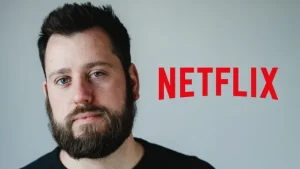 Steve Wilson has been tapped to head Netflix‘s podcast division as it seeks new growth opportunities, Deadline has learned. The former Apple Podcasts executive has been contracted by the streamer to lead the company’s podcast acquisitions.
Wilson had spent 15 years at Apple, where he worked across editorial, partner relations, and marketing. He left in 2020 and joined QCode as Chief Strategy Officer, overseeing partnerships, marketing, distribution, and content strategy. When he joined QCode, Wilson said, “Podcasting empowers individuals to share their voice with the world and promote storytelling, which engenders connection and empathy,” something he can now apply at Netflix.
That sentiment would make for a really nice needlepoint suitable for framing in any content creator space (or its virtual background). But may I humbly add that this time around exclusivity might be an even bigger priority. It might mean you’d have to pay more and give a bit more creative control than you might otherwise want to in order to get some significant or even emerging examples of those empowered individuals to eschew other avenues for yours. But if the goal is indeed to increase the number of different reasons to move that QPD needle it’s imperative that your walled garden is the only one where one can find that particular brand. Scripted series have had that benefit, for better or worse. That needs to be an overarching mandate for anything else as well.
Even the relative Luddites in over-the-air TV have begun to figure that out. Witness the provocative thoughts that even a recently relocated former executive from the 70th largest DMA named Dawn Ennis was able to ferret out over the past weekend:
Here’s the wakeup call: Local network-affiliated TV stations are paying their networks more money and getting fewer viewers in return. They’re seeing a dramatic decline in ROI in just the past five years! This formula makes no sense.
 My last station, WSLS, has been an NBC station since signing on 74 years ago this December and it is the third oldest affiliate in the Commonwealth, and the oldest in Southwest Virginia. I can imagine a scenario in which the company that currently owns WSLS seriously weighs the benefit of removing the peacock from its logo, gives up its NBC affiliation, and goes independent in a competitive small television market, where Nexstar, Gray and Sinclair own the Fox, CBS and ABC affiliated stations. The numbers in the story linked here tell me this is a conversation happening in boardrooms nationwide.
https://lnkd.in/eswyK9-h
The story she links to is hardly a radical insight but it is a sobering reminder that if a modestly rated station in a marginal diary market is already thinking about this as a way to get more people into their garden it’s probably time for Netflix to ascribe a similar hierarchy of values in their case. Especially since Wilson will likely have a lot fewer people around to help him promote whatever he decides to license.
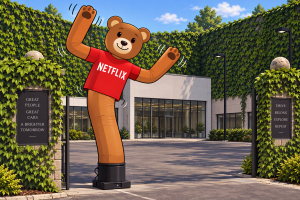 Or there’s always Air Tube Teddy.
Until next time…