
Those of you who actually know me know full well I have a love/hate relationship with Nielsen. Over the decades I’ve been directly or indirectly responsbile for putting close to a billion dollars in contracts into their coiffeurs, and those that empowered me to deal with them put a lot more in theirs. And at various times I didn’t exactly come up empty myself, and they even picked up a few dinners and open bar tabs.
I’m often been among the most vocal of their critics when I have been frustrated by their historic sluggishness to evolve their products at times when there were clearly signs of generational and technological shifts that fledgling competitors would tout in their presentations and mission statements to desired early adopters like me, promising better mousetraps to more accurately and cost-effectively catch the rats we would otherwise call viewers and consumers. I’ve occasionally been given opportunities to shepherd such efforts, most recently at Sony where its unique position as a mature and prolific supplier without the benefit of credible first party data made it all the more a target for those upstarts. But time after time the balance of the industry regressed to the mean and the familiar–mostly out of habit and the reality that posturing and bravado aside, most buyers are inherently lazy. For better or worse, Nielsen is a brand name with more than a century of street cred that doesn’t require a dissertation to describe or several pitch meetings to educate end users of what or why it should exist. And besides, when such potential threats to their business do gain traction, they seem to have the resources to align and/or acquire them and stifle whatever competition was mushrooming. The latest example of this officially went down yesterday as AXIOS’
 Nielsen has agreed to buy DoubleVerify, a digital media measurement firm, for around $2.15 billion, or $13.60 per share… This highlights a recent trend of media measurement firms going (or staying) private, which could accelerate as AI continues to pressure software valuations…Nielsen plans to finance the acquisition with cash-on-hand and debt from Barclays, BofA Securities, and Citi…”While Nielsen is known for measuring the size of audiences, DoubleVerify helps companies measure the effectiveness of their advertising, a service that could help Nielsen push deeper into the world of digital media.”
DEADLINE’s prolific Dade Hayes provided some additional context in his version:
Nielsen plans to finance the acquisition with cash-on-hand and debt from Barclays, BofA Securities, and Citi.
 Nielsen was attracted to the deal as it looks to improve its ability to track streaming and work with programmers and advertisers reckoning with the ongoing shift from linear TV to streaming. While networks since the rabbit-ears days have complained about Nielsen’s methods, the company has been in the crosshairs numerous times during the streaming boom as its capabilities have faced scrutiny. Nielsen CEO said in a statement that the transaction is in line with the “fundamental transformation” Nielsen has undergone in recent years. The company now aims to track “the full media lifecycle, from discovery and planning through measurement and outcomes; and strengthening our financial foundation. The result is a stronger, more agile Nielsen that has earned its place as a leading media intelligence platform for the modern advertising ecosystem.”
That all sounds upbear and encouraging, but as he is want to do the kvetchy scion of MEDIAOCEAN and his ADOTAT consultancy Pesach Lattin called this out for what it actually appears to be:
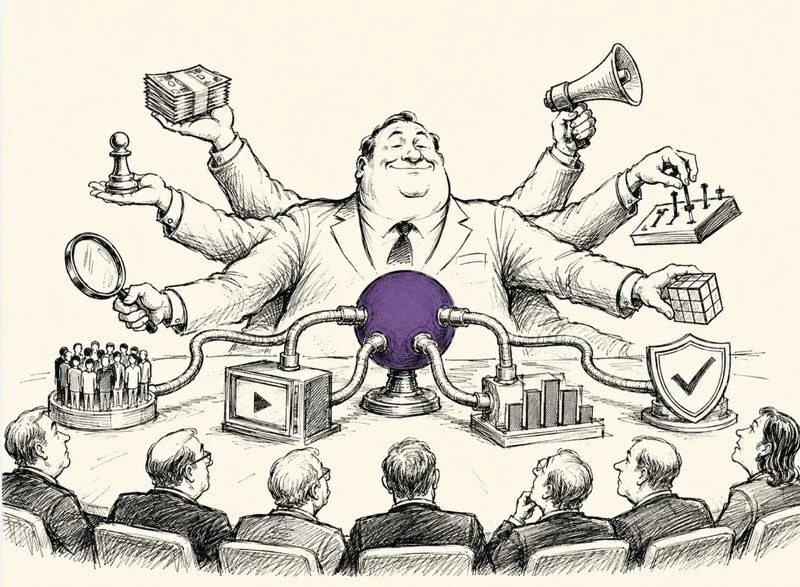 The entire independent verification layer of digital advertising, the part that was supposed to be publicly reported and answerable to shareholders who could ask rude questions on earnings calls, is owned by private equity. Nobody has to explain themselves to anybody. The press release uses “independent” seven times. I counted. Repetition is not a defense. It’s a tell. Second thread this closes. I’ve spent two series arguing that Nielsen wins by outlasting challengers who think disruption means replacement. Paramount, WBD, the NFL, all of it: loud alternative-currency announcements, quiet Nielsen renewals. This is the sequel. Nielsen stopped outlasting and started buying.
Well, they do have a history of doing both. They did swallow up their one-time local television measurement competitor Arbitron decades ago, concurrently putting it into the radio measurement world. And it was those histories that converged recently with this additional announcement that we briefly touched on last month that what little was in front of the the respective paywalls of TV NEWS CHECK and STRATEGIC MEDIA, INC.:
 Nielsen is changing its local TV measurement rule so that a viewer only needs to watch one minute per quarter-hour to be counted, down from the previous five-minute qualifier LinkedIn+1. This change, effective August 31, 2026, is part of a broader methodological update that also includes HDAM (Home Device Activity Monitoring) and co-viewing data integration…Nielsen says the shift better reflects today’s shorter viewing patterns, noting that 23.5% of TV events run shorter than five minutes LinkedIn. The company frames it as a post-diary-era evolution, similar to how radio shortened its listening qualifier from five to three minutes in 2024.
Some industry observers see the change as a way to capture more fragmented viewing and align with how platforms like Meta count “impressions” even for brief, non-interactive views LinkedIn. Others question its practicality, noting that most TV programs last longer than five minutes, and wonder if it will drive more business or just inflate numbers LinkedIn..
It’s been those inflated numbers that have shifted numerous local broadcasters in the direction of Comscore and attracted the disruptors that Lattin rattled off to companies such as Videoamp and Samba, among others. In a world where little else matters beyond how close to the promises made to investors and superiors one eventually nets out at, volume more often than not triumphs accuracy. The expected impact of Nielsen’s shift for the key profit centers of today’s content suppliers is striking:
- Local news impressions: Up 20–30% depending on market and daypart LinkedIn.
- Sports impressions: Up 18–22% depending on market and daypart LinkedIn.
- More viewers qualify for measurement, which can make audience numbers look larger and potentially lower CPMs for advertisers.
And if these bigger numbers come from a company as well-known and turnkey as Nielsen is, so much the better. With Paramount’s support and the people behind it now a thing of the past, they have, per Brief Glance.com, decided to focus on those less interested in impressions than what they see as direct returns:
Media performance platform VideoAmp today announced the appointment of Andrea Zapata as its new Senior Vice President of Agency Partnerships, a move that signals a significant escalation in the industry’s race to solve the cross-platform measurement puzzle. Reporting to Chief Revenue Officer Bryan Goski, Zapata will take the helm of the company’s buy-side revenue organization in a role that seems tailor-made for her extensive and unique background.
 The hiring is more than a standard executive shuffle; it’s a strategic chess move. Zapata joins VideoAmp at a critical juncture for the advertising industry, as agencies and advertisers alike buckle under the pressure to prove performance in an increasingly convoluted media ecosystem. Her appointment underscores the company’s aggressive focus on embedding its platform within the agency workflow, moving the market beyond legacy metrics and toward tangible, outcome-based advertising.
We are indeed a fan of Zapata’s; we mused on that very point a while back. But the ensuing paragraph from the Brief Glance write-up tells one all one truly needs to know about this “chess move”:
(A)s Vice President of Advertising Data, Measurement, and Partnerships at T-Mobile Advertising Solutions, she was on the buy-side, focused on leveraging vast sets of first-party data for audience activation and measurement. Before that, however, she spent years on the sell-side. Her tenure as EVP of Ad Sales Research, Measurement and Insights at Warner Bros. Discovery is particularly noteworthy. It was in this role that she worked directly with VideoAmp(.)
You helped us then, we’ll help you now.
I would quietly and humbly ask how many billions she was responsible for funneling toward Videoamp directly or indirectly, and whether that was ultimately enough to keep executives like Peter Liguori in place. We have recently learned he has departed the company for the relative sanctuary of calmer days and more time to moan about the Mets and Jets than he has about Nielsen.
I am indeed elated for anyone deserving to remain gainfully employed in an industry being otherwise decimated by indifference and consolidation. I do wish Zapata well, and sure hope her virtual Rolodex yields better results for her new employer than those of other closer friends of mine who weren’t able to make a material difference. Just be wary of the guerrilla–er, gorilla on the skyscraper, as well as the elephant in the room.
Until next time…