It’s been nearly four decades since I was fortunate enough to have visited my ancestral homeland of England yet I still regret falling for the tourist trap recommendations of local cuisine which the Fodor’s guides recommended I try. The fish and chips I sampled at a pub adjacent to Piccadilly Circus was no better in my mind than an order at Arthur Treacher’s. Bangers and mash, much as I like the name, was the last thing one should put in one’s stomach first thing in the morning. And mutton as a main course might have worked in the 15th century with a mead chaser, but for even my pre-surgical stomach it produced the kind of violent reaction that had me all too familiar with the inferior quality of the loo vs. a good old fashioned American bathroom.
So when I saw the somewhat surprising news that reverberated across the pond yesterday that for the second time in as many weeks put Comcast front and center in the headlines all I could think of was that poor little lamb that eventually provided that unsatisfying meal–a calf being fattened for slaughter.
 On the surface, the story that among other the LOS ANGELES TIMES’ classy veteran Meg James dropped yesterday would seem to be far each removed from this maddening crowd as to be interesting but not consequential:
In a bid to become Britain’s largest commercial broadcaster, Comcast’s Sky pay-TV business on Monday unveiled a $2.1-billion deal to buy ITV Media and Entertainment. ITV is a television powerhouse in Britain, with “Love Island,” “Midsomer Murders,” and the hugely popular FIFA World Cup. It operates a robust TV production studio and free-to-air channels that attract nearly 32% of the nation’s ad-supported viewing…ITV also has built a popular streaming service, which would round out Sky’s portfolio of subscription services that include satellite TV, phone and broadband internet.
ITV reaches nearly 40 million people every week and boasts 16.5 million monthly digital users. Combined with Sky, the business would command about 20% of in-home viewing in Britain, second to the BBC and ahead of YouTube….The deal comes as traditional TV providers increasingly battle tech companies Netflix, Amazon and Google’s YouTube for consumers. Gone are the days when British audiences largely tuned into the BBC or ITV, which launched 70 years ago as Britain’s first commercial competitor to the dominant state-supported programmer…The proposed union would create a British advertising juggernaut with an estimated two-thirds of the TV ad market.
It’s indeed a big deal and reflects an amalgamation of cradle-to-grave appeal that becomes all the more necessary as the evidence mounts that YouTube is no longer a generationally distinct source of content. And it provides an escape hatch for the throwback regime that has handicapped ITV ever since I was briefly tasked with a project to analyse (that’s how they spell it) potential acquisition targets when it was given a green light to do so roughly 15 years ago that resulted in a few smaller swallowings of unscripted production outlets but not the sea change that we recommended that might have elevated it sooner to a more viable competitor to the BBC monolith.
The more local lens put on this by TECHRADAR’s Mark Wilson yesterday shone a light on the near term:
Will ITV continue to be free-to-air? Yes, for the foreseeable future at least. ITV has public service broadcasting commitments from its licence that run until 2034. The Sky deal doesn’t change that. Tom Harrington, a TV analyst from Enders Analysis, says ITV being free-to-air is also likely one of the main reasons for the potential deal. “ITV remains profitable and the reach that it commands as the major commercial broadcaster is probably the main reason why it would be attractive to Comcast/Sky”. However, Sky’s focus could increasingly shift from ITV’s broadcast offerings to its online streaming platforms – and may ultimately see ITVX and NOW TV merge.
And it would also create a more significant compliment to Comcast’s U.S. businesses which last week were cleaved in two for the express purpose of giving a zetz to its struggling stock price which we noted was already bearing early fruit. Bear in mind that as part of this eventual reorganization this will all fall under the side of the street where Universal Studios and the theme parks also sit–basically, everything that isn’t a distribution pipe. All that noise about a used Peacock now gets to be revisited with the revised lens that all of a sudden there’s a much more significant resource for Peacock to draw upon that will give them access to globally appealing English language content–and vice-versa, of course.
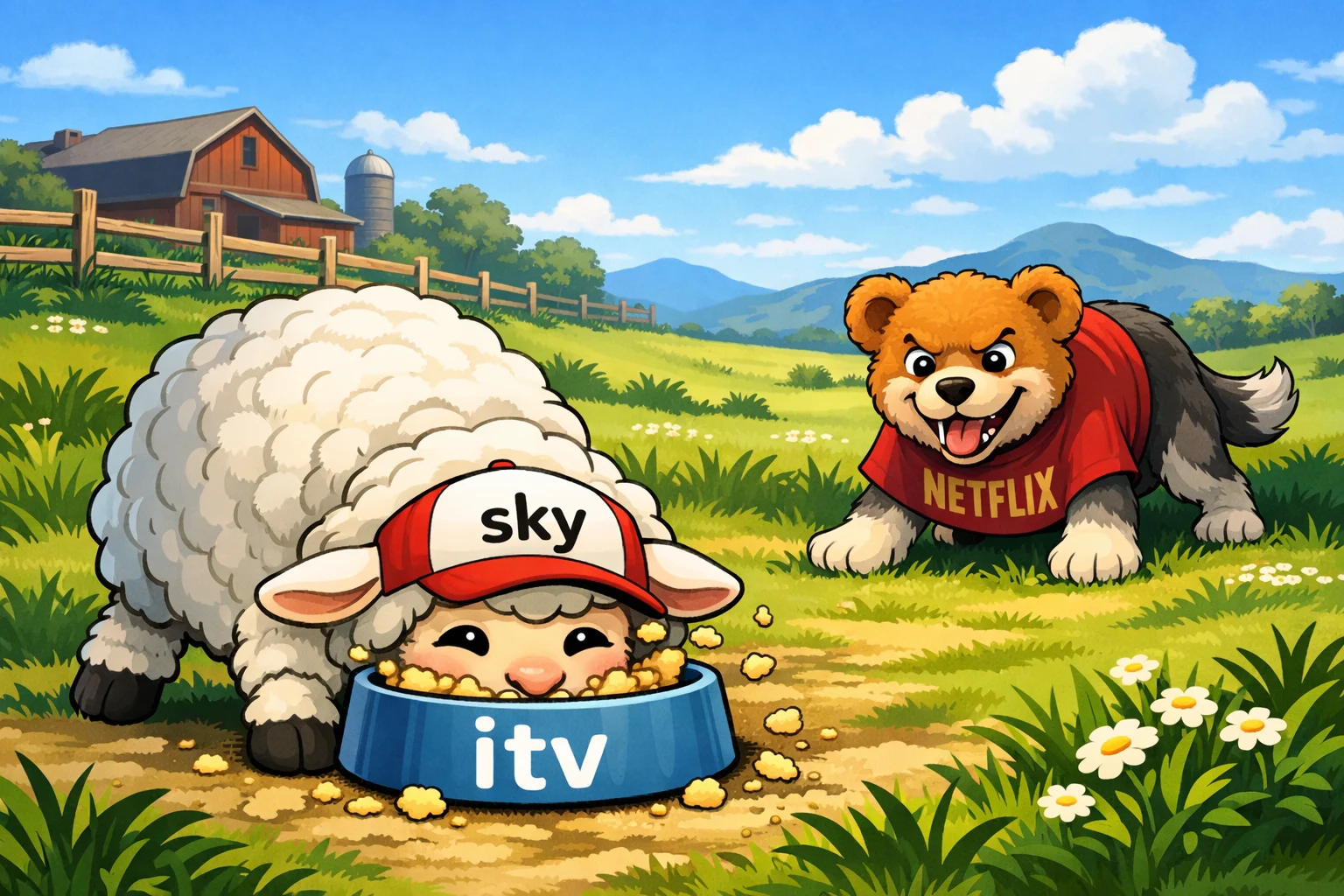 A much more appealing and viable target for Teddy Bear and his Netflix brethren to salivate over. Now all of a sudden besides the tempting morsels of profitable live event venues there is a significant rollup of online destinations that could provide Netflix with the library and IP that made the Warner Brothers deal desirable for them in the first place as well as a measurable boost to their ramping up of advertiser-supported content. It’s enough to turn a teddy bear into a ravenous sheepdog more likely to salivate at the fat little mutton that yesterday’s moves started the ball rolling on.
It’s a rolling stone that won’t immediately become an avalanche–there are plenty of regulatory procedures and scrutiny ahead that will likely push these end results well into 2027 or even 2028. But this also mirrors a timeline where yet another regime change is about to be finalised (they spell that that way too) at 10 Downing Street and where the balance of ITV is already the subject of further speculation for being part of a necessarily larger entity to better deal with the YouTube monolith, as the HOLLYWOOD REPORTER’s Georg Szalai pointed out in his breaking news story from late Sunday night U.S. time:
ITV Studios, which produces such shows as Love Island, Britain’s Got Talent and the Harlan Coben Netflix hit series Fool Me Once, among many others, has been a topic of separate deal chatter, which returned this week after news of the mega-merger between production giants Banijay and All3Media, owned by a joint investment partnership between Gerry Cardinale’s RedBird and IMI Media, led by RedBird operating partner and RedBird IMI CEO Jeff Zucker. RedBird IMI had acquired All3Media in 2024 for $1.45 billion.
During a Wednesday conference call, François Riahi, the CEO of Banijay Group, the parent company of Banijay, was asked about the merged entity’s possible interest in ITV Studios. “Consolidation is the name of the game,” he said, adding that the company would keep all options open. “When you look at the Warner-Paramount deal, it’s very easy to understand why you need to be big and global to be relevant in this sector. So we share this view with RedBird IMI.”
It’s a sobering but accurate perspective. Even a strapping sheppdog like Netflix realises–and realizes–that. And should they perhaps decide it’s not in their diet, by the time that decision is made the appetite for the likes of the Ellisons might just be ready for another helping. Especially if they continue to have friends in high places here, and if that friend indeed carves out a more favorable bond with Andy Burnham. They’ve already demonstrated more of a tolerance for lower-quality classic fodder than others. Mutton might sit better with their stomachs than it did with mine.
Until next time…
“