
When Nielsen began to compile its monthly report called THE GAUGE it was done as a marketing move to give the company increased visibility and theoretical currency in a streaming world they haven’t quite fully figured out. As I’ve mused on numerous previous occasions, Nielsen still has only a partial lens on who watches non-linear content as it’s still not fully able to include device-only viewing in its numbers. And when most streaming services were exclusively driven by subscriptions, much as it was during the emerging days of pay TV networks any discussion of ratings was effectively superfluous. Most of them had far superior internal and parochial measurement anyway.
But as the number of competitors increased both for viewing and the pursuit of talent, much as HBO and Showtime were forced to begin to share data on how many people were watching to serve those battles in their day streaming services, especially those from established media conglomerates, were itching to see how they stacked up. What they saw when Nielsen first starting producing the data made many of them uncomfortable. As a pure destination, YouTube was number one with a bullet.
 So roughly a year ago, as the 2024-25 upfronts were approaching, a particularly motivated Disney got several of their mainstream brethren to heavily lobby Nielsen to offer an alternative way of crunching the data, one that aligned with how they were positioning their portfolio moving forward. By offering what amounted to programmatic opportunities, an advertiser could purchase inventory across both networks and studios, and in many cases they weren’t fully aligned. So by creating what was eventually called a “distributor gauge” a monolith like Disney could be credited for what it was supplying both inside and outside its ecosystem.
And ‘sho nuff, those wily weasels at Mouse House got their story, as Nielsen’s web site “objectively” reported just around the time Disney sales czar Rita Ferro was wining and dining the New York buying community:
In Nielsen’s first report of The Media Distributor Gauge, 14 media companies achieved a 1.0% or greater share of total TV usage. As the top performer in April, Disney accounted for 11.5% of TV viewing, with 42% of its share attributable to viewing on Disney+ and Hulu. YouTube was the No. 2 overall company with a 9.6% share of TV in April, followed by NBCUniversal at 8.9%, Paramount at 8.8%, and Warner Bros. Discovery at 8.1% to round out the top five. Netflix was sixth with 7.6% of TV, and the second-highest streaming distributor reported.
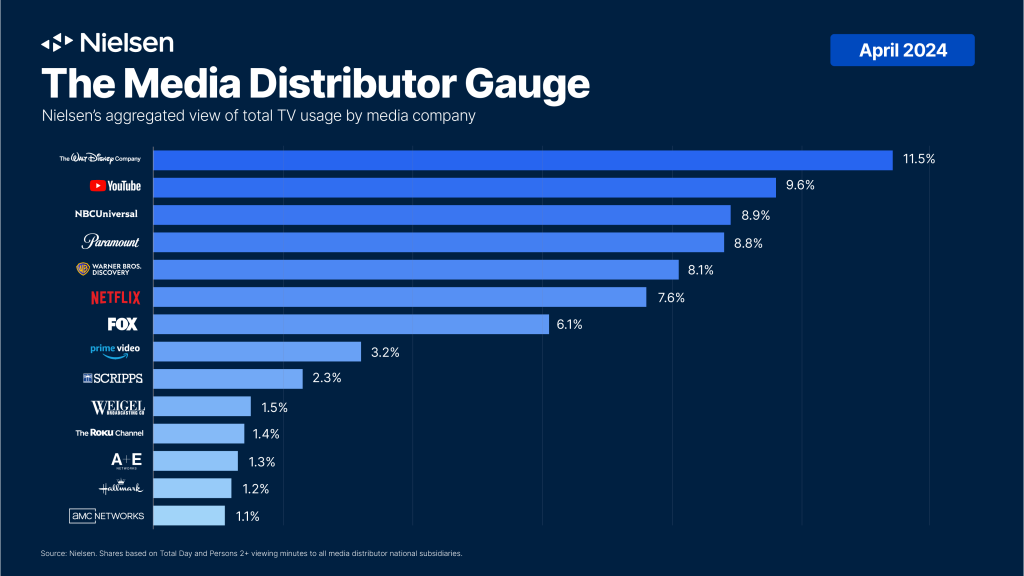 Contrast that with how Disney entities showed up on the actual Gauge–with Hulu a reminder that Disney+ was not doing all that well. Not the message Ferro wanted to have out there–or, for that matter, her historic competitors whose performances were even weaker.
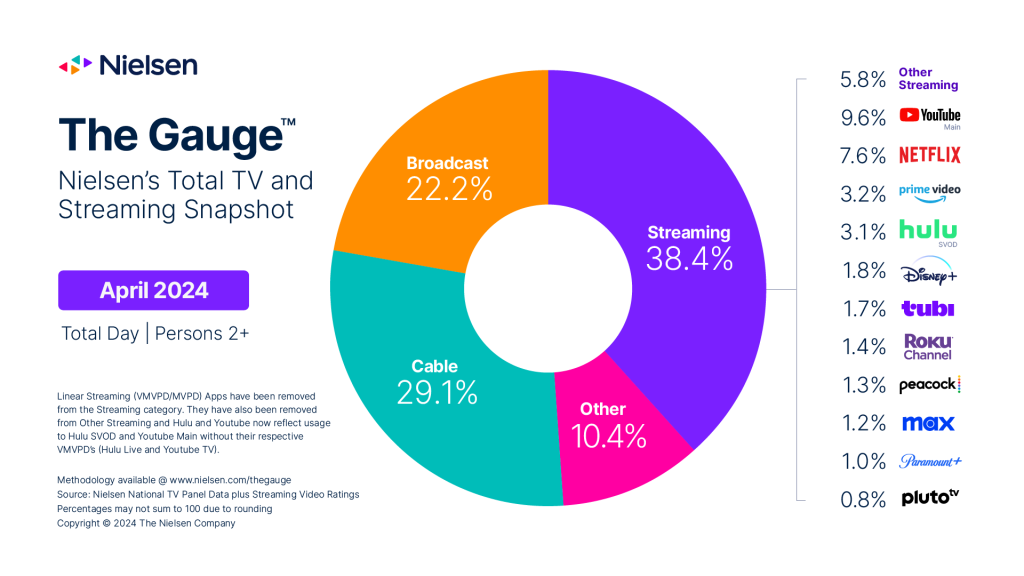 “With more programs available across platforms, it’s vital for creators, advertisers and the industry at large to understand what and where audiences are watching,” said Karthik Rao, CEO of Nielsen. “The Media Distributor Gauge is a perfect complement to the The Gauge and serves as the first convergent TV comparison of its kind. Together, these reports paint the most complete picture of TV viewing today, which is critical as we head into the Upfront.
In other words, thanks, Karthik, you finally gave us a reason to renew you. Mission accomplished on both fronts, I suppose.
And for the ensuing months the gist of the story stayed unchanged. Disney was the top “media distributor”. But as we are heading into the home stretch of preparations for the 2025-26 upfronts, YouTube has now risen to the point where it now holds that crown. As DEADLINE’s Dade Hayes crowed this morning:
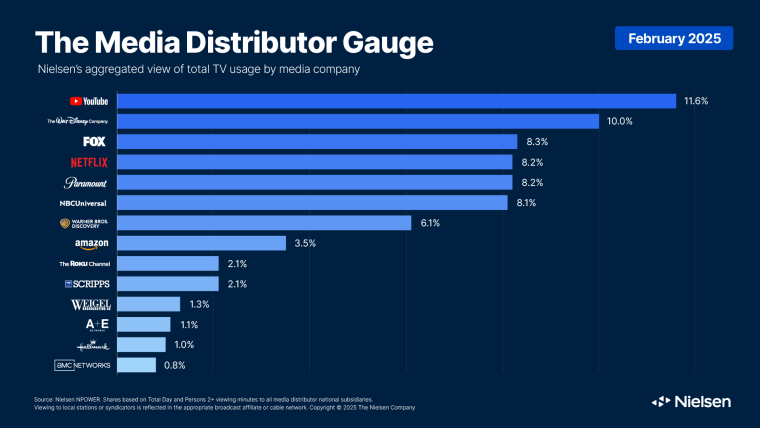
YouTube hit a record 11.6% of all TV viewing in February, according to the latest edition of Nielsen’s Distributor Gauge Report. The top finish was only YouTube’s second, largely due to Nielsen methodology, which groups together all platforms of the Walt Disney Co. (including ESPN, ABC and streaming). Disney in February fell to No. 2, while Fox Corp. rode a surge of tune-in to the Super Bowl across broadcast and streaming outlet Tubi to edge Netflix and end up third. (See full ranking below.)
 And in the process of taking that victory lap over Disney the YouTubers pulled out the mothball-eaten playbook of its legacy competitors to remind the media world that it’s now found a way to beat the old schoolers at the very games they urged Nielsen to exploit to their advantage–the screens and demographies that at least to this point offered Disney and company a built-in bias. Continued Hayes:
YouTube has been on a long-term growth trajectory in the Nielsen statistics and recently announced that living-room viewing had exceeded that on mobile devices and computers. In just two years, YouTube’s share of total TV viewing has jumped 53%, going from 7.9% to 11.6%.
The overall viewing upturn has been increasingly driven by older audiences, Nielsen said. Viewing from adults 65 and over has nearly doubled in the last two years, rising 96%. That older demo now makes a contribution to the total that is similar to kids aged 2 to 11 (15.4% vs. 16.9%).
 And while I’m usually loath to rely upon my own ancedotal experiences as exemplary for seminal changes like this, I must confess thatin this particular case I’m Exhibit A. I rarely turn on my televisions, instead opting to watch multiple viewing sources on multiple browsers. In the case of YouTube, virtually all of my national news and comedy is seen on a loop that usually lulls me to sleep and yet is still going whenever I wake up. And whenever my bestie sends me something she watched, it’s almost always a YouTube clip that overrides my ongoing feed and therefore expands my endless loop into algorhytmically more possibilities.
At least it now appears I’m as likely to be doing that as a toddler or grade schooler. And therefore less inclined than ever to want to see a bastardized version of numbers that tried to make it seem like the world of media consumption isn’t as systemically altered as those still trying to sell against it would like us to think.
Well, you do still have Disney as a client, Nielsen. Time to go back to the drawing board.
Until next time…