
Yet another old-fashioned media bacchanal is going on this week in Las Vegas, in this case the gathering of the National Association of Theatre Owners, pretty much the only worthwhile use of the acronym NATO these days. To say that there’s more than a little concern that their fate may be headed in the same direction of the North Atlantic Treaty Organization would be an understatement.
This has not been a banner 2025-to-date for the outdated Luddites who operate those overpriced and sterile gathering houses. The LOS ANGELES TIMES’ Ryan Faughnder, a senior editor on the still-somehow surviving COMPANY TOWN beat, tersely recapped the first quarter in a sobering piece he dropped last week:
 The first quarter of 2025 has been bleak for the movie theater business. The year that many analysts thought would be the one when the film business got back on track has been a bust so far, with few hits and plenty of flops.
As of Sunday, movies have generated $1.34 billion in the U.S. and Canada this year, down 7% from the same period in 2024, according to Comscore. March has been particularly weak. The month is expected to end down 50% year over year. Remember, last year‘s first quarter was down significantly from pre-COVID-19 levels, so business is bad. Really bad.
Last week didn’t help matters. Walt Disney Co.’s “Snow White” opened with a disappointing $43 million in domestic ticket sales, having stepped on multiple cultural landmines while also receiving poor reviews and a tepid response from audiences, per CinemaScore. Warner Bros.’ “The Alto Knights,” starring Robert De Niro, was dead on arrival with $3 million.
 So it’s a particularly nervous group that’s sitting through the presentations and not yet publicly released trailers for the next two years and change’s worth of Trojam horse hope at the conclave known as CINEMACON. Predictably, the convention’s first presenters were those with as much, if not more, invested in the fate of theatrical releases than the owners–the studios without outsized presences in the streaming world. Sony and Lionsgate charmed the crowd with some intriguing teases that despite the content blackout have gotten more than their share of live-blog real-time attention from trade press and cinemaphiles, including the TECH RADAR squad led by Matt Bolton, with able assistance from Amelia Schwanke, Tom Power and Al Griffin. Feel free to peruse their enthusiastic barrage of x-eets and coverage at your leisure. The group effort also gushed about what Warner Brothers Discovery has in the offing that was shown last night, all the more ironic considering that it’s been even more widely reported that the folks most directly responsible for putting it together–Michael De Luca and Pamela Addy– are apparently being teed up for jettisoning.
Sony, which now has its oar in the theater ownership water itself, produced some particularly intriguing news which the DISCUSSING FILM staff revealed yesterday morning on top of the anticpated reboots and brand extensions of proven IP like JUMANJI, RESIDENT EVIL, STARSHIP TROOPERS and, natch, SPIDER-MAN:
- The Beatles, “a four-film cinematic event” directed by Sam Mendes. Paul McCartney will be played by Paul Mescal, John Lennon will be played by Harris Dickinson, Ringo Starr will be played by Barry Keoghan, and George Harrison will be played by Joseph Quinn. All FOUR movies, teased to be simply titled Paul, John, Ringo, and George, will be released in April 2028.

Even assuming they can be as well-produced as the award-winning homage to Bob Dylan A COMPLETE UNKNOWN, trying to rally the industry to salivate about the challenge to get people into theatres for a binge three years from now is a reach. Especially in light of the conclusion that Faughnder’s piece offered:
Still, many people have watched the struggles of the theatrical market and concluded that consumer behavior has changed in fundamental ways. With so many entertainment options available in and out of the home, movies in theaters have lost their cultural sway.
It was therefore all the more necessary for the event to take on even more of an evangelical call to action than ever–one which DEADLINE’s Jill Goldsmith reported on yesterday:
In a keynote address this morning, head of the trade group representing movie theaters asked Hollywood studios to commit to a 45-day window for all films and to marketing that emphasizes “only in theatres.”
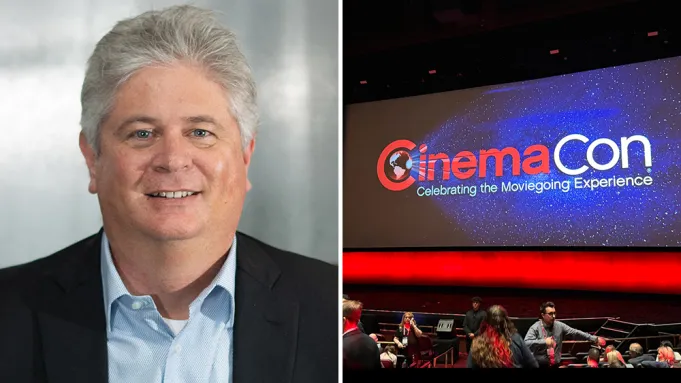 Michal O’Leary, president of Cinema United, also warned about the growing mania for costly premium large screen formats, and the need for independent theaters to have more autonomy in scheduling. O’Leary said a 45-day window should be the baseline, “a clear, consistent starting point” because “for most movies, the ultimate box office success and consumer demand cannot be effectively determined short of a 45-day window.
His predecessor offered up his own optimistic take to Faughnder:
One person who strongly disagrees with that assessment is John Fithian, the former longtime head of the National Assn. of Theatre Owners (recently rebranded as Cinema United). He exited as the movie theater business’ top advocate and lobbyist in 2023 and founded the Fithian Group, a consulting firm, with colleagues Jackie Brenneman and Patrick Corcoran.
You wrote a recent post that was refreshingly candid about the poor state of the first-quarter box office. How did the industry get here?
Well, the movie theater industry has been a roller-coaster ride for decades, where people always pronounce its death, and it’s never the case. As movie lovers found ways to watch movies on television, via DVDs, via streaming, it made them more movie lovers. So the theory that competing ways of watching movies is what’s challenged the movie theater industry, in my opinion, is wrong.
Secondly, the theory that COVID is responsible for the numbers in the movie theater industry not coming back to where they were pre-pandemic is also wrong. Yes, COVID was a massive struggle for the exhibition industry, and exhibitors fought like hell to survive. But the other COVID-impacted out-of-home experiences [Broadway, concerts, sports] have rebounded and grown post-pandemic, and the movie theater industry hasn’t.
Yes, John, and that’s because in those examples you’re actually paying for the privilege to see actual humans live in three dimensions that don’t require IMAX augmentation. That’s a de facto upgrade from a Zoom call. And that’s still also a relatively small percentage of the overall population that’s contributing to those higher-priced growth areas. Movies need mass appeal and populist support, and storytelling alone seems not to be cutting it.
 So it will be especially intriguing to see how the second half of presenting studios are received over the next 36-ish hours. At the week’s outset DIRECT’s Richard Nebens offered up a preview of what’s to come from Universal/Dreamworks, Amazon MGM, Paramount and, of course, Disney. Ya know, the ones with those streaming services. The ones who fought tooth and nail–and got concessions–for 17-day windows and have motivation to move compelling content onto them as soon as reasonably possible. Warehousing product that are losing “cultural sway” aren’t a formula for that. And their bosses aren’t any more patient than our good friend Yosemite Zas is.
Like every else in Vegas seems to be, CinemaCon is a salute to a crapshoot. Happy dice rolling, folks.
Until next time…