
NOTE: We interrupt this “Best of ’25” countdown to bring you a dual illumination of what we shared today on our sister site Double Overtime–ya know, the one where we typically urge you to visit regularly for coverage of sports of all sorts plus occasional reports on business and technology. As you will hopefully discover momentarily, we consider this to be a more than timely and exceptionally worthy topic worth musing about and while the numbers aren’t quite there just yet to support its inclusion, let’s just humbly say we think they eventually will–or should.
There’s a whole lot that’s new about the world of hockey these days, not that regular readers here might have noticed. We haven’t been paying a whole lot of attention to it–and judging by the usual topics that drive digital and even old fashioned linear consumption of podcasts and debate shows, we’re hardly alone. Then again, most of us don’t fall into the demographic cells that are driving that change that has already occurred, and after finally catching up with a burdgeoning buzz that’s beginning to disrupt a whole bunch of the usual year-end best lists in TV I’m now convinced a lot more attention from heretofore disnterested segments is about to be bestowed. Both good and bad, I’m afraid.
 The NHL itself has been infused with a host of talent that’s barely old enough to legally drink but more than capable of lifting moribund franchises back to competitive levels not seen in decades. You probably know about the Chicago Blackhawks’ Connor Bedard, the NHL’s much-coveted #1 2024 draft choice who’s gained enough recognition to even get noticed in this space, though his efforts haven’t quite translated to his still cellar-dwelling team. But you might not know about Matthew Schaeffer, the 2025 top choice who has already drawn comparisons to and whose exploits for the New York Islanders have rivaled the great Bobby Orr’s impact on a perpetually underforming Boston Bruins franchise back in the ’60s, or Macklin Celebrini, third in the league at this writing in total points as one of several young stars for the San Jose Sharks, or Lane Hutson, who actually won the league’s Rookie Of The Year hardware (the Calder Trophy) in 2024-25 and whose improved play this year has him a legitimate candidate for the Norris Trophy, awarded to the league’s top defenseman. (and 18-year-old Schaeffer isn’t far behind). Their teams are all in the thick of races for playoff berths in large, diverse and victory-starved metropolitan areas.
 But it’s in the fictional world of Major League Hockey that the real change and attention is occurring, courtesy of a six-episode scripted drama called HEATED RIVALRY that very quietly dropped onto HBO Max (not even the mother ship linear network) last month. It’s based on a popular series novel from the author Rachel Reid called GAME CHANGERS which have carved out a following with Generation Z, especially the plurality that is more fluid and accepting of queer romance that, say, the counterpart sectors of older demographies. Make no mistake, it’s explicit–it’s chock full of man-on-man animallistic encounters not seen on mainstream media since the days of Showtime’s QUEER AS FOLK. But as THE ANKLER’s Katie Rich explained in her PRESTIGE JUNKIE piece from last week, it’s become a lot more than merely just guilty pleasure for those open to it:
Produced in Canada and then licensed in America by HBO Max, as my colleague Lesley Goldberg has been reporting, the adaptation of Rachel Reid’s smash hit romance novel has been a grassroots success, with leading hunks Hudson Williams and Connor Storrie mastering the viral videos and provocative photoshoots that every young rising star dreams of. Drawing in plenty of eyeballs with its promise of explicit sex and slow-burn romance, Heated Rivalry has picked up a fervent American fanbase and a lightning-quick promise of a season 2 renewal from Canadian producer Bell Media, which streams the show on Crave.
It was all fun, frothy and definitely sexy… and then with its fifth episode, which debuted last Thursday, it also got really good. As young, emotionally repressed hockey players on rival teams who surreptitiously hook up in hotel rooms but rarely call each other by their first names, Williams’ and Storrie’s roles in the first few episodes were primarily physical — sex scenes, sure, but also silent moments of looking at each other and saying very little of what they were feeling out loud.
 That all shifts dramatically in the latest episode, “I’ll Believe In Anything,” which finds Storrie’s Ilya back home in Moscow, dealing with a family tragedy and leaning on Williams’ Shane emotionally for the first time. In an extended phone call scene, Ilya unloads his heart — but in Russian, so Shane can’t understand him. As an eternal fan of movies where characters are in love but can’t quite make it work, the sequence is an automatic entry into the pantheon — Shane listening and not understand but realizing the import of the moment, Ilya hesitating and swearing before finally saying out loud, “I’m so in love with you, and I don’t know what to do about it.”
VARIETY’s Michael Schneider weighed in with a bit more inside baseball–er, hockey–back story that accentuates how and why so many have exploded in enthusiastic support:
The story behind the success of “Heated Rivalry” is one of those rare feel-good stories in TV at a moment when the business could use a few more of them…in early November, Casey Bloys — HBO and Max’s content chairman/CEO — got a call from Jason Butler, an executive on his team who’s focused on worldwide program planning. Butler had just acquired a Canadian show about gay hockey players called “Heated Rivalry” for HBO Max in Australia: Would he be interested in also looking at the show for the U.S. service?
“He sent the episodes to me on a Friday, and then on Monday we started negotiating,” Bloys recalls. “It was an easy and very quick ‘yes.’ Obviously, I’m a gay man, so I had a sense that it might make some waves. I thought it was very well done. To tell you the truth, I was surprised that it was even available, because this was about three weeks before it aired.”…In Canada, “Heated Rivalry” is now the most-watched original series ever on Bell Media’s Crave streamer.
(O)nce Bell Media and Crave knew what they had in the series, they kept pushing the premiere date up. And up. “I think we were looking at February,” says executive producer Brendan Brady, the co-founder of “Heated Rivalry” producer Accent Aigu Entertainment with series creator Jacob Tierney, who wrote and directed every episode. “And then it was maybe January. Then Christmas. And then … Nov. 28.”
With support from the likes of Rich and her colleagues, which has been equaled by the RINGER’s resident LGTBQ champion Joanne Robinson, the amplification of the show’s relative success has reached a fever pitch. Rich went on at length to educate her readers as to how the current arcane limitations of certain organizations may deny HEATED RIVALRY from receiving hardware of its own:
What makes Heated Rivalry different, then, from Canadian Emmy-winners like Schitt’s Creek and Orphan Black is that American studios only got involved after the hockey romance was produced; HBO Max is strictly licensing the show in the United States, and currently doesn’t plan to be a co-producer on the second season either. That’s excellent news for fans who want Tierney to continue making the show exactly the way he wants. But that means, at least the way the rules are structured now, that Storrie, Tierney and the rest of the Heated Rivalry team will be sitting this Emmy season out.
Still, there are a few reasons to think this could change. First, the Emmy rules for the 2025-2026 season have yet to be announced — the Television Academy tells me to look for them in early January. Though there’s no reason to assume they’ve tweaked this very nitty-gritty rule about co-productions, it’s always possible!
There’s also the utter uniqueness of Heated Rivalry’s release, which debuts simultaneously in the United States and Canada, making the viewing experience fundamentally the same across borders. That could provide room for HBO and Crave to petition the Television Academy to make Heated Rivalry an exception, though no such plans are yet in place based on my reporting. If the rules stay firm, Heated Rivalry will remain eligible for the International Emmys, whose submission deadline is Jan. 31. So by then, one way or another, we’ll know where Williams and Storrie will be competing.
The spin from the service is what one might expect from an outlet that’s been otherwise overwhelmed with news about pending acquisitions and multiple rebrands. My onetime partner in crime Ted Linhart did his part via his TED ON TV Substack this weekend to throw some ice water on this with a detailed dive into the actual numbers that only the heart of a serial researcher could offer:
I have been reading that Heated Rivalry is a “hit” but when people hear that word there is an implication of a large audience size. However, success here appears to be based far more on social metrics and buzz, reporter fandom, and viewing outside the U.S., not domestic audience size. …the one Variety report I’ve seen with audience claims is slicing and dicing the data to such a degree that it’s clearing hiding a generally low audience — “the top-rated non-animated acquired series on HBO Max since it launched in 2020, and is in the top five among all scripted debuts on HBO Max this year.”
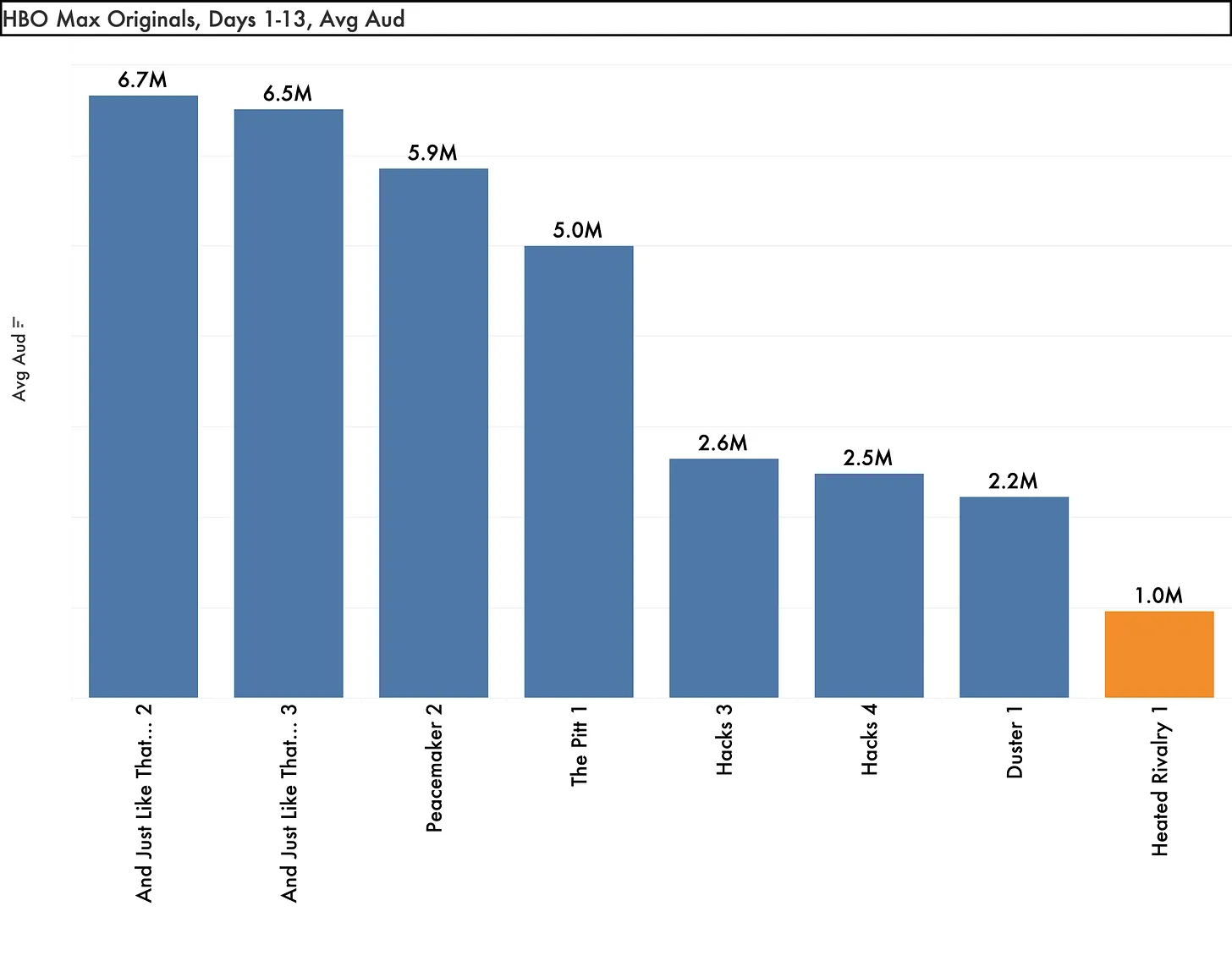 One of the most frustrating parts of being a media researcher is observing how the press and many TV executives don’t really know the data details and can think that a program is doing much better than it actually is, or vice verse, because of press, discussion, or marketing vagaries. During my time at USA Network we experienced a similar situation as the noise around Mr. Robot far outstripped the actual ratings levels.
Well, Ted, been there, done that myself and here’s what I learned along the way, courtesy of our mutual one-time leader Barry Diller: Research can only tell you where you’ve been, it can’t really tell you where you’re going. For that, you sometimes have to look at other signposts. As a hockey fan, I can point to changes already taking place in their fandom going back to Joe Reedy’s 2022 piece for the ASSOCIATED PRESS recapping the just-concluded NHL season:
One of the biggest stories in the NHL this season has been the increase in viewers in the league’s first year of its television contracts with ESPN and TNT. The league is also seeing unparalleled growth in female and younger fans that should have a big impact for years to come. According to NHL research, 37% of hockey fans are female, including an eye-popping 26% growth in that demographic since 2016. Most of those new fans are likely within the coveted 18-49 age demographic, too, since nearly 40% of all NHL fans are under 50…The increase among female viewers was higher during Wednesday night games on TNT. During the regular season, there was a 44% jump in female viewers compared to previous years, when the games were aired on NBCSN.
The effort to grow connections has include social media. The league formed a content partnership with TikTok while the agreement with Turner led to Bleacher Report expanding its coverage and the B/R Open Ice vertical. Bleacher Report’s hockey site posted its most viewed month (35.8 million page views) in May and saw engagement triple compared to last year…”Not only do we want to give our avid fans the content that they love, but how can we share it with casual and new fans and make sure that they feel welcome,” said Heidi Browning, the NHL’s senior executive vice president and top marketing officer…Browning is also pleased with the NHL’s share of young fans. League research found that 80% of the users on its digital channels are Gen Z and millennial.
And if one doesn’t think that something like HEATED RIVALRIES has all the trappings of accelerating those augmentations and skew shifts, even if it’s based on something that hasn’t quite reached the raw numbers of AND JUST LIKE THAT…then one probably isn’t paying attention to details and nuance as much as they should.
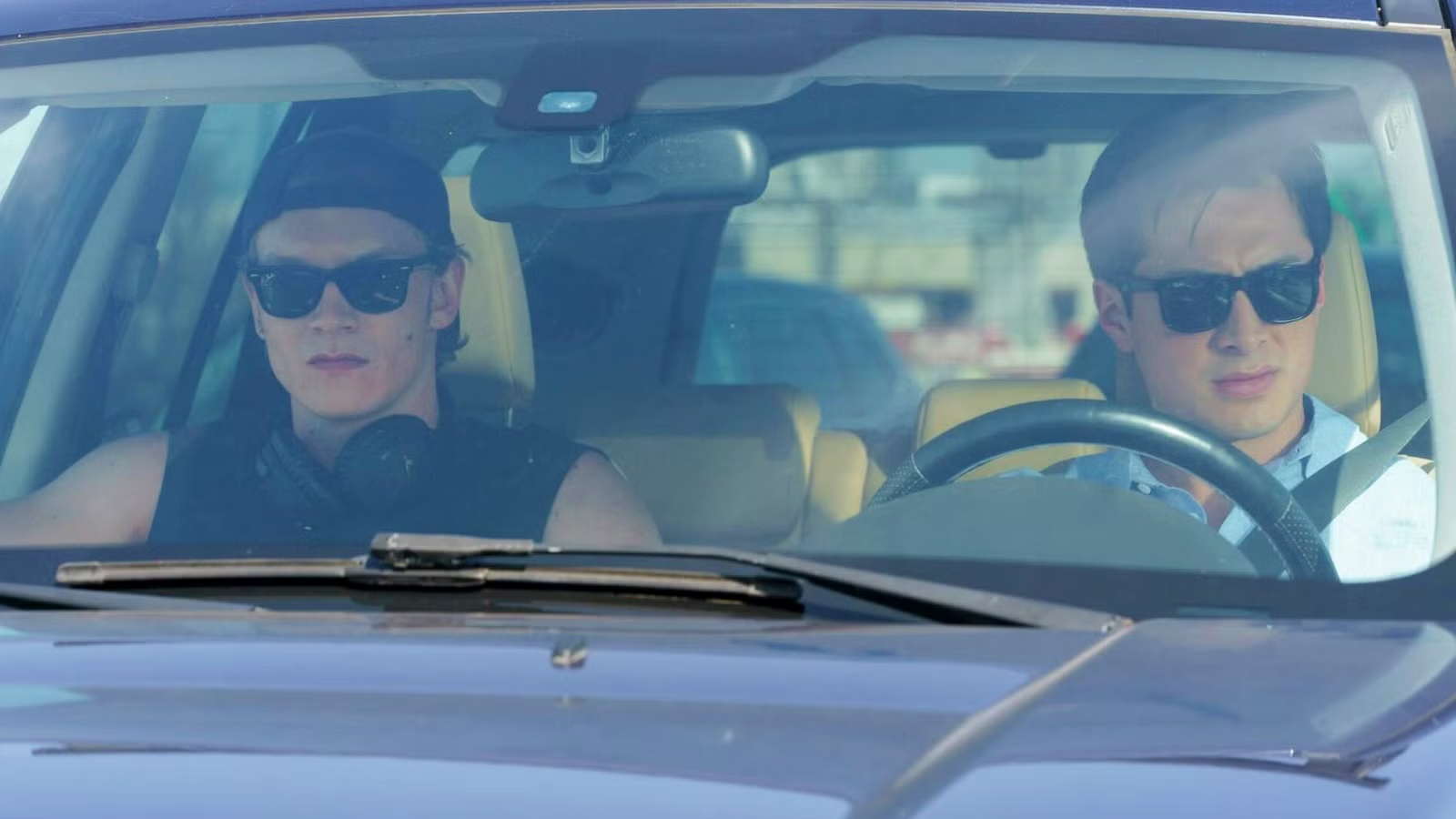 I actually binged the series myself–even I can handle six hours–and came away pretty much in Rich’s camp about the fifth episode and even more enthusiastic about the season finale, which takes place at a summer cottage where Shane’s mother finally learns of her son’s leanings. (Dad already found out the hard way in an earlier episode when he inadvertently walked in on the two sui coitus). She’s shocked, to be sure, and then pivots to determine what the opportunities for new and revised endorsements might arise before her son shuts it down–while indeed the fictional league’s MVP and his teammate comes out with a passionate kiss during the Stanley Cup-equivalent celebration, Shane and Ilya aren’t quite ready to do same. I absolutely loved it.
But in the light of day and rummaging through the groundswell of attention and the sources that are championing the outright rewriting of Emmy rules it began to dawn on me that perhaps the best thing going for it so far are the very modest raw numbers than HBO Max has brought forth so far. Especially when one considers how opportunistic some folks can be about calling out a streaming service for its creative choices. Ask the folks at Netflix how they coped with the flurry of overreaction to the years-late discovery the platform contained a show called DEAD END: PARANORMAL PARK earlier this year. Revisit the details if you need to. I’m personally too disgusted by them to italicize them herein. But I’m also not blind to the possibility that once this gets the kind of attention for awards that the zealots are demanding, the likelihood of similar reactions can only increase.
To their credit, the real NHL seems to be getting out ahead of it, as GT’s Jordan Robledo reported earlier this week:
In a new statement to The Hollywood Reporter, a representative for the North American league discussed the show’s success and its undeniable role in attracting new hockey fans. “There are so many ways to get hooked on hockey and, in the NHL’s 108-year history, this might be the most unique driver for creating new fans,” they told the publication. “See you all at the rink.”
Hence my one small suggestion to the HBO Maxers: Might be worth checking into how your algorithms aren’t capitalizing on it. You do happen to carry the NHL, whose Winter Classic will take place in Miami on Friday–airing live on your platform– and for which you’re already airing several behind the scenes previews on the transformation of the Marlins’ stagnant fish tank-adorned stadium into the rink of the two-time defending Stanley Cup champion Panthers. Maybe you should have telescoped me into something like that rather than the movie THE SEDUCTION–a box office flop even rejected by its targeted demographic whose only connection to HEATED RIVALRIES is far less emotionally connected gay sex?
That said, that’s about my biggest overall gripe with HEATED RIVALRIES. I’m hoping against hope those who will inevitably discover it in the next few weeks will net out where I am. It’s too good to be judged by any other barometer.
Until next time…
Well written article! Thanks for the insights, Steve.