
Not all that long ago a media executive could practically recite from memory what their schedule would be like during upfront week. When you’re jetlagged, multi-tasking and frequently dealing with conference calls that could often extend into early evening East Coast time having some semblance of order was one less thing to fret about.
 You’d typically fly in at some point over the weekend–if your family was from the New York area, you were in early enough to celebrate Mother’s Day; otherwise, you’d shoehorn in an early brunch near an airport and make sure you took something to knock you out on your flight, since you’d usually be landing after midnight. You’d sleepwalk your way through the Monday morning presentation from NBC and its array of networks. knowing you’d be getting enough Bloody Marys and a kickass performance from a Tonight Show host to jolt you back into work mode. You’d then have a late afternoon kaleidoscope from FOX who would then whisk you to an evening soiree at some gorgeous setting near a park that you’d have just enough energy to make it midway through before slipping away to collapse in your hotel room. Tuesdays was usually Jimmy Kimmel and a bunch of ESPN personalities giving you enough to talk about that you’d forget how creative Disney needed to be to create sales stories for fourth place shows; often, they’d sponsor some sort of party to ply you with enough alcohol that you’d be more likely to forget about that anyhow. By Wednesday morning your body clocks were adjusted enough to be able to pay rapt attention to the typically fact-heavy spiel from CBS. Even as their competitors pivoted into tap dances around programmatic and theme park-related marketing opportunities, CBS always made sure to devote ample time to their actual schedule and the rationales behind them, not to mention take several victory laps crowing about how if one ignores those silly little things like demo composition they yet again were America’s Most Watched Network. And while they’d often have a fairly decent buffet, they rarely would try and keep people past noon, since that would typically be when the exodus for the airports would begin, because who besides the locals and the underlings really cared about the CW anyhoo?
The pandemic, of course, inexorably altered that clockwork pattern, and then management changes and budget pressures assured that any return to normal would be at best partial. In particular, CBS’ management changes and, of late, bigger picture concerns has resulted in their eschewing the traditional glitzy and massive in-person event; they now make their presentations in more intimate settings where their advertisers need not have to fly in it all. And these days, who’d want to risk having to be on a flight that lands at Newark?
But the focus on nuts and bolts, strategy and victory lap is still omnipresent and now that upfront week has evolved into upfront/newfront fortnight, they have taken the opportunity to tell their story ahead of the pack, which they did yesterday. We’ve already known about a good deal of what was shared thanks to the constant flow and chatter about spin-offs and parting ways with almost all third party participants’ shows. And just to make sure, DEADLINE’s Lynette Rice devoted one of her publication’s many articles yesterday to those issues:
The Equalizer as well as FBI: Most Wanted and FBI: International may have been yanked from the CBS schedule, but execs on Wednesday were still touting the strength of the three dramas.
 When boasting about its top performers from the 2024-25 season, all three shows were given shout-outs by CBS Entertainment President Amy Reisenbach. But the net still opted not to renew The Equalizer for a sixth season, Most Wanted for a seventh season, and International for a fifth as part of its pickups for 2025-26 that included eight new shows and 18 returning ones. ” It’s not easy to end shows and we had a lot of options this year,” Reisenbach told reporters Wednesday. “The schedule is really full and so we always have to look at all of our shows, look at the aggregate information, the creative of where they are in their life cycle, what the finances look like, what the ratings are, and then we make those tough decisions. We have to be fiscally responsible and ultimately, those deals and the shows just weren’t penciling out for us from an economic perspective(“). When asked if there was even the smallest chance that they would reconsider the cancellation of S.W.A.T., Reisenberg said no.
The idea of fiscal responsibility seemed to be the order of the day, as Rice also reported on how those loss of a tentpole event was justified:
It was an “uneconomic deal.” That’s how CBS topper George Cheeks described the decision to say goodbye to the Grammy Awards ceremony, which has aired on the network for more than 50 years. In October, Disney snatched the rights to the annual music awards show in a 10-year pact. When asked by a reporter if ABC made a bad deal, Cheeks replied, “I did not say that. I just said the economics are different at every company. For us, it would have been uneconomic.”
 You can practically see Rice’s eyes roll from that retort. I’m not all that sure in a more private moment Cheeks wouldn’t have admitted she would have been justified.
But they do have a whole lot of new stuff that I suppose the execs could classify as fiscally economic. A curve ball which at least was off my radar was this ambitious attempt to reach podcast lovers and perhaps folks in the CBS demo who recall when UNSOLVED MYSTERIES was a hit, again per Madame Intrepid:
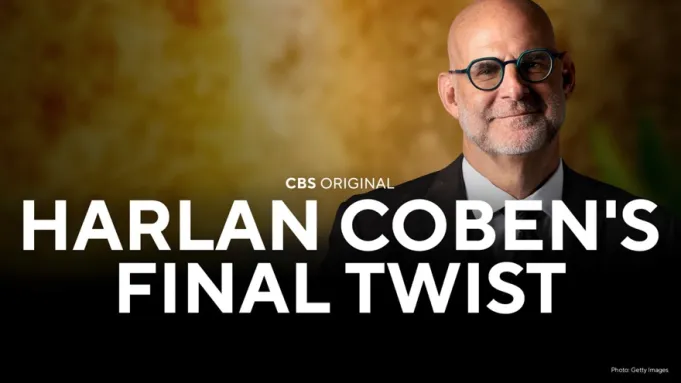 HARLAN COBEN’S FINAL TWIST brings the world’s best-selling mystery author into the true-crime television genre for the first time. With over 90 million books sold globally and scripted series (“Fool Me Once,” “Safe,” “The Innocent”), Harlan Coben is known for his twisting narratives and intricate plots. In each one-hour episode, Harlan will guide audiences through gripping tales of murder, high-profile crimes and life-altering surprises, each meticulously unraveled to reveal hidden truths, deceptions and lies. With exclusive interviews and never-before-seen archival materials, the series will provide an in-depth look at stories where nothing is as it seems.
Meanwhile, there were some other surprises and eyebrow-raisers. Monday night will now be an alphabet soup and will see the most-watched show on broadcast TV being relocated, which Reisenbach attempted to both justify and get guffaws from, as Rice’s colleague, the intrepid Nellie Andreeva, reported:
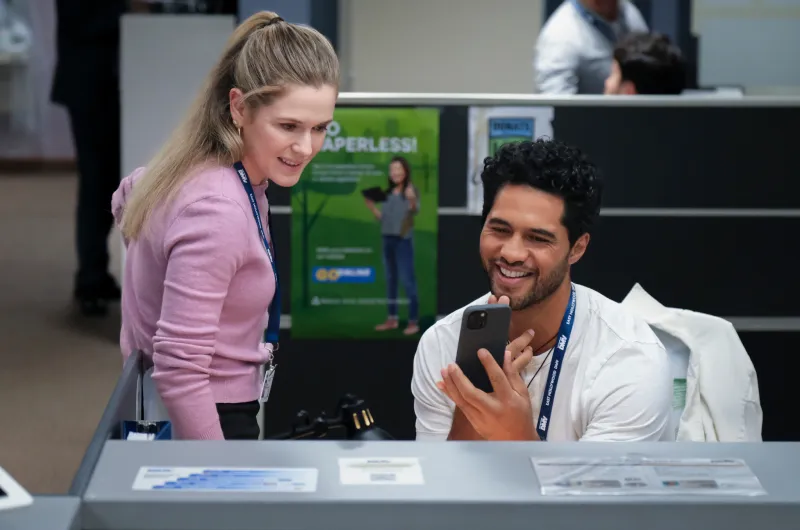 NCIS is swapping places with FBI, which is moving to Monday at 9 PM, leading into new offshoot CIA. Getting the hammock slot between The Neighborhood, back for its eighth and final season, and FBI is new comedy series DMV, making for a lineup that features DMV, FBI and CIA airing back-to-back. “Marketing will have a lot of fun with it, and so will Stephen Colbert,” Reisenbach quipped. “There are higher PUT levels for Monday, and we feel this is great counter-programming to sports and reality on the other networks,” Reisenbach said about the crime drama’s relocation.
I would offer up that perhaps the fact that those PUT levels are higher may be BECAUSE sports (particularly NFL) is on Monday nights, and I’m not too sure you’re going to lure a football fan away from a competitive game to watch any Dick Wolf-produced series. But I’m sure someone high up signed off on that statement.
They also put forth a somewhat convoluted talking point that framed their long-tail viewership which is typically used to reflect programming consumption as a way to perhaps dissuade advertisers who may be swayed by the increasingly loud siren’s song of streaming, which TV INSIDER’s Meredith Jacobs dutifully regurgitated:
In 35-day multiplatform viewership average per episode against all streaming and broadcast series, CBS has six of the top 20 most-watched shows, including two in the top five with Tracker fourth and Matlock fifth. Tied for #15 are Georgie & Mandy’s First Marriage and Ghosts and tied for #18 are Elsbeth and Watson.
For that top 20, Netflix takes nine of the slots, including the top 2 with Squid Game and Adolescence. Prime Video‘s Reacher completes the top 3. The only other broadcast network shows in that grouping are ABC’s High Potential (#5) and Will Trent (#17).
Maybe the overzealous folks who uncovered this nugget forgot that a majority of streaming viewers aren’t seeing any ads at all. Last December, TUBEFILTER’s Sam Gutelle cited this as part of a story otherwise intended to show progress in their quest to grow that universe:
A report from market data firm Antenna found that 43% of all streaming subscriptions are now supported by ads. That number comes from the third quarter of 2024, when the percentage of ad-supported subs went up for the fifth quarter in a row.
A month earlier, THE VERGE’s Emma Roth threw out these Netflix-specific numbers:
Netflix’s subscription plan with ads has reached a new milestone: it hit 70 million monthly users since its launch two years ago…As part of its earnings results last month, Netflix reported an increase of 5 million subscribers, bringing its global total to 282.7 million.
My back-of-the-napkin math reads that as a 25% penetration rate, which admittedly might now be a tad higher. But it sure isn’t a majority, and were I designing something for an upfront presentation I’d probably at least have made that a talking point.
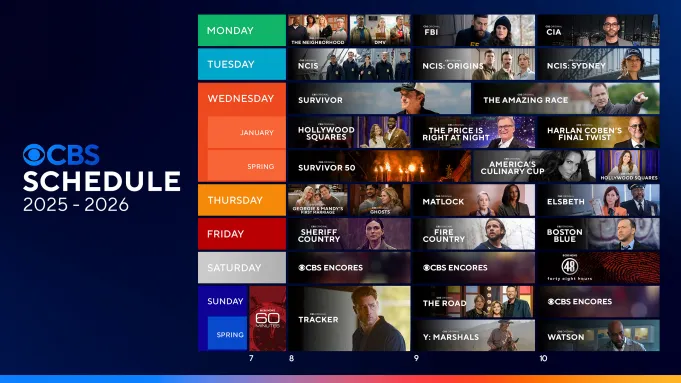 Look, I’m not suggesting that everything CBS is doing now pales in comparison to how it was when they owned Getaway Wednesday. And I don’t dismiss for a second that the executives now charged with storytelling are under tremendous strain, particularly as the clock is ticking louder and louder toward the possibility of the sale to Skydance being compromised or even negated. I give them credit for at least putting out a meticulously designed schedule and a graphic that reflects the forethought that was put into it.
But that’s all the more reason to at least figure out in advance more buttoned up narratives and talking points which reinforce the fact that in spite of all of these distractions they’re still the alpha dog that everyone else–and that includes streamers–are chasing, and that if you’re a responsible marketer you’re gonna do substantial business with them–just like your predecessors did. With the folks that preceded the ones who presented yesterday who enthusiastically took their money.
You can review that playbook when the dust finally settles, CBS. Or maybe you can send out some shrimp.
Until next time…