
When I first began to interact with the movers and shakers in the cable industry after spending my formative years in the world of over-the-air TV on both the buyer and seller side, I was struck by two constants that I began to see with every meeting I was a part of. One was how much shrewder and savvier the majority of the people in any room were compared to many of the more emotional and mercurial personalities that I tended to deal with–at times, to be candid, taking full advantage of those qualities to my advantage. And two, how many of the most challenging and steadfast ones all tended to resonate when someone would reference the phrase WWJD? In the case, the J didn’t stand for Jesus; it stood for John. As in Malone. But to those who were his disciples and espoused his principles, in many ways John Malone was the more influential of the two.
 I personally never dealt one-on-one with him, but as the epitome of most-favored nations in his role as chairman of the omnipotent Tele-Communications Industries (TCI), which during the 80s and 90s was far and away the supplier of cable entertainment and information for more U.S. homes than any multi-video provider his imprint was on every company that I worked for. Yes, even FOX, as the majority of their affiliates would have been afterthoughts were it not for the leveling of the otherwise skewed playing field that cable allowed these nascent stations (including a few of our O and Os) to have. And if you even had a thought for a cable network at a time when the expansion to digital was opening up such opportunities for almost every conceivable demographic or lifestyle niche you could imagine, you’d better sure as hell have John’s blessing–or at bare minimum his indifference.
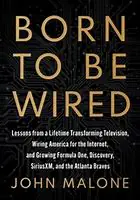 So I unsurprisingly breezed through his no holds barred autobiography BORN TO BE WIRED as soon as the Kindle version was available for download. Not that I needed it, but the NEW YORK TIMES’ profile which the flippant Benjamin Mullin dropped over Labor Day weekend while, as his byline bragged, he was (r)eporting from aboard a yacht in Maine, where his green running shoes clashed violently with the teak deck, allowed readers without my history to get a deeper appreciation for why it can be argued that in many ways Malone is indeed the godfather of the industry I (and I suspect a lot of you) revere:
Of all the captains of industry who have transformed what we read, watch and talk about over the last half century, John Malone is among the most influential and the least understood. An engineer turned omnivorous investor, Mr. Malone, 84, guides his expansive kingdom from a remove, serving as a behind-the-scenes consigliere to the executives at Warner Bros. Discovery, Formula 1, LiveNation, the Atlanta Braves and Sirius XM.
Mr. Malone largely offers an unsparing view of himself, noting that he was frequently “cast as a ruthless villain,” even ticking off all the pejorative nicknames he amassed over the years: Genghis Khan. Robber baron. Darth Vader. (That last one was bestowed upon him by Al Gore, then a Democratic senator from Tennessee.)
Mr. Malone’s personal history is a chronicle of American media, tracking the rise and fall of cable TV, the ascendance of tech giants like Netflix and how Americans have become glued to their phones. (His companies laid the cable and fiber optics that connect millions of homes to the internet.) Along the way, the memoir, “Born to Be Wired,” pulls back the curtain on an industry still very much shaped by the ambitions, whims and rivalries of a small group of powerful men.
THE WALL STREET JOURNAL’s Laura Landro was no less laudatory:
(W)hile “Born to be Wired” instead riffs on the classic Steppenwolf rock anthem, the point Mr. Malone seems most eager to make calls to mind another refrain: that he’s just a guy whose intentions are good. . . . Please don’t let him be misunderstood. Rather than the ruthless monopolist he has been portrayed to be, Mr. Malone envisions for himself a legacy as a builder, shepherding the innovations that have shaped modern television and internet services and acting as a steward of capital, structuring deals to preserve value and avoid taxes. As for his oft-criticized aloofness, he attributes his public-facing persona to being on the autism spectrum, with a natural tendency to introversion and shyness.
It takes a lot of self-introspection and brutal honesty to confess something like that, even at a point in life where both his age and immense wealth would shield him from the kinds of consequences many of us would otherwise suffer if we chose that path. It’s that sort of bluntness and awareness that I’ve always admired and myself come to embrace during my own journey. But don’t kid yourself–Malone is anything but an entitled sap–a point Landro further underscores:
 The story is most compelling as Mr. Malone recounts his maneuverings with other industry power players. He sparred with Bill Gates over control of the software in cable boxes, duked it out in court with the litigious Sumner Redstone of Viacom, and alternately partnered and competed with Brian Roberts, the scion of archrival cable powerhouse Comcast. He calls Barry Diller a close friend and “bona fide genius,” but after building up a 30% stake in Mr. Diller’s company, IAC, the two ended up in a bruising legal battle over Mr. Diller’s plans to spin off several businesses. Tensions also arose between Mr. Malone and another friend, Rupert Murdoch, when in 2004 Liberty quietly amassed nearly 20% of News Corp voting stock without being clear that he had no plans to challenge the Murdoch family’s control or make a run at the company. (Today Mr. Murdoch is the chairman emeritus of News Corp, the parent company of Dow Jones, publisher of The Wall Street Journal.) The relationships with Mr. Diller and Mr. Murdoch were salvaged with mutually beneficial transactions, but the experiences taught Mr. Malone that, when dealing with a friend, the most important thing is to be “absolutely clear about my intentions” and avoid all-out war.
You regular readers know how influential those men were on my career and life; and they couldn’t be more polar opposites in ideologies. Indeed, much of the criticism being lobbied at Malone and parenthetically Mullin for painting what a sizable number of his readers contend is an overly softball portrayal of someone so inflential on so many divisive forces in today’s industry is directly due to Malone’s more conservative mindset. And he pulls no punches in directly calling out companies he feels have caved to what he sees are the largely biased and ultimately ill-informed mindsets of those that now make decisions. Witness this scathing take which Mullin recounted:
Mr. Malone, who identifies as a libertarian, says in his memoir that CNN is now “a shadow of what its founder had envisioned,” though he adds that it still has “some of the best journalists in America.” One problem with CNN, he said, is that the network’s employees — whom he described as being largely “left of center,” — “express their opinions too much in their news.” He said Mr. Zaslav had been “unable to have any meaningful impact” in fixing what he viewed as the channel’s partisan tilt, a problem he said affected every news network. “They can’t help themselves,” Mr. Malone said. “And so what you’ve got is a left-leaning, anti-Trump news service.”
As someone who had a front-row seat to the rise of CNN during Gulf War I coverage where it literally covered missile launches in real time complete with pictures from remote reaches of Iraq theretofore inaccessible, I saw the version of CNN that Malone waxes so nostalgic about–and indeed enabled at all. When VARIETY’s Todd Spangler reported this quip in his coverage of a Paley Media Council event last week I couldn’t help but wax nostalgic myself:
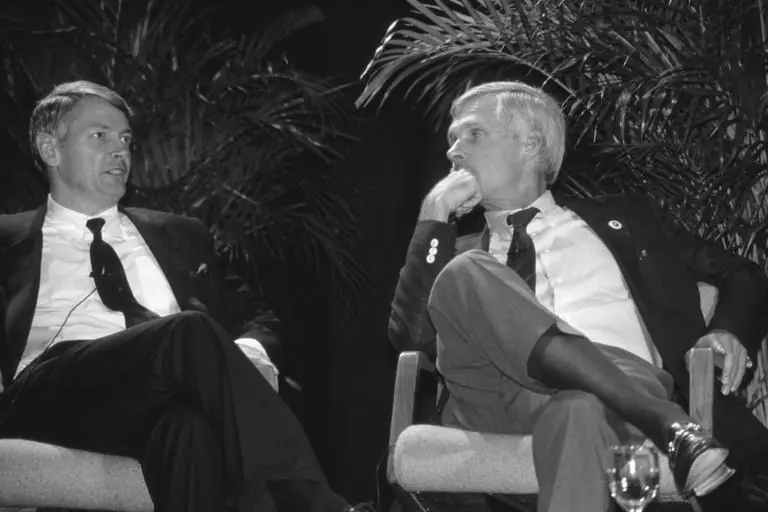 The mogul also recalled Ted Turner coming to Malone in the 1970s, when Malone led TCI, to help him launch TBS as one of the first national cable TV networks. Malone quoted Turner as telling him: “I’ll kiss anything you want if you launch my channels.”
I heard Turner tell that very story several times, both in corporate meetings where eventually several employees filed complaints and in bars where it was clear he hadn’t taken his lithium prescription. But regardless of his state of sobriety in those moments he always offered his eternal gratitude and showed complete reverence to Malone, and for someone with Ted’s outsized ego that wasn’t something we bore witness to all that often. The fact that Ted has wound up in the same ‘hood with a sizable land grab of his own can be directly attributed to how highly he regards Malone both in business and in life.
You’re certainly entitled to whatever opinion you may have on Malone as a person, and he’d be at the head of the line of allowing you that freedom. But it’s impossible to not at least admire someone who, as he recounts in the book’s first chapter, took a company that once had a net worth of 78 cents to the value it now has. With a lot less drama attached to where and who will control it once he’s gone; something that it took the likes of Murdoch decades of family retreats and countless lawyers to resolve. Mullin even dropped that nugget into his piece:
As he contemplates retirement, Mr. Malone says he and his wife, Leslie, are redoing his estate plan, winnowing it down to make it easier for his survivors to sort through. His vast land holdings will go into a conservation trust, so that they can be used by the public. He does not plan for either of his two children to succeed him at Liberty Media, his media colossus.
If that what’s John would do, consider me an evangelist.
Until next time…