
Yesterday began such a celebratory day for the fine folk at the hodgepodge somehow labeled Versant. Their key executives got to play bell ringers to open the first full trading day of 2026 , with the cameras of their crown jewel CNBC (revised logo and all) covering them. And they’ve actually decided to establish roots in what was supposed to a Vrbo stop, as DEADLINE’s Jill Goldsmith caught us up with: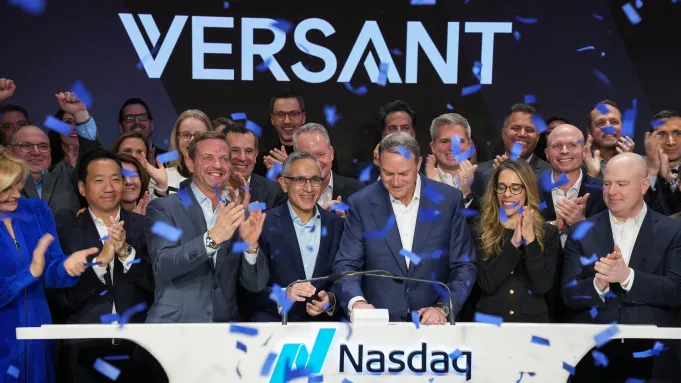
Versant has settled on its new digs…, making the historic New York Times building its permanent home. It had settled temporarily into three floors there, but (CEO Mark) Lazarus told staff in a memo that it is taking another three and renovating all six as well as a lobby and cafeteria at 229 West 43rd Street. “After careful consideration and hearing from many of you about how this location makes your commute more manageable, we have decided to remain here. We are excited to become a fixture in this hub of media, entertainment and finance, joining our neighbors — Paramount Global, Snap Inc., TikTok, Roku, Nasdaq, Morgan Stanley and Bank of America,” he wrote.
But their jubilant mood was soured greatly by the closing bell, likely while a lot of unboxing was still going on. YAHOO! FINANCE’s Aaron McDade drew the short straw of unofficial party-pooper:
Versant (VSNT) shares fell sharply after they started trading on the Nasdaq exchange Monday, as the company completed its spin-off from Comcast (CMCSA). Versant shares opened the session just above $45 but finished the session at $40.57, after falling to near $39.
Comcast announced plans in late 2024 to spin off its cable TV channels including CNBC, MSNBC (since rebranded to MS NOW), USA Network, Golf Channel and others. That new company, which also owns digital brands Fandango and Rotten Tomatoes, was eventually named Versant. Versant’s performance as a standalone stock could signal how investors feel about the shrinking cable TV business.
It’s pretty clear that the investment community had at some point perused the roll call of year-over-year deltas that VARIETY’s Michael Schneider dropped over the holidays. The Versant group averaged a particularly egregious -22% decline, with those having more to lose (MS whatever and USA) exceeding that average. In a way, the fact that the stock price dropped merely -13% on Day One could have been seen as a pyrrhic victory.
Were this merely a vote of no confidence based on the track record that this particular array of underperforming networks has produced, one could almost take the tap dance from King Verdsant on his least declining network yesterday morning which McDade also shared as believable:
 “As part of Comcast and NBCU we had other priorities as a company,”… Mark Lazarus said on CNBC Monday. “We made different decisions, because we had a different company and a different strategy. Now we’re bringing these [assets] into their own company, we’re going to be able to invest into them.”
But when pressed for details as to even an inkling as to what said investments could be, one could hear the crickets descending into the room. Not even a passing reference to a favored-nations acquisition of something of consequence or even the development of a video podcast about movies from a few prominent critics who post on RT (think AROUND THE HORN for pop culture). Ye Gods, I just dreamed that up while sitting on the toilet. Team Versant has had months while they’ve been hiring movers to do the heavy lifting of a six-block relocation to conjure up even a few plausible ideas.
And timing being what it is, unfair as it may be to judge the rest of the industry off a small sample size of early returns the fact is that a more seminal event is about to go down that this rejection will impact, which THE ANKLER’s veteran observer Claire Atkinson (all too familiar with Versant’s digs thanks to her many years at the NEW YORK TIMES) noted in this morning’s Substack:
A few investors were acquiring “when-issued” conditional shares ahead of the debut, suggesting a valuation of around $6.5 billion, according to Barron’s, which reported estimates setting Versant’s value at somewhere between $10 billion to $12 billion once its public debut shakes out. That will impact the valuations of Warners’ cable unit — comprising Discovery, Food Network, Eurosport and CNN — when it spins out in Q3.
It’s those networks that are the sticking point in the difference between Netflix and Paramount Global’s bids to seize the assets of Warner Brothers Discovery, with that D-Day for its investors coming up less than 48 hours from now. Netflix has no need or desire for them, while the Ellisons have indicated they’re OK with adding a few more tons of crap to their existing array, which as Schneider’s doomscroll noted are also delivering a whole load of double-digit declines over underwhelming YAGOs.
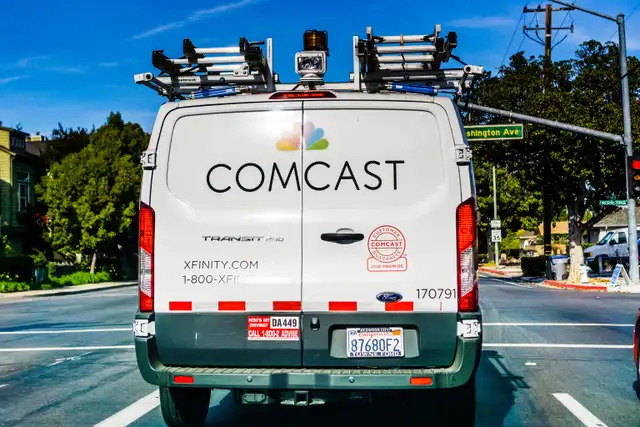 And don’t think Comcast doesn’t have an oar in that water. They make significant cache as an MVPD to carry cable networks besides the ones they’ve punted to Versant. CORD CUTTER NEWS’ Luke Bouma noted last summer that they lost 325,000 TV subscribers in 2Q25, not to mention 226,000 internet customers–nearly double the amount they lost in the comparable YAGO quarter. Also don’t think these aren’t interrelated. If one has no reason to bundle services and save accordingly because there’s nothing they want to watch, what incentive is there to keep broadband alone?
According to J.D. Power and Associates’ 2024 U.S. Television Service Provider Satisfaction Study, Comcast’s Xfinity scored another pyrrhic victory as being voted best-in-class among cable/satellite TV providers, but that score was more than 20 per cent below YouTube TV and more than 10o points below Hulu’s Live Channels. Not exactly a vote of confidence for that sector, either.
Hence would it have been too much to ask of the Versant team to at least put SOMETHING out there to gnaw on besides these minus signs, with so much at stake not only for them but the industry at large?
 We’ll soon see if this Lazarus is capable of emulating his namesake by rising from the dead. The clock is ticking loudly.
Until next time…