
It actually hasn’t been all that long since I was last choosing to spend extra time in my office around this time of year. In my line of work, it was all the more necessary as we frequently rescheduled oft-postponed vendor presentations to the last full week of the year–which most willingly went along with because it gave our East Coast and Midwest-based ones a chance to savor a couple of days of substantially better weather and our local ones a chance to get us in a slightly more attentive environment than they’d otherwise get when they would be able to snag us. It sometimes translated to eventual sales for them, and it always meant a relatively easy and shortened day for us.
But in a world and industry that now prioritizes WFH (we’ll see exactly how diligently those RTO declarations are enforced moving forward; so far, there’s been far more talk than action on that count)–especially at this time of year–those presentations now frequently take place in the form of press releases where password protections are waived, making it possible for just about everyone who might be interested and have a bit more time to focus to take better advantage of these companies’ deep dives. There’s frequently worthwhile insights that often prove to be jumping-off points for the future as much as they are recaps of the past year we may have otherwise been too distracted to realize. And Lord knows that’s been especially true in the last twelve months.
The good people of Nielsen are experts at such stuff; as is the case around this point of every month they breathlessly update us with their latest overly simplistic lens on quantitative viewership patterns which a willing and otherwise clueless trade press obligingly gives them a megaphone to tout. Such was the case yesterday morning when THE HOLLYWOOD REPORTER’s Rick Porter touted these tidbits:
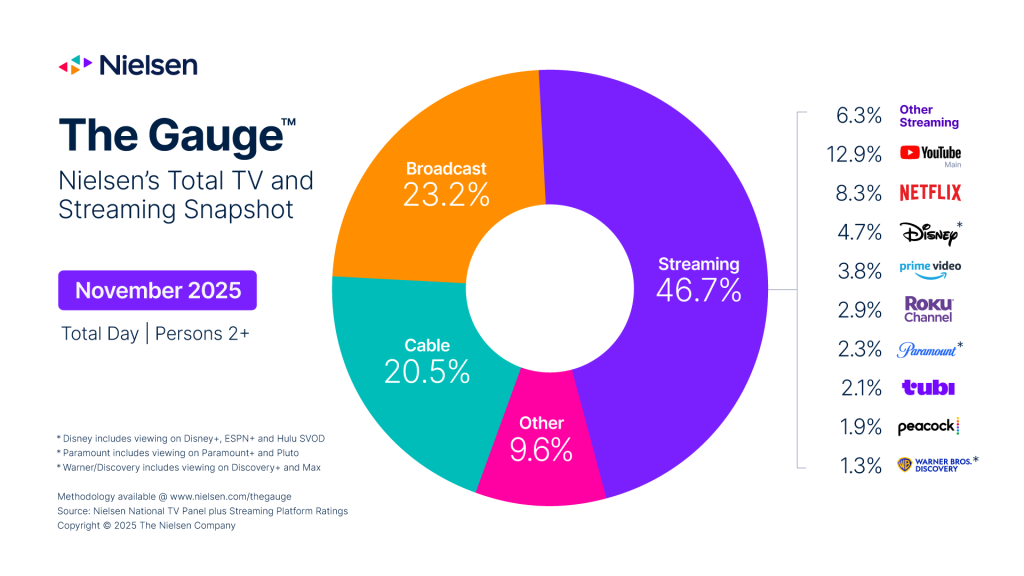 A record-setting NFL Thanksgiving slate and the return of one of streaming’s biggest shows helped both broadcast outlets and streamers in November.
The return of Stranger Things to Netflix on Nov. 26 — and increased viewing of past seasons in the weeks leading up to the premiere — helped streamers claim 46.7 percent of all TV viewing in the United States for the month. That’s up from 45.7 percent in October and the second highest share of TV use streaming has ever had, behind only July’s 47.3 percent.
Broadcasters also took a larger piece of the viewing pie in November with 23.2 percent of TV use, up from 22.9 percent a month earlier. Network sports broadcasts — including most of the World Series (Nielsen’s November reporting period includes the final five days of October as well) on Fox and three Thanksgiving NFL games that set ratings records for Fox, CBS and NBC — accounted for 6.4 percent of all TV use by themselves.
But this time we also got some reasons as to why this phenomenon of splintering and engagement is happening –and how thrilled those participating in it might actually be- courtesy of the company’s qualitative-focused Gracenote division, who yesterday dropped a full deck of their own along with the summation to their extensive e-mail list:
As the streaming landscape has grown, the abundance of content and sources has become so overwhelming for viewers that they can’t find the content they want to watch. In fact, one-third say that the amount of options and content has a negative effect on TV enjoyment.
 Gracenote’s 2025 State of Play report, Data is the key to solving the paradox of choice for streaming viewers, reveals the challenges audiences face in the current landscape and what they want from their streaming experiences.
In this report you’ll uncover insights from streaming viewers such as:
- It now takes an average of 14 minutes to find something to watch.
- 49% say it’s likely that they would cancel a streaming subscription because they can’t find something to watch.
- 66% say they would prefer a single guide or menu that provides information about all available content across all content sources.
If you do happen to dig a little deeper, you’d get additional revelations that can make you a tad smarter or least make you go “hmmm”, such as these:
Amid the fragmentation of both content and content source, audiences face two
primary challenges:
• They often don’t know what they want to watch, and the abundance of
services and content is overwhelming, which makes it harder to find something.
• They often know what they want to watch, but they don’t know how to find it.
This is particularly relevant for sports content.
At an even higher level, many say the overabundance of choice is making the
overall TV experience less enjoyable. Among people 18-34, this sentiment is
even more pronounced.
More than 45% of streaming viewers say
that the saturation of streaming services are overwhelming.
But don’t just take Nielsen’s admittedly scratch-the-surface views as pure gospel. The ever-insightful Evan Shapiro of ESNAP had a holiday GIF-t of his own where he dropped a pretty impressive deck of his own to his subscribers. Along with it, he once again took the time to man-splain to us what we’ve all somehow been missing along the way and some sage advice as to what kind of New Year’s resolution might rectify it:
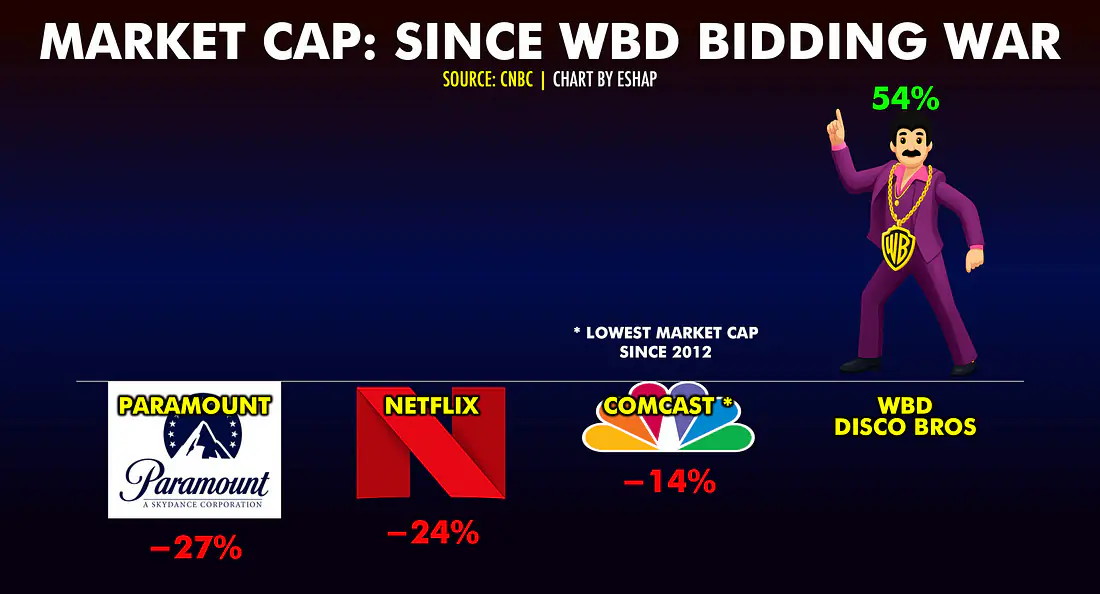 In 2025, the Media industry wasted so much time, money, and energy looking backward for answers. The perfect case study for this misspent bandwidth is the irrational bidding war for Warner Bros. Discovery (Disco Bros) that’s at the center of everyone’s attention as the year ends. Media’s most powerful men are all desperately grasping for the past; for a Hollywood that no longer exists and never will again – battling to be Kings of irrelevancy.
So, why does Media do this to themselves? Because Trad Media consistently ignores the data of its own demise, staring them right in the face.
Examples: Netflix’s viewership has been flat for at least two years. Paramount’s $7 billion payout for UFC can never break even. Comcast is spinning out the traditional cable networks that generate free cash flow, while simultaneously trying to buy two other, very old school Media giants – ITV and WBD – even as their core business, broadband, flatlines. Yet the easily-distracted analysts who cover the industry never ask its leaders the right (or hard) questions. They’re far too busy covering Media’s silly horse races.
The Moguls no longer run our industry. That is why they are spinning out of control. The audiences are now in complete control of their entertainment. That user-centric gravity has created the radical fragmentation that will define Media – in 2026 and forever more. This makes our business much more complicated and difficult than earlier eras and makes our old business models irrelevant. Radical transformation is possible. I promise…However, the key to our successful evolution is putting away the childish bullshit of our past and start listening to our audiences. If we follow them, they will lead us to the future.
Since the authors appear more than willing to share their work with the class, I invite you to do same. You know you’ve got the time and Lord knows we could use the distraction more than ever.
Until next time…