
NOTE: This also appears today on our sister site Double Overtime. Please visit it regularly for coverage of sports of all sorts plus occasional essays on business and technology.
It’s once again time for an Olympiad, and it’s about as welcomed as any in recent memory. For one, it’s taking place in Italy once again for the second time in 20 years (the Winter Games were held in Turin in 2006), and as we all know far and away there’s few places on Earth more beautiful (let alone an awful lot of its fans). Yesterday’s opening ceremonies were a spectacular example of that, even though one particular fan who has an unusual appetite for making love to couches almost ruined it. For another, the fact that it’s set in a time zone that just like the summer Paris games of two years ago allows for a plethora of live coverage during the hours that this particular insomniac tends to crave white noise while musing, and I must tell you these events are a lot more upbeat and entertaining than even an endless loop of Sportscenter or heaven forbid the news can provide–lately, especially.
 For me the Winter Games also provide me a chance to reconnect with a host of sports that I first discovered while I laid in bed sick as a dog during the Sapporo Winter Olympics, when my mom was generous enough to sacrifice her bedroom portable and give me access to my first in-room TV ever. NBC had those rights then as well, and took advantage of a TONIGHT SHOW lead-in to provide an extended late-late night block that included live coverage, which for that era and time slot was practically unprecedented. My mom felt sorry enough for me to also gift my first-ever SPORTS ILLUSTRATED subscription that provided detailed coverage of those games 20 issues for $2.97; I recall those figures to this day. That subscription is still ongoing, even though the magazine now only publishes 12 much skinner issues a year.
Sure, I watched the sports I was already familiar with (still do)–skiing, figure skating, speed skating and of course hockey. But in the wee small hours one I had never seen captured my attention. A weird combination of what to me looked like chess, bowling and shuffleboard that had a line score that looked just like a baseball game. That was my first exposure to curling. When I later attended college in a border town I discovered that it was a far bigger deal in Canada than it was here in the States–snowy Saturday afternoons regularly featured live competitions on the CBC affiliate that even my college dorm’s closed-circuit system carried. I learned more about it and was captivated. In later Olympiads when NBC used its cable networks for expanded live coverage they would frequently dedicate CNBC to nonstop live and taped coverage of the sport, and it allowed me to get even more familiar with the nuances and quirks that make it so compelling.
AXIOS SCIENCE’s Carly Mallenbaum provided a timely primer to all of this on Thursday when the first matches of Milano-Cortina began to be shown on what the spectacle called “day -1”:
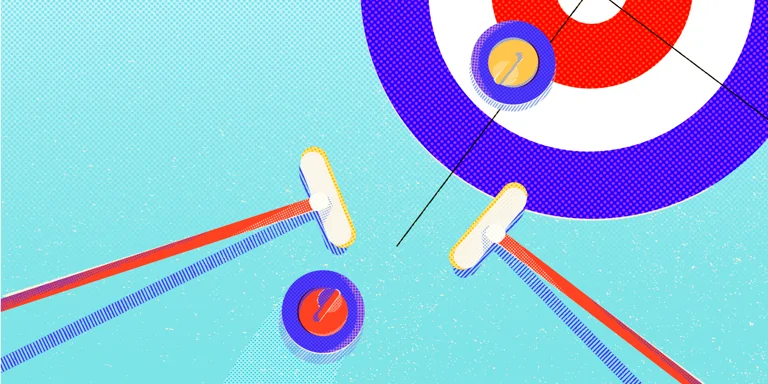 Curling is the Winter Olympics sport in which teams throw 42-pound granite “rocks” toward the “house” (target) on ice that’s been sprayed with water — this gives it a pebbly surface…The name comes from the way the rock arcs as it moves down the ice — a phenomenon that’s inspired dozens of scientific papers. On each team, a thrower lunges and tosses the rock with spin. Then, sweepers brush the ice to influence a rock’s path after it’s thrown. The direction a rock is turned as it’s thrown (clockwise or counterclockwise) determines its curl direction (right or left), and sweeping ahead of it extends its distance on the ice. Sweepers consider strategic timing, angles, speed and pressure as they sweep, while teammates yell “straight” and “curl” to coach sweepers on how to brush the ice.
“People call [curling] ‘chess on ice’ because there is a lot of strategic thinking,” Dean Gemmell, USA Curling CEO, tells Axios. But he thinks the analogy should have a caveat. “It doesn’t take much physical ability to move a chess piece, whereas we have to actually make shots,” he says. Curling requires power, balance, flexibility and “significant athletic ability to play at the highest levels.”
And as THE ATHLETIC’s Zach Pierce wrote early this morning, this year the appeal and the upside for our team is already beginning to crest:
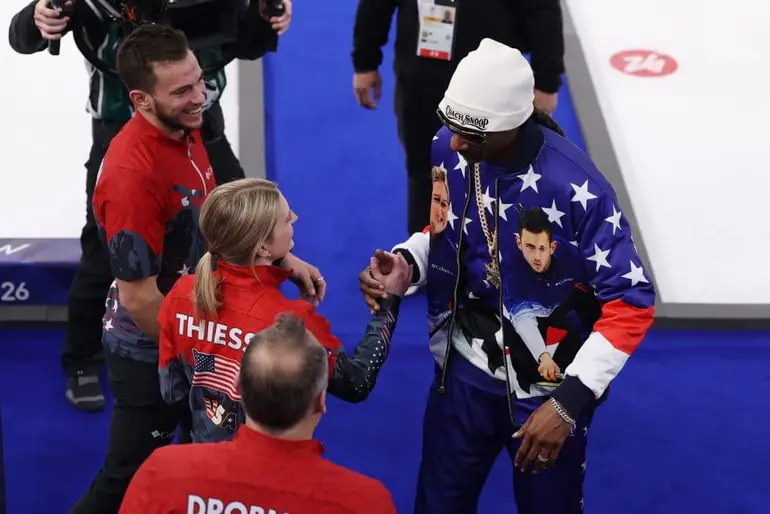 There’s nothing like knowing Snoop Dogg will be sitting next to your mom and watching you compete for your country to get you fired up to beat a rival. Cory Thiesse and Korey Dropkin, the Americans’ mixed doubles curling entrant at these Olympic Games, got an early heads-up that one of the world’s most famous personalities would be in attendance Friday for their round-robin match against Canada, then responded with a 7-5 win against their previously unbeaten northern neighbors. Thiesse and Dropkin sure looked like they were playing with a little extra juice as they improved to 3-0, equaling the best undefeated start for an American curling team at an Olympics. They would win again later Friday to move to 4-0 and set the new national mark.
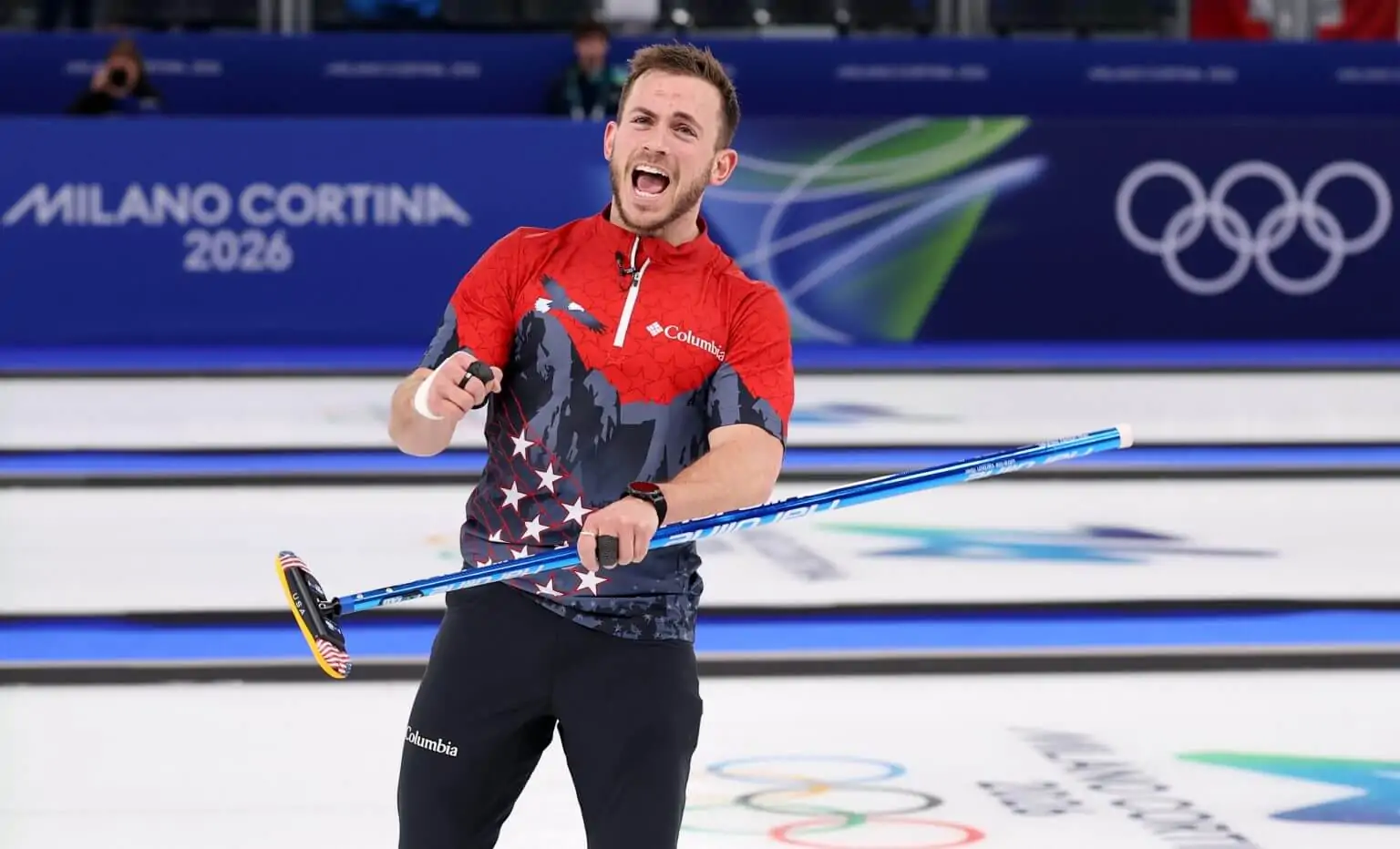 A key sequence in the sixth and seventh ends swung the game for the Americans. After the U.S. was forced to take only one point with hammer in the fifth — typically, you want at least two points with the last-shot honors — Canada, down 4-3, opted to use its power play, a once-a-match option for each team that sets up the initial stones in a more favorable position for whoever is using it.
A team definitely wants at least two points when using its power play, but Canada’s Brett Gallant and Jocelyn Peterman managed only one after some great shot-making by Thiesse and Dropkin. Tied at 4 and with the hammer, the U.S. then used its power play in the seventh end and capitalized, scoring three times for a lead Canada couldn’t erase in the final end.
Ya know, while watching this unfold live, I was as enthralled and inclined to sit up in bed as I typically inspired to do by any sport I use as to help induce at least a little sleep. And it sure looks like there will be more such moments ahead in the coming fortnight. As Pierce added:
No U.S. men’s, women’s or mixed doubles team had started better than 3-0 at an Olympics since curling was officially added to the program in 1998. The 2022 women’s team was the only other squad to start 3-0. Mixed doubles was added in 2018. Great Britain, the only other unbeaten team left and the Americans’ first opponent Saturday, leads the overall standings at 5-0 after topping Sweden and South Korea in its two matches Friday. Teams play nine round-robin games — one each against every other nation — before the top four advance to a two-round knockout stage.
That to me means a lot more excitement and comfort food TV ahead–and far fewer chance to have to see sights like this for now.  I’d better grab at least a little shuteye while I can. Nighty-night for now, kids.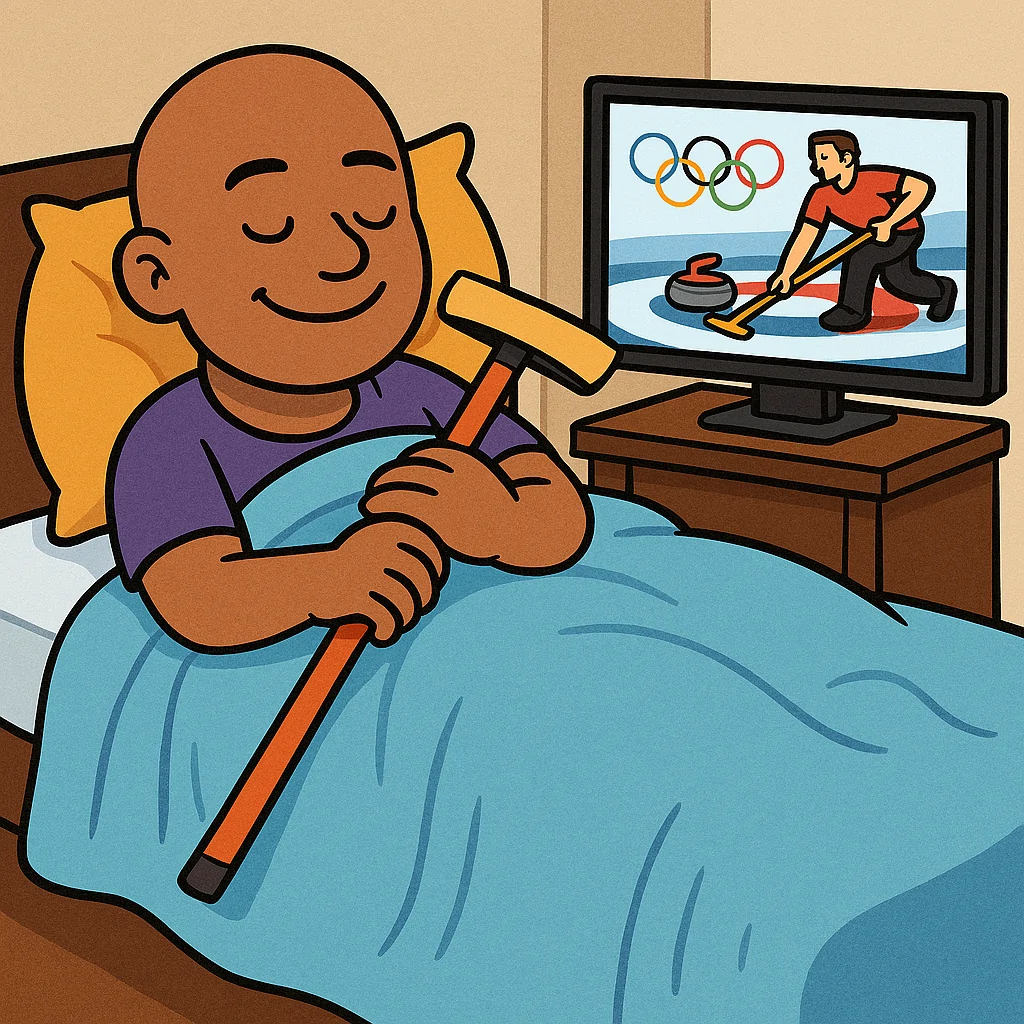
Until next time…