
It seems not a day is going by lately where someone with a Substack platform and a desire to create enough curiosity to attract a few new paying subscribers comes up with what they see as a smoking gun that involves some dramatic data reveal that they hope will resonate with those who apparently suffer from CDS–CBS Derangement Syndrome.
The latest came last night courtesy of STATUS’ Oliver Darcy, who in the wake of a victory lap of sorts being taken earlier in the day dropped this dime–which I’m relieved to say my Palm Springs Savior who already has thrown a few shekels his way was yet again kind enough to share the behind-the-paywall details in this direction:
 Earlier this week, CBS News touted a ratings milestone, claiming that “CBS Evening News” anchor Tony Dokoupil had snapped his six-week streak of averaging fewer than 4 million viewers—a threshold widely viewed as dangerous territory for a broadcast evening newscast. The network circulated a press release and successfully persuaded several media outlets to amplify the claim.
But a closer look at the numbers tells a different story. According to Nielsen data obtained by Status, Dokoupil actually averaged 3.985 million viewers during the five-day period ending Friday, May 22—just below the 4 million mark. In other words, the streak wasn’t broken at all. So how did CBS get him over the line? By employing a too-often-abused ratings maneuver. The network coded Friday’s broadcast, typically the week’s lowest-rated edition, as “CBS-EVENING-NWS” instead of “CBS-EVENING-NEWS.” That omission of the letter “e” excluded Friday’s audience from the program’s weekly average, allowing CBS News to report a figure above 4 million viewers.
To those who aren’t as seasoned as some of us who can’t seem to find peace in their souls without finding some reason to throw shade at the network they continue to swear they will “boycott” until the end of time, this was received as a revelation–in the same manner that yesterday’s obsessive detail about Byron Allen’s “cratering” on a holiday Friday night got traction. When we mused about that, we were able to impart our decades of real world experience to remind how little this actually mattered in the real world save for the Audience Of One. We had seen it before long before Bibi Netanhyahu’s unapologetic cheerleaders were even zygotes, let alone the keepers of the Tiffany Network flame that far too many that claim they were still loyal viewers to had reached their respective bridge too far. The fact that actual audience skews and frequency studies consistently reveal they were likely exaggerating or outright lying continues to be immaterial to the narrative that somehow paints them to be defenders of democracy, at least in their minds.
Darcy’s demography falls somewhere closer to mine, so he was quick to add this little qualifier:
To be fair, this is a common industry practice. ABC News and NBC News have both used similar tactics to their advantage. But it was particularly audacious in this case given that CBS News was actively promoting the number as evidence Dokoupil had ended his ratings drought when, by the actual five-day average, he had not.
 Damn right it’s common. Forget the most recent examples when NBC coded out certain episodes of its own still-competitive and less knee-bending newscast when Olympics overruns created atypical start times on different coasts. Back when stations stripped movies in key afternoon slots leading into profitable early newscasts and independents effectively competed against networks in prime time this was a science. “Special” weeks were similarly coded for ratings books so that the “tapes” that early computers would utilize to process results for advertisers to defend their buying decisions to their clients coudl be tweaked and mainpulated as opportunties allowed. My mentors and I initially wanted to employ this when we ran a block of kung fu movies in prime time in Little Rock, Arkansas against the Winter Olympics–these were titles that were decidely downscale and about as reciprocal in appeal to figure skating fans as possible. We even found a couple of obscure titles that featured a black lead for reasons we can diplomatically say reflected where the data strongly suggested our greatest upside lied. When we got some pre-sweeps data via a telephone coincidental–another old-school trick strategists employed before algorithms and real-time response ruled the world–that showed those particular titles were outperforming even our greatest expectations we eventually decided to scrap the coding out and conflate it all with our classier titles. We wound up as one of the top ten newly signed on stations in the country with prime time movies during that long-ago February sweep. I assure you it was as big a deal then as the daily CDS downloads are now. Or not.
But it seems like every time someone else decides to take a stab at what they think is indicative or to them unique in the pious hope someone will be motivated to subscribe these sorts of skill sets are sought out by those who employ enough of a caveat emptor filter to seek out counsel. Earlier last night I was forwarded this attempt at revisionist history authored by one Daniel Parris of STAT SIGNIFICANT with the clickbaitable headline Do Most TV Shows Stick the Landing? His theory was postulated thusly:
 The Tommy Westphall Universe is a pre-Internet fan theory that imagines most television shows taking place inside the mind of St. Elsewhere’s Tommy Westphall. The Westphall Universe’s logic goes like this: because characters from St. Elsewhere appeared in crossover episodes for Homicide, and Homicide connects to the Law & Order universe, both shows can be attributed to Tommy. If you allow this web to keep expanding, then programs like Cheers, M*A*S*H, and Chicago Hope all exist within the mind of a child. Ultimately, St. Elsewhere’s finale was so baffling and widely disliked that fans built a satirical TV reality to make sense of their disappointment. Four decades later, television has changed dramatically, reshaped by streaming and a clearer understanding of what makes for a satisfying conclusion. But has this institutional knowledge led to better endings? Have showrunners learned from the mistakes of St. Elsewhere, Game of Thrones, and other finale fiascos?
I applaud Parris for at least trying to dredge up memories of a long-forgotten show that essentially set the standard for today’s minimalistic requirements for a streaming service’s show to be considered a hit–something else we mused about as late as yesterday. But when he went into the flimsy methodology he used for hsi exercise, it became clear that his memories are a lot fuzzier than those that would be in the mind of a highly functioning austitic child like Tommy Westphall:
To assess the quality of television endings, we’ll compare each show’s IMDb finale rating with its average rating across earlier, non-final seasons.
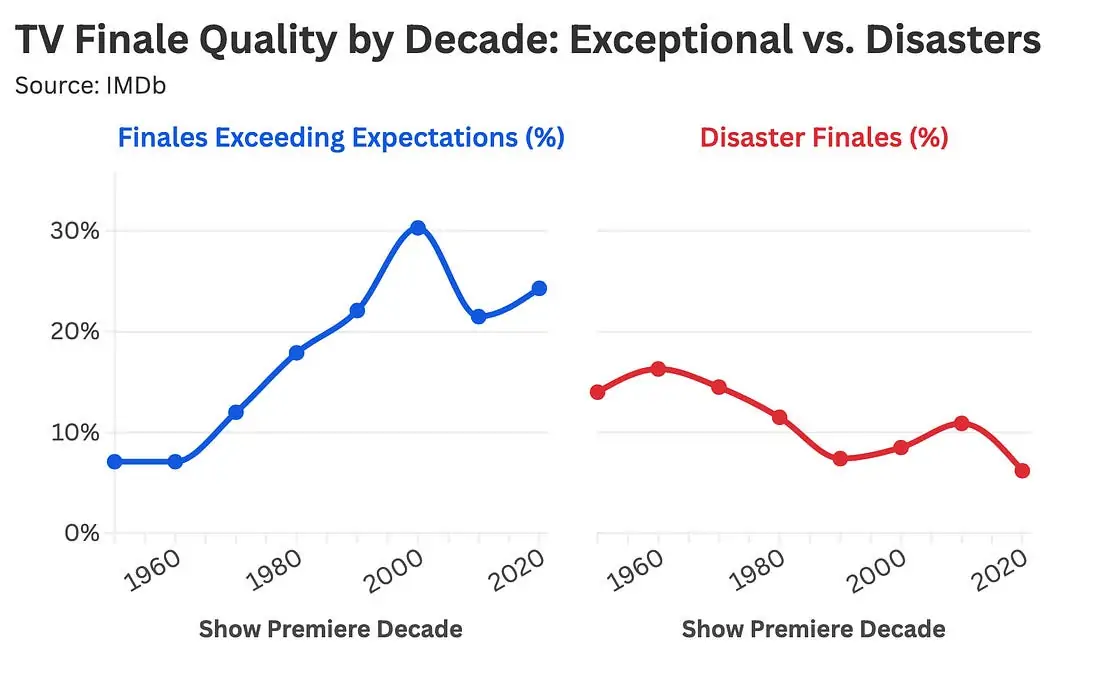 Somehow, Parris thought that an opt-in rating from a select audience of subscribers to an information platform that aggregates over time regardless of recency is somehow a statistically representative or reliable sample to base the array of charts and conclusions he spewed out.
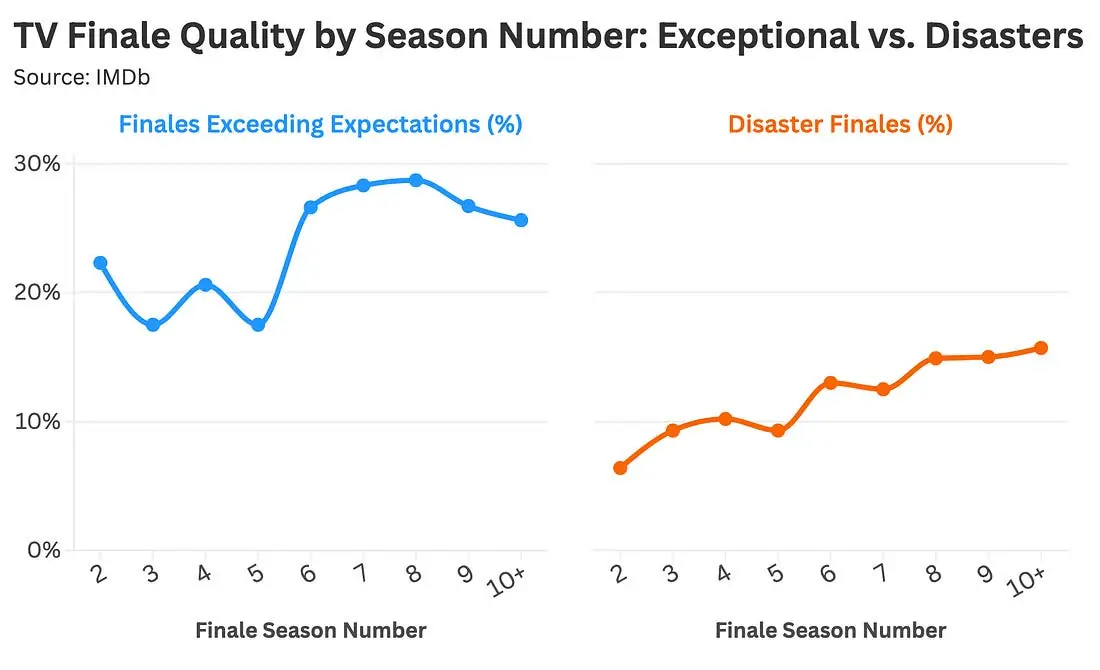 It sure looks like Parris would like us to all to think he’s got the sort of attention to detail that would justify his $60/year request for future reports like this. That’s in the same price neighborhood as that nameless Entertainment Strategy Guy has been asking for and literally a tenth of what Darcy is seeking for the “founders’ edition” of his nightly elite reporting. At least Darcy and team break a few stories and ol’ ESG has the chops to source multiple data providers to provide the foundation for his opinions. The fact that Parris–a self-described Data journalist and pop culture lover–thinks an effort this lazy and incomplete is comparable suggests he’s anything but a researcher.
 I should note that he also describes himself as #40 in film and TV with more than 25,000 subscribers. You bet I’m envious. As any researcher worth their chops oughta be.
If there is any hope to be gleaned from the spread of CDS, it’s that yesterday’s barrage of headlines involving the new management instilled by Bari-um Enema at 60 MINUTES that filled out the balance of STATUS’ nightly newsletter will create a whole new set of opportunties for folks to be as clear-minded and detail-oriented as Darcy to weigh in. As you can see, he hid most of the juicy stuff behind that paywall, so I’ll leave it to you to search for them elsewhere. Suffice to say it has already provoked enough sky-is-falling consternation to carry through the long, hot summer in advance of a fall where football overruns will as usual create a slew of apples-to-oranges comparisons year/year and week/week that undoubtedly will be conveniently misconstrued one way or the other. An episode that runs with a 7:45 start time that follows an overtime thriller of consequence that delivers a sizably larger audience than one that runs at the typical start time will have done so with likely zero attribution to the content and/or personnel attached to it.
I have a hunch there will be a desire, if not a demand, for accuracy, among those most deeply afflicted with CDS, especially as we head to (we hope) midterm elections. If nothing else, I’ll be available to provide you with those groundings–for the moment, for free. And I assure you, I won’t be using IMdB as my source.
Until next time…