
I’m arguably a walking anachronism when it comes to my consumption of streaming services. Having spent a lifetime in the business of reporting on people other than myself experience content I’ve developed what at times is a morbid curiosity to learn as much as I can about shows that I would otherwise never be personally intrigued by. When you add that to my own admittedly voracious appetite for shows and IP that date back to my youth, I suspect the magical forces behind my algorithms are working overtime to try and get me to stay in their walled gardens. As a result, I rarely discover anything binge or even graze-worthy through such inducement, because most of the time AI just can’t figure me out.
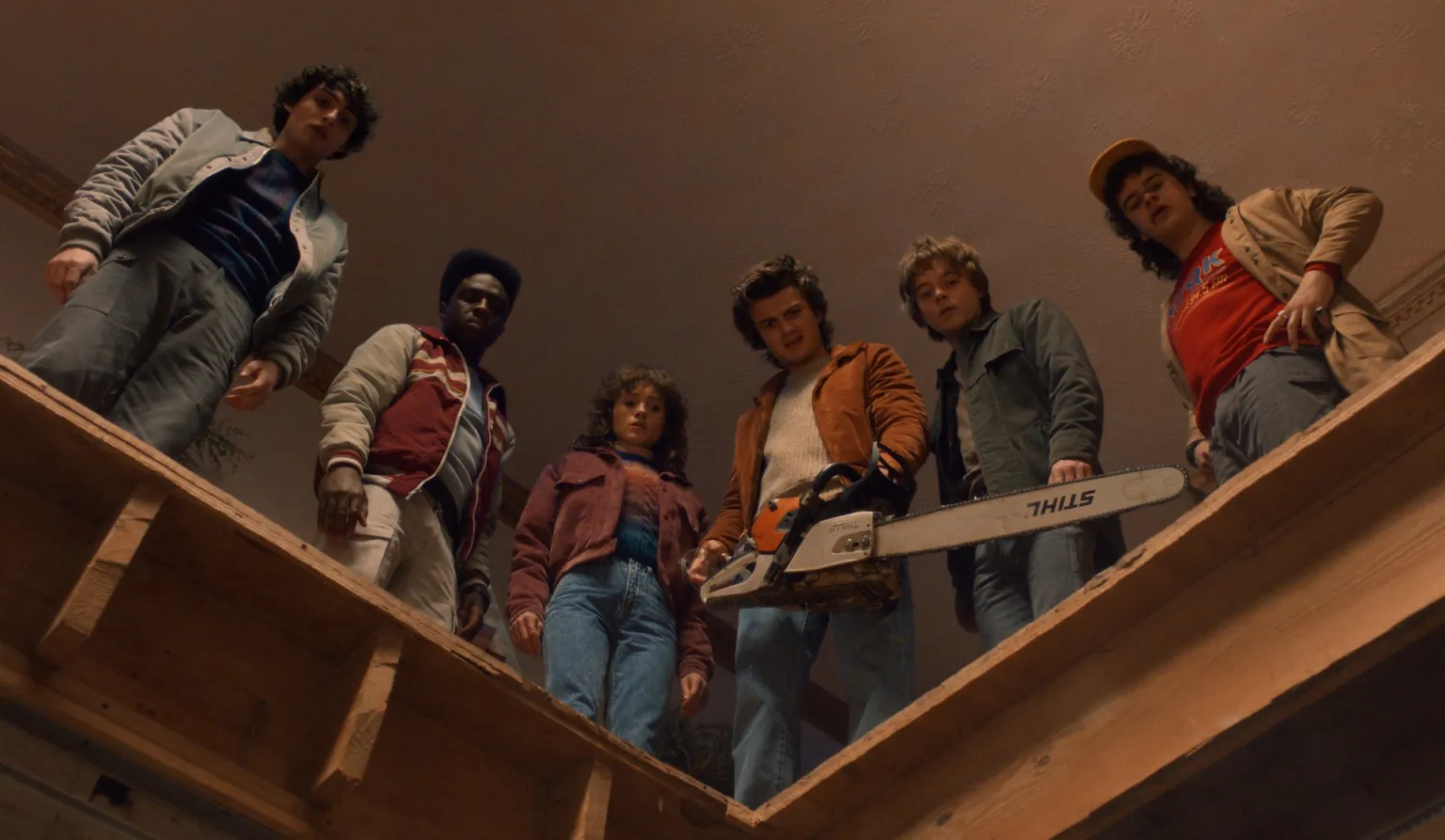 But after settling in for one of my rare binge sessions with the eminently digestible and demographically compatible second season of Netflix’s A MAN ON THE INSIDE when the sun set last night I noticed that the bag of Doritos I was shamelessly chowing down on looked a little different than the ones I typically indulge in. What I thought was merely a limited edition mashup of two flavors my challenged stomach can actually handle–pizza and ranch–turned out to be a promotion for the upcoming final season of STRANGER THINGS. And as I was simultaneously savoring the surprisingly satisfying mix of flavors I would otherwise be loathe to combine in real life because I’m just not from a generation that seems to think apple pie flavored mac n’ cheese or bacon flavored milk shakes is normal along with a show I really get into somehow that logo burned into my brain enough to remind me that I should at least for once have STRANGER THINGS on my to-do list.
 So when the final three-quarters of A MAN ON THE INSIDE S2 satisfactorily wrapped after a manageable three-hour tour the fact that I was returned to a home screen that ranked the service’s top ten shows as of my viewing I was somewhat surprised to see STRANGER THINGS’ tile right next to my show as an apparently close #2 to AMOTI. A wholly unexpected sight considering AMOTI just dropped last week and STRANGER THINGS last had new episodes three years ago .
Aha, it must be that dreaded echo effect we’ve previously mused about. I’ve reported on it enough to recognize and appreciate its importance at luring viewers and subscribers back into a service’s tent when they’ve strayed outside the walled garden. But until I read Peter White’s recap of Netflix’s most recent efforts at data transparency that he dropped earlier yesterday I had no idea how strong this phenomenon was playing out:
The first four seasons of The Duffer Brothers nostalgia-drenched series have entered Netflix’s top ten television chart – the first time that a series has had four previous seasons in the Top 10 all at the same time. The first season of Stranger Things entered the top ten this week at number three with 4.1M views, season four is at number five with 3.3M views, season two is at number seven with 3.1M views and season three is at number nine, also with 3.1M views. Stranger Things has clearly been growing as promotion around the final season grows; last week, the first and second season made it into the top ten at number four and nine, respectively, with 3.3M and 2.7M views.
 So the siren’s song of that adjacent tile burned into me enough to click on STRANGER THINGS for the first time in my Netflix subscription history–which goes back even longer than the series, which first burst onto the scene in 2016. I went to the S5 trailer to at least set me up for what was ahead and, yep, it was captivating even to someone who is perhaps at the polar extreme of the Generation Alpha for whom STRANGER THINGS has arguably defined their video puberty. But I honestly had little idea why so much of what I saw was meaningful–which considering the “further insight” that White added as a postscript to his “analysis” I shouldn’t have been all that shocked by.
I made it my business during my latest bout with insomnia to at least make myself as up to speed as possible. No, I didn’t contribute more incremental minutes to STRANGER THINGS’ impressive total. But thanks to an opportunistically timed story from USA TODAY’s Brendan Morrow that came up as adjacent in this search as the show did in my post-AMOTI daze I didn’t have to. And if you’ve the need or the curiosity to do so yourself, feel free to click here for all that you’ll need to make yourself at least as rudimentally cognizant as just about any adolescent in your life.
So the drumroll for them and me is building to 5 PM Pacific time today when S5 finally debuts around the world. It’s actually the first of three holiday drips that this crucial final bow will seep into cultural zeitgeist–we get the first four of the final eight hour-ish episodes on Thanksgiving Eve, the next three on Christmas Eve and the series finale on New Year’s Eve. Among others, INDIE WIRE’s Emma Flint isn’t exactly thrilled by all that:
What the “Stranger Things” TV model has attempted is to slow the binge by staggering its release. It’s not alone in doing this — other Netflix hits like “Bridgerton” and “Wednesday” have also taken this route. Unfortunately, rather than keeping us fed for longer, the enforced gap and long breaks produce a significant decrease in engagement.
Although the Duffers claim that yearly TV shows offer “diminishing returns,” as per a recent Variety interview, we’re seeing those same reduced returns from the very shows the Duffers are defending. “Wednesday” Season 2 is a prime example: It’s one of the most popular Netflix shows, yet splitting the second season in half resulted in a 43 percent decrease in viewership by the time Vol. 2 aired. In just under a month, the fandom’s curiosity had abated.
Maybe for a serial binger and obvious fan like Flint the inability to reach denouement ahead of a tryptothan rush is a downer. After all, when STRANGER THINGS debuted Netflix’s primary selling point was dropping all episodes at once, a phenomenon no linear service had tried and no viable competitor had let emerged to offer evidence to the contrary. But over time and actually studying consumption patterns and time spent, as well as addressing the need to keep those who venture back into those walled gardens captive for as long as possible so as to look better to advertisers and shareholders, serving the habits of less ardent but still viable viewers has been deemed a necessary evil.
 So apologies, Miss Emma and your hive-minded, mashup-indulgent generation. As a show that’s likely never turned up in any of YOUR algorithms used to urge. it’s time to “make room for daddy”. I’ll even save you some Doritos.
Until next time…