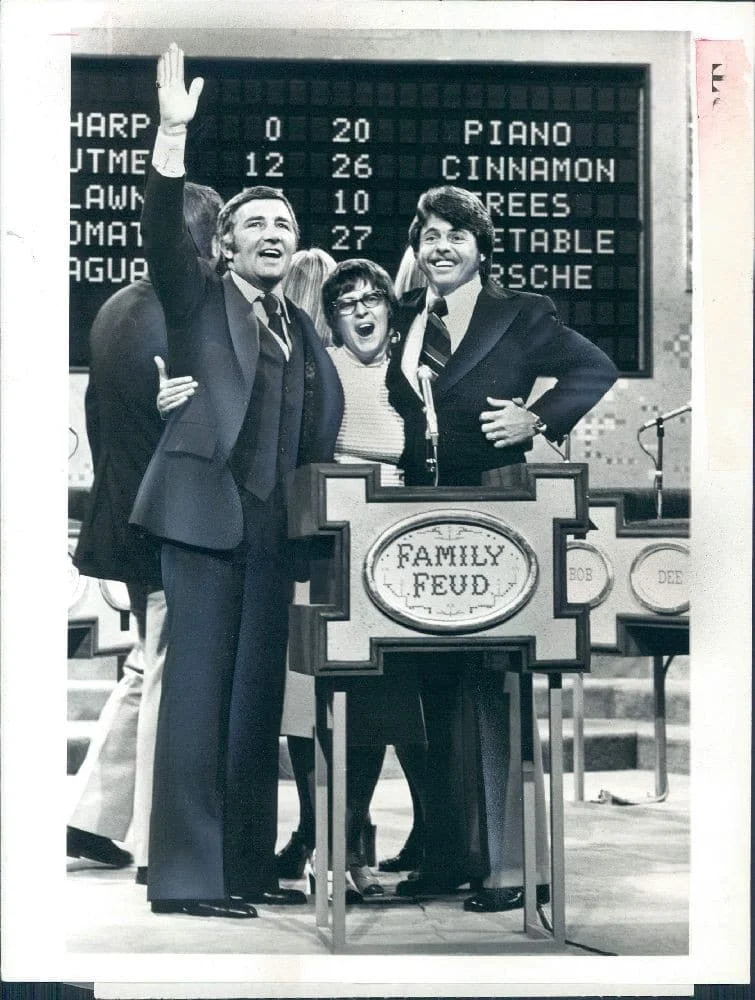
 Happy Golden Birthday to FAMILY FEUD. It was exactly fifty years ago on a humid Monday that ABC’s struggling 1:30 PM time slot infused with what was initially dismissed as a way to take elements from the then top-rated afternoon staple MATCH GAME dressed up in a corny Whitman Sampler package and topped off with an overlay of peapicking DELIVERANCE-esque guitar solos to a new car cue from THE PRICE IS RIGHT. It was far from Mark Goodson’s most original creative endeavor.
And essentially, the game itself was an extension of the MATCH GAME bonus round that was first introduced in its original and dreadfully dull NBC version. 100 people were asked to give a response to a nondescript open-ended question such as name any fruit. In the much more popular celebrity-driven CBS hit of the 70s the reveals were expanded to the top three answers with escalating cash prizes. FEUD basically took the answer reveals a few steps deeper and introduced the concept of competing players attempting to uncover them. Again, hardly a breakthrough concept.
But as the unparalled researcher for the National Archives of Game Show History Adam Nedeff authored for the Strong Museum of Play’s website earlier this month, sometimes all it takes to turn something meh into something iconic is a few new wrinkles. And in this case the process involved a lot more than just aesthetics.
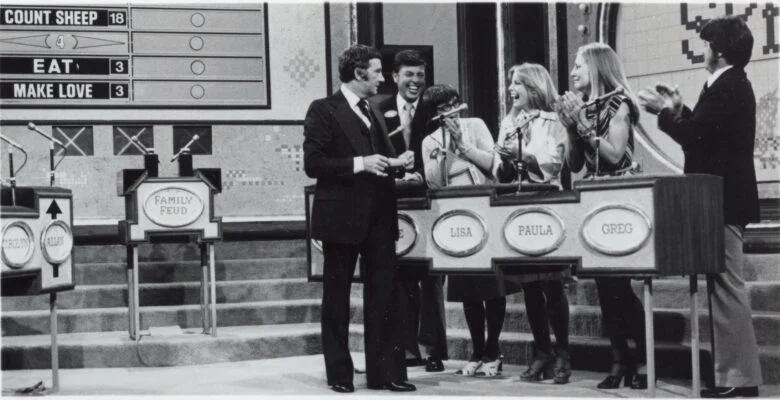 Around the Goodson-Todman offices, staffers began toying with the idea of making Audience Match its own show… As the ideas started coming together,… Goodson was worried that survey answers might prove too unpredictable to support an entire 30-minute game. He turned into a believer when a few sample surveys were collected and he was shown that the rankings of the answers were surprisingly consistent among multiple groups of 100 people. Also, his staff was noticeably having fun trying to match the answers on those surveys.
His staff originally developed a format that they named On a Roll, and then Fast Company, in which two contestants competed against each other. But the staff noticed a problem: contestants asked to match the top six or seven answers in a survey could come up with one or two answers off the top of their head but then run out of ideas. The game could be a little dull as a result. The game needed more players; teammates instead of one-on-one contestants. When the staff tried playing with teammates who were members of the same family, they hit the jackpot. They wanted to win money, but they wanted their family to win money, too. The game became Family Feud.
The other significant wrinkle came from a bit of opportunistic yet out-of-the-box casting. Initially the show was going to be helmed by an experienced emcee. Both Geoff Edwards and Jack Narz, who had been each hosting two game shows during the most prolific year in the genre’s history in the 12 months prior, were initially in the running. But as Nedeff further delved, what to others may have been an albatross turned into what became the opportunity of a generation:
Richard Dawson was a regular panelist on Match Game, so even though he wasn’t really known as a game show host, the notion of Dawson hosting a Match Game spinoff made sense. Besides that, during a Match Game contract renegotiation, he had received a cushy clause that allowed him the chance to host a game show for Goodson-Todman. Dawson had one ace in the hole: Michael Brockman, the head of ABC daytime, had seen Dawson host an unaired, unsold pilot in 1975, titled The Numbers Game. Brockman rejected the show itself, but made a mental note because he liked Dawson’s performance. Brockman liked the show that was becoming Family Feud, and he liked Dawson. The combination worked. Family Feud would be hosted by Richard Dawson.
Dawson brought his James Bond-like charm and his freedom to eye-roll particular odd answers to the show, whose format allowed him enough time and opportunity to let both shine through. He became noted for his penchant for planting kisses on attractive female competitors, often right in front of their husbands, and that brought him and the show further notoriety. Instead of a knee-jerk panic response to moral hypocrisy that far too many invested parties typically cowtow to, ABC and Goodson allowed Dawson to make his plea to the actual audience to ask what they thought. Hey, if they loved to watch the responses to other surveys unfold, why not ask them to be part of one themselves? That survey’s number one answer by far was keep the kisses coming.
FEUD not only improved that tepid time period measurably, it was immediately upgraded to a crucial midday slot where it eventually rose to number one among all daytime shows. Yes, it became more popular than MATCH GAME itself and was regularly besting PRICE. And even when ABC was hell-bent on expanding soap operas and downgraded the show to a lesser slot, the nighttime version dominated key prime access time slots, quickly moving from one to two to five nights a week as the number one show in all first-run syndication. It wasn’t until the WHEEL OF FORTUNE and eventually JEOPARDY juggernauts debuted on its desperate competitors that the merry-go-round stopped.
 The ensuing quarter-century was anything but memorable. The show was proven enough to prompt multiple revivals, the first of which debuted a mere three years after its ABC demise and introduced an almost unknown stand-up comedian named Ray Combs as Dawson’s replacement. Combs had wowed a TONIGHT SHOW audience and Johnny Carson himself with his act, and for Goodson that was endorsement enough. The initial excitement and ratings were encouraging; many of the same key clients of the nighttime Dawson version who had fallen on extremely hard times with such ill-fated attempts at counterprogramming WHEEL and JEOPARDY with some truly G-d-awful syndicated comedies went right back to the well and stripped the Combs version. Sadly, Combs proved to be nowhere near as charming or connective as was Dawson, and such weaknesses were accelerated when his personal life began to unravel and the effects were all too obvious on screen. Combs didn’t even make it to that version’s final season, a whimper that was helmed by a hail-mary attempt to bring back a now much older and bloated version of Dawson–who by this point was married to a former FEUD contestant who actually responded to his kisses and then some.
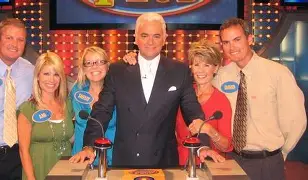 At the turn of the century the overall demand for game shows rose with the outsized success of MILLIONAIRE as well as the continuing dominance of the Merv Griffin duo. FEUD returned once again, but as it had in its latter days of the Combs version introduced new and unwelcome elements into the simple formula of survey says, Hatfield-McCoy ambience and a comedian who contestants actually liked. While production continued through the oughts ratings went from modest to marginal and a cadre of ill-fitting hosts circled through. First Louie Anderson, whose own life story was at times as complicated as Combs’. Then Richard Karn, the almost forgettable HOME IMPROVEMENT neighbor, and finally John O’Hurley, best known for his flamboyant turn as J. Peterman on SEINFELD but who as as himself was about as well-received as undercooked Beef Wellington. Test groups I supervised dismissed his performance as a Shakespearean lead down on his luck.
But in another case of hail mary desperation–not to mention an honest look at the available audience for what was now mostly FOX and CW-affiliated stations competing with local news and talk shows–a few astute observers from the Debmar-Mercury group that had at this point taken over distribution noted that the opportunity was greatest with African-Americans, who made up a disproportionate amount of the over-the-air TV audience. And they noticed that the number one radio personality with stations so targeted was a one-time King of Comedy named Steve Harvey. Like Dawson, he had a history as a sitcom performer (his eponymous WB sitcom was beloved by the niche that was propping up otherwise struggling smaller stations and targeted cable networks with “black blocks” of off-nework shyows. And what he may have lacked in a desire to kiss was more than made up with his dozens-esque disses of unbelievably awful answers that the pressure of a ticking clock often produce.
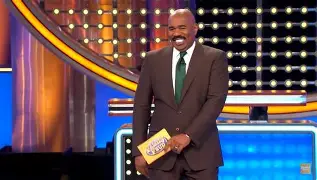 Harvey, as well as some astute tweaking of how syndicated Nielsen ratings could be reported, resulted in a near-doubling of the show’s national rating at the start of the 2010s, and they haven’t looked back since. Yours truly was responsible for accelerating that further when I licensed the first years of his version for Game Show Network after badgering my superiors for two years to do so. It was only after several of their more ambitious and expensive attempts at first-run productions flopped that I was finally able to even enter into negotations with the Debmar-Mercury folk, but once they did grudgingly admit the turnaround I was seeing was legitimate they went as all in as possible. We committed to as many as sixteen incremental runs per day of their national commercials and joined the station community in running earlier seasons on weekends, all of which aggregated into one massive number that at some points actually eclipsed what WHEEL and JEOPARDY were getting on far stronger lineups of stations and time slots (but without a Game Show Network window).
FEUD has become still more ubiquitous since. The CELEBRITY FAMILY FEUD version that had been stillborn in 2008 with THE TODAY SHOW’s Al Roker as yet another turnstile choice became an instant hit for ABC with Harvey and has allowed them to launch its Summer Games franchise that successfully returned many other classic formats, including many of Fremantle’s that they inherited from its acquisition of the Mark Goodson assets. And last year in what may be the ultimate tribute to the secondary significance of the stakes being played for Debmar-Mercury launched a series of funniest moment clips called FAMILY FEUD FAVORITES where its FAST MONEY round is never seen and intermixes material from the now 16 years of Harvey’s version.  And yeah, Game Show Network still plays the FEUD practically all night and even more often on weekends, and their aggregated national rating is still more than competitive.
So as its second half-century kicks off it’s hard to imagine any world where some version of FEUD isn’t around somewhere when it’s time for its third to commence. Harvey has already dropped hints he may be getting ready to move on from producing new episodes (he’s pushing 70) but the timeless nature and the virality of the material–even in short-form–has already demonstrated the need for something as structured as an actual episode isn’t necessarily required. And who knows? Maybe those who run Fremantle may actually pay attention to the touchstones and track record necessary to connect with an available audience and discover some TikToker or content creator who has cross-generational appeal. We KNOW there will be people lined up to play whether it’s in a studio or virtually. Because as long as there are families there will always be FEUDs.
Until next time…