
Last week a disproportionate amount of people I know were retweeting (yeah, a couple were even retruthing), posting links to and sh-tposting about something in THE NEW YORK TIMES–and blissfully it had zip to do with politics.
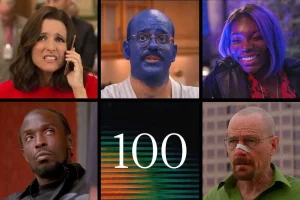
Over a five-day span the publications released a slow drip of clickbait via their 100 BEST TV SHOWS OF THE 21st CENTURY, 20 per day, each its own invitation to debate which those aforementioned social media warriors took to like a fly to you-know-what. The end result is here, and in the words of Linda Richman, “discuss”.
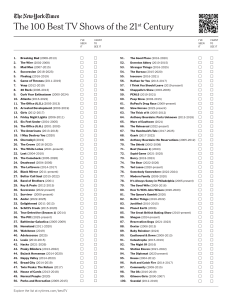
The TIMES’ editorial board set up a series of very specific ground rules in the hopes of creating a framework that they hoped would buy them gravitas and rachmunis:
To identify the best work of that period (as we did with books and movies), we polled hundreds of stars, showrunners, craftspeople, executives and other industry experts and asked them to vote for the 10 best series that have premiered since Jan. 1, 2000. (So don’t expect to see “The Sopranos,” which debuted in 1999.)
Among the more than 500 people who responded were stars like Elisabeth Moss, Adam Scott, Bryan Cranston, Rose Byrne, Colman Domingo and Jason Bateman, and showrunners like Damon Lindelof, Lena Dunham, Lena Waithe and Noah Hawley.
As a researcher, I appreciate their transparency in providing what is usually reduced to a boilerplate and microscopic font size or merely a hyperlink. For good measure, one of the machers who supervised this project provided further context to the HOLLYWOOD REPORTER’s Alex Weprin:
The New York Times’ exhaustive list of the best TV shows of the 21st century traces its origin to a similar list of the best books a couple years ago. The idea, Times canon editor Gilbert Cruz tells The Hollywood Reporter, was to reach out to the world’s best authors (many of them he notes, already write for the Times or the Times Book Review in one capacity or another), and have them select their favorites.
“Part of the thing that we’re promising readers is we’re doing this because these are people in these industries — the book industry, the movie industry, TV industry — who know about this stuff, create this stuff, but also care about this stuff,” says Cruz. “When you hear creators, showrunners, stars talking about the things that they love to see, yes, they are famous people, but also they’re just TV fans like the rest of us, right?”
Well, not quite, Gilbert. With that aside you’ve lost whatever goodwill you might have been seeking to justify this as a living, breathing research project. To your credit, you have amplified something that I’ve gotten on my own soapbox for literally hundreds of times over the years–your sample matters more than anything else.
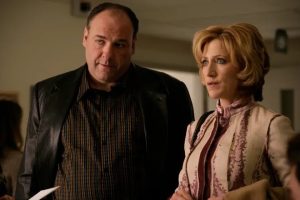
Cruz continued to bury himself as he dug deeper into his defense. He clung to a hard-and-fast qualifier that a show had to have premiered no earlier than January 1, 2000 in order to be considered at all because, as he dismissively addressed colleague Natalie Kitroeff while hyping this on yesterday’s DAILY ON SUNDAY podcast, “we have to have rules”. This immediately disqualified shows that happened to premiere in, say, 1999, which most notably includes THE SOPRANOS. I’d vehemently contend this is a technicality that opened up at least one slot for something far less impactful on 21st century television than this–not only executionally but just as importantly in public demand. Not only did the show capture at times as much as a 20 coverage area rating which even in a universe that only covered roughly one-third of the country was significant enough to impact full-reach broadcasters, but it also created a groundswell of demand among the two-thirds of the country not yet subscribing to HBO to find some creative way to get on board. It was the first measurable example of churn–we’d regularly see HBO’s universe rise during the months where original episodes premiered and then decline during hiatuses. In an era where such maneuvers required lengthy phone calls with MVPD’s marginally competent customer service departments and not a few clicks just after a binge that was both an atypical and herculean accomplishment when it comes to an otherwise lazy public. It also drove DVD sales of completed seasons that were typically released just before a new season launched–one of the first measurable examples of the “echo effect” that I’ve spent a lot of time analyzing in the streaming era.
And Cruz’ equally elitist partner on this project, “chief TV critic” James Poniewozik, indirectly made my case when he passionately added his own feelings about this:
A list honoring continuing series must make a choice that discrete works like movies and books don’t require: Where do you draw the line? Apologies to “The Simpsons,” “S.N.L.,” “Sesame Street” and “60 Minutes,” but our line is that 21st-century TV is TV you couldn’t watch in the 20th century. That’s the technical answer. The aesthetic one is that “The Sopranos” is all over this list. These 100 series, ranked by polling hundreds of TV makers and TV lovers, cover a quarter century of creativity that became possible partly because “The Sopranos” helped redefine what TV could look like. It was a period when great and daring TV became not an exception but an expectation, when the medium was reshaped by changes in how TV was made, who made it — and even how we watched it.
I first crossed paths with Poniewozik when he was on the beat for TIME magazine during my FX tenure where he openly credited us with reinventing basic cable; we were all urged to drop everyone and anyone else we might be asked to engage with at press tours and launch parties because a favorable quote from him carried a disproportionate amount of weight with cable operators and advertisers. He would perpetually remind us exactly how exhaustive his knowledge base was and yeah, he does know his stuff, as the exceptionally detailed diatribe that followed his caveat demonstrates. But he brings those spirited defenses to the table from a unique personal perspective of more than a quarter-century as a tastemaker living in New York making six figures and dining in world-class restaurants with his husband. Right then and there are asterisks that would disqualify him for a projectable research study.

Those adjectives and others that are anything but representative of regressing to the mean are applicable to a significant portion of the 516 fine folk who contributed their votes and their own video takes, some of which were indeed entertaining. They may indeed be “just like us” in some ways if you reduce that qualifier to whether they own a connected screen and put their pants on one leg at a time. But the SES characteristics of those 516 voters don’t index anywhere near close to 100 vs. U.S. population. There’s undoubtedly inherent geographic bias as well–even when factoring in vacation homes and personal lifestyle choices that have become more a necessary statement than ever since COVID and the current administration became factors.
There also are the personal histories of the respondents to consider. Did someone include a show because someone they once attended improv classes with was involved? Was a show that they auditioned for but were not cast in omitted because of lingering bitterness? Were votes cast for shows attached to companies that currently or at one time generously employ them? Please don’t attempt to lecture me that’s not a possibility. This is a sample that far more closely resembles the voting base of the Emmys than Nielsen. Every year I cast an Emmys vote I was STRONGLY encouraged to vote along partisan lines in ways that would make “vote blue no matter who” seem more wishful than a demand, And we also know from last week’s record-low Emmy audience how non-representative they have become.
To be fair, if confronted I’m certain neither Cruz nor Poniewozik would contest that my feelings are unfounded. They’ve indeed left the door open by openlu inviting readers to submit their own Top 10s–though that door closes at 11:59 pm ET tonight. Personally, I’m not sure I could responsibly submit a distilled list of my own fairly on such short notice. I’ve watched a ton of TV but not necessarily the ones that the TIMES has identified. And I’m also not sure I could defend my choices as passionately, parochially and arrogantly as those that already have or will be doing so in this call to action could. I’m far too much a slave to numbers and a pragmatist to fall on my sword for anything like the opinion of someone clearly not representative of any targeted demographic cell. And I love this business too much to want to accelerate its demise by falling into the same trap that far too many of those represented in this survey already have. Take another look at this list. Choosing to renew some of the shows on it at the expense of others hasn’t exactly helped the future potential to substantially add more to it going forward.
There are indeed no right or wrong answers. But there are valid and invalid ones. I leave those intrepretations to you.
Until next time…