
 I needed some warmth last night and I was fresh out of chicken broth. So I binged a few episodes of what was getting an awful lot of positive critical reviews, the just-dropped MID-CENTURY MODERN on Hulu. It’s gotten quite a bit of attention from folks like me that lament the near-passing of the traditional three-camera studio audience sitcom and applaud the very fact that there’s at least some platform willing to give one a shot these days. And as someone who’s binge-watched an awful lot of marathons of GOLDEN GIRLS and WILL AND GRACE over the decades these shows have run nearly ubiquitously on multiple cable networks, I certainly recognized an awful lot of the personnel attached and the beats the show draws from to get its laughs.
A good deal of the positive spin this show has gotten has come from those who readily acknowledge the influence of GIRLS on this show, beginning with the fact that both are set around three (upper?) middle-aged friends who share a house in a warm-weather location along with the overbearing elderly mother of the homeowner. MID-CENTURY MODERN replaces Miami Beach with Palm Springs, all the more apropos considering the actual GOLDEN GIRLS house is actually located in California In this case, it’s a pair of Nathans that effectively split the Dorothy Zvornak character–the multi-talented and award-winning veteran Lane as the protagonist and the lesser known Lee Graham as the slinger of snarky jokes. Matt Bomer, the impossibly hunky veteran of numerous Ryan Murphy dramas, is finally allowed to channel his comedic side as a sort of hybrid of Blanche’s promiscuousness and Rose’s naivete. And, at least for the first eight of 10 episodes, Linda Lavin fills the Sophia void as the family matriarch that is both loving and obnoxious at one, in this case with an awful lot of Jewish guilt replacing the Italian version, (not that they’re not interchangeable to begin with).
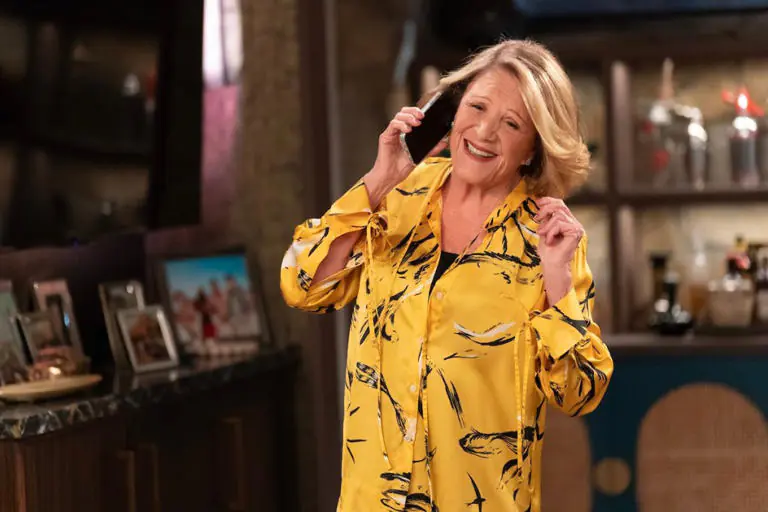 As we sadly know, the plot line that’s offered up as a running gag in the first few episodes where Lane’s oppressed and often confidence-lacking Bunny Schneiderman alternates between adoring his mom and praying for her demise was tragically altered by Lavin’s death last December in the middle of filming. VARIETY’ Daniel D’Addario endearingly put it in perspective over the weekend:
Sybil Schneiderman, the breakout character on Hulu’s new sitcom “Mid-Century Modern,” is discussed, amply, before she is seen. “The woman could probably make it another 20 years just on cottage cheese and spite,” her son Bunny (Nathan Lane) declares. But when she finally appears, it’s an event. Bunny has moved his two best friends into the Palm Springs home he shares with Sybil, and, she declares, it’s good that he won’t be alone when she’s gone. “Which won’t be for a long while!,” she declares, her voice suddenly crescendoing into a scream.
That was not to be. Linda Lavin, the TV legend who plays Sybil, died in December, during the filming of the season, and Sybil is written off the show in the ninth episode. In her time on “Mid-Century Modern,” she provided the best argument for viewers to keep watching, imbuing the particular, vintage form of the series – a multicamera sitcom – with joie de vivre and sharp wit. And her farewell, on a show that tends to play things fairly light, proved to be surprisingly moving.
And that’s unfortunately how I feel about the show’s prospects going forward. Lavin was indeed the top reason to keep watching, as while her character was familiar it was at least not redundant. It’s not that I’m not a fan of Lane’s–indeed, his turns as Max Bialystock in THE PRODUCERS and F. Lee Bailey in Murphy’s AMERICAN CRIME STORY brilliantly demonstrate his remarkable range. And whenever I rewatch THE BIRDCAGE, if for no other reason to see how many hot South Floridians my friends of today knew who were featured extras, I break out into hysterics whenever the scene where Lane struggles to butter a slice of toast without coming off effeminite so as to preserve the secret of his and dad Robin Williams’ gay relationship from his son’s future in-laws.
 But that’s the point. We’ve seen Lane in the role of over-the-top queen with a heart before, nearly 30 years ago. We’ve heard a lot of the same spit-takable gay humor jokes referencing everything from a club called Fisty’s to a motel called the Shovette Inn from the lips of Sean Hayes and Megan Mullally in WILL AND GRACE–no surprise considering MID-CENTURY MODERN is the newest work from the former shows’ creators. And as they tried to explain to ROUGH DRAFT ATLANTA’s Jim Farmer, it’s a natural evolution for them:
Even when they were younger, Max Mutchnick and David Kohan… have always focused on characters of a certain age. Now that they are of that age, they have considerably more insight into their new creation. “It’s so fun to write guys (like this),” Mutchnick said. “You don’t usually get to.”
But they DID, and prolifically, for a total of 11 seasons that began in 1998 and most recently in what evolved from a one-off viral video that hoped to muster support for Hillary Clinton in a three-season resurrection that proved to a be a finger in the eye of the first Trump administration. It’s somewhat apropos, and perhaps sobering, that MID-CENTURY MODERN is streaming as the second takes root.
 That fact of life–that a sizable portion of today’s America would not even sample a show with this overt a gay overtone–made the road to renewal a steep grade even before Lavin’s passing. What she provided was what made GOLDEN GIRLS and WILL AND GRACE popular beyond the Logo audience–the older and female counterbalance to the bed-hopping and inevitable screw-ups of the balance of the casts. Lavin’s Sybil (fittingly with such a name, and don’t think the pop culture-savvy Mutchnick and Kohan didn’t already know that) effectively mashed up Grace Adler and Sophia Petrillo into a scene-stealing presence, a belief Graham espoused with the elegance of his ex-Vogue editor character to Farmer:
“She was so full of life and zest and so great,” Graham said. “When I think of her I think of joy and gratitude and of support. How lucky can you get to work with someone that incredible? As an actor it is one of the best things in the world. She was a true gift to all of us.”
 And without her, left to their own devices, my fear is that the show loses its ability to resonate beyond the statistically small sector of viewers that will guffaw at every double-entendre that invokes some reference to oral or anal sex or the endless pursuit of it. A scene where the three men interview a prospective housekeeper who turns out to be yet another bohunk gay Greek god (apparently Palm Springs is full of them; who knew?) is particularly overreliant on man-drooling; it’s not until Lavin adds the perspective that he’s pretty lousy at his job that the episode becomes watchable. Even with the presence of experts and adults like Jim Burrows still in the room the prospect of watching these guys on their own is not, in the eloquent words of Lee Graham’s Arthur, “creating a twinge down there”.
I fear on a service owned by Disney, at a time when the company is being investigated by the FCC, it would take an outsized performance at the level of what GOLDEN GIRLS did for NBC’s Saturday nights forty years ago for enough people to stand up to scrutiny. We’re not likely to hear a peep out of Hulu on any results; for the most part, they are loathe to report any real viewership levels.
So enjoy this throwback as I did–in the moment, as a diversion. But also a reminder that they don’t make ’em like they used to.
Until next time…
.