
Like apparently most of you, I’ve been doing a little refreshing of my knowledge of THE ODYSSEY, which later today will in all likelihood begin dominating cultural zeitgeist as well as the box office for at least the rest of this month. So trust me, musings on that are forthcoming.
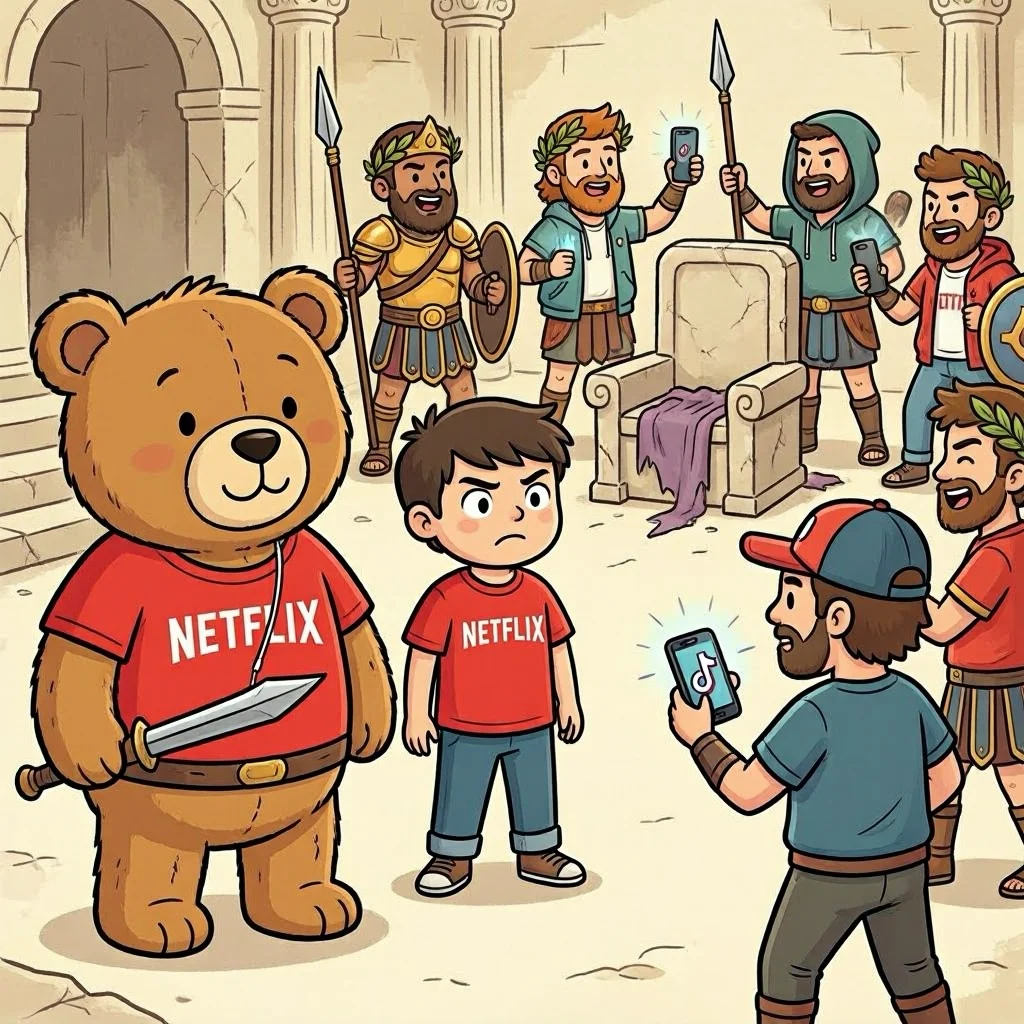
 But our good friend Teddy of Netflix is already engaged in his battle to reclaim what at least in the eyes of the investment community is his own lost throne, and yesterday was anything but a good day in his particular odyssey. REUTERS’ Lisa Richwine laid out the net results succinctly:
Netflix offered third-quarter revenue and earnings projections on Thursday that hovered below Wall Street targets…Shares of Netflix fell nearly 8% in after-hours trading to $68.45. The company said it expected $12.86 billion in revenue from July through September and diluted earnings per share of 82 cents. Analysts had forecast $13 billion in revenue and diluted EPS of 84 cents, according to LSEG.
Third-quarter projections “appear to reflect a combination of management caution and a naturally maturing growth profile, rather than any sudden deterioration in the business,” PP Foresight analyst Paolo Pescatore said. He added that they would “reinforce the view that Netflix remains strong but is entering a steadier phase of growth with considerably less room for error given the always-high expectations.”
The fact that the decline of the proportionate value in shares was four times that of the actual diluted EPS and eight times that of its forecast revenue should give you some indication of the degree of pressure our ursine combatant is under. Pescatore was at least a bit measured in his criticism. THE HOT BUTTON’s David Poland scratched the crumbs out of his beard to deliver an emergency and atypically late day reaction to his vast Substack minions to weigh in with a ton more grievances, some of which were even offered up in front of his paywall:
 Netflix under $70 a share. Market Cap under $300 billion. Wow. One year ago, the stock was at $125 a share. WTF happened? Disney, for the record was at $119 a year ago and is at $99 today. So a 17% drop. Presumably, a chunk of what is happening to Netflix is just the market for this segment of the market. But Netflix is off 46%….Wall Street didn’t like the idea of the Warner Bros (sans Discovery) merger for Netflix. So why has the stock dropped almost twice as much since they gave up the merger?
Theories include:
- By showing the desire for a merger, Netflix showed investors that they desired additional revenue streams, suggesting that the ones they have will not multiply… as investors had convinced themselves.
- Time and the natural evolution of the company caused people who had convinced themselves that Netflix was a tech stock were dashed and market folks woke up and realized Netflix is an entertainment stock.
- The advertising business is going poorly, not just slowly.
- It’s a content issue… Netflix just doesn’t have enough “hits” anymore.
- It’s a competition issue… everyone else is, somehow, catching up with Netflix
All are true, of course, and we’ve not ignored those issues through the many musings we’ve featured all things Sarandos in. THE WRAP’s Roger Cheng weighed in with his recap of what he observed was the pushback Sarandos and his own personal Telemachus Greg received:
 Netflix executives tackled the engagement question early in the conference call, but it wasn’t a satisfying response. Co-CEO Greg Peters stressed the quality aspect of engagement. Fellow CEO Ted Sarandos dismissed reports (including our own calculation) that its shows were seeing a big drop-off in their second seasons, noting that in aggregate, overall Season 2 fallout is “slightly improved” from the prior year. Overall, views rose 2% year over year, slightly faster than 2025’s 1.5% growth, Sarandos said. But for Wall Street, that growth just isn’t fast enough.
We have at least we had the benefit of what he used to represent as transparency to draw our own conclusions from. Concurrent with this earnings report was its now highly anticipated release of six months of viewing data, which as usual the likes of Cheng’s star employee Loree Seitz parsed through with the tenacity of an FBI agent to trumpet some of what she saw:
Limited mystery series “His & Hers,” which debuted on Jan. 8, was the most-watched TV show from January to June 2026 with 104 million views, outpacing “Bridgerton” Season 4, which tallied 100.2 million views within the same time frame. Notably, “His & Hers” and “Bridgerton” Season 4 were the only TV titles to reach over 100 million views during the six-month period. “War Machine” was the most-watched film for the first half of the year with 146.9 million views. While only two TV series surpassed 100 million views, six movies surpassed the milestone, including “The Rip” with 136.1 million views, “Swapped” with 130.8 million views, “KPop Demon Hunters” with 130.4 million views, “Apex” with 129 million views and “Thrash” with 100 million views.
 Netflix said it would cut its biannual release of a viewing-hours report to once a year starting in January 2027 “to keep the focus on our primary financial metrics — revenue and operating profit.” It stopped publishing quarterly subscriber numbers in 2025.
 - Live video is a big deal: While not a huge source of views, six of the top 10 new member sign-up days over the past five years have come from live events.
- The breakdown: Live video accounted for just 1% of view hours, but 5% of the content budget. Animated and kids content also make up 5% of the budget, but capture 8% of views. Peters’ point was that each deliver different value to the company, even if the budget is equal.
- Netflix FAST?: Peters also kept the door open to a free tier, known as a FAST service like Tubi or Roku Channel, but said there was no near-term plan to launch one.
- Video podcast: Netflix placed a big bet on video podcasts, but was relatively mum beyond some general praise for the medium. They also weren’t part of the data dump report.
- Bullish on AI: Sarandos gave his most full-throated support of AI, noting gen AI tools had been used on 300 Netflix projects. He said he sees it cutting costs and creating shots that never would’ve existed in the first place.
It sure seems like they’ve been breaking out the whiteboard and essentially dismissing what actually put them on the map in the first place. A diverse array of shows both elite and populist (occasionally both) from proven creators that you couldn’t watch anywhere else. Nowhere in the remarks was any acknowledgement of the fact that not everything these days should be a binge, which might give subscribers a reason to stick around a bit longer than the algorithmically tuned up on-screen suggestion of something else you might like after one of those seminal live events. Ask anyone at Peacock, or more recently Paramount Plus, how that’s worked out over time.
What we instead got was this sort of eye-rollable spin that THE HOLLYWOOD RE (Rick) PORTER shared from ol’ Teddy himself:
The season two problem narrative was sparked by a recent Bloomberg story detailing steep viewing declines for several shows in their second seasons, among them Beef, The Four Seasons and One Piece. Sarandos didn’t dispute those findings — which came from Netflix’s own publicly released weekly top 10 lists — but said that “in aggregate, we’re not seeing any material change in our second season viewing compared to season ones. Our second seasons are performing well within our bands of expectation.”
Sarandos also said that viewing declines for the second season of a show are “very common” across the industry and offered this rationale for why it happens at Netflix: “It’s even more so with us, because we launch our shows so big,” he said. “Our global reach, our discovery mechanism, releasing all at once — this enables us to find a very large audience early. Our shows tend to start really big, where most other places, their shows start pretty small and occasionally grow from there.”
But chee, Teddy, what you seem to be owning up to is more of your subscribers expected more from your hype than they ultimately got and you couldn’t figure out how to prevent them from walking out on you. And imagine how much less spinable that story might be if one were to break out full binge series from more stratified releases–or compared the retention rates of more mediocre performers closer in tonnage to those “pretty small” competitors’ hits and leveled the playing field? I have more than an educated guess that your track record is nowhere near as rosy a picture as you’re offering up, and that denying those of us capable of parsing it for what you might deem inconvenient truths is, frankly, more than a bit cowardly.
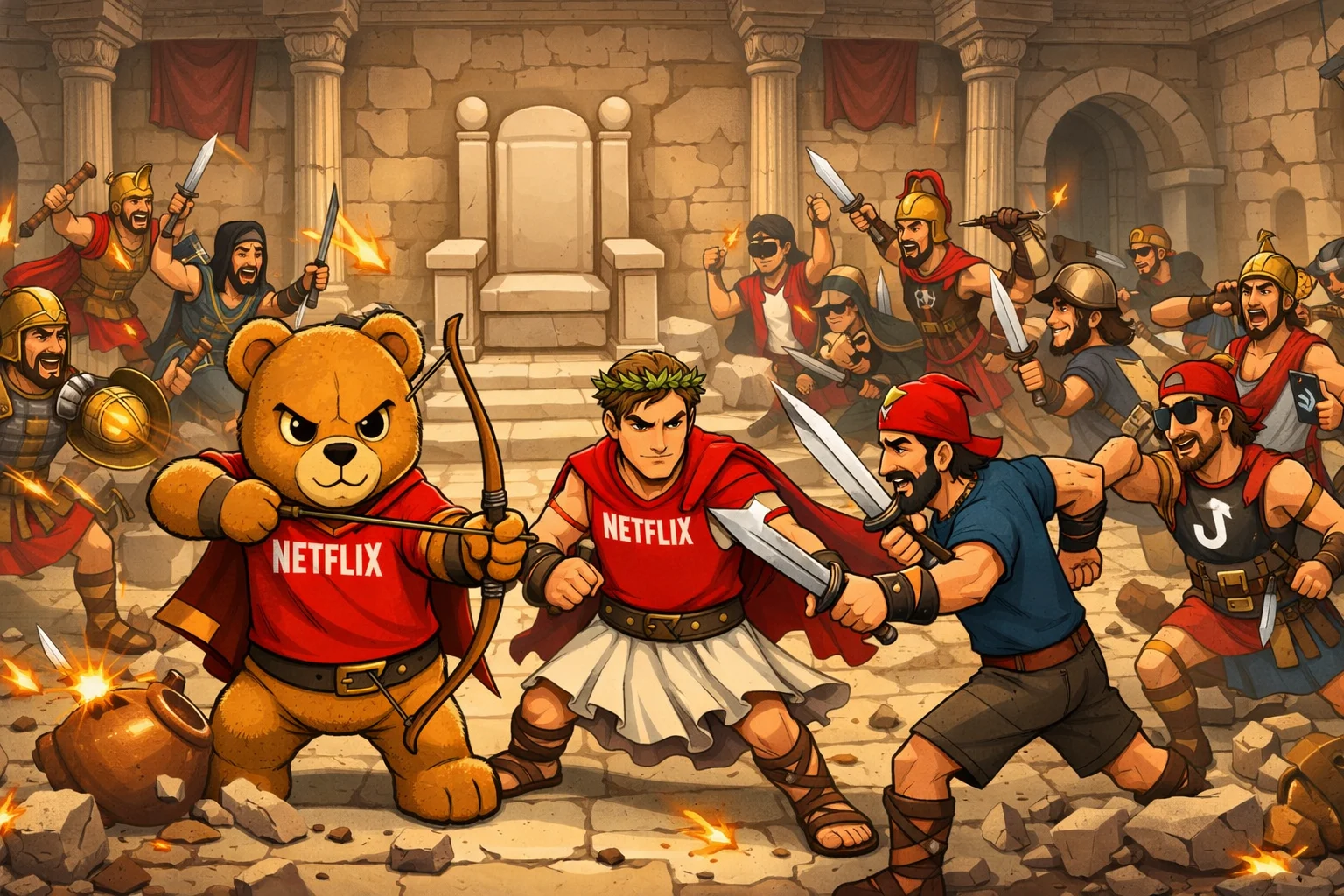 Consider the battle lines drawn, Teddy, and prepare to do battle. Go ahead and try to reclaim your throne. Odysseus did.
Until next time…