
It’s difficult enough for the folks that still have jobs in American media to figure out a path to success that motivates consumers to engage and placates their employers and, most of all, their board members. Now throw into the mix the draconian and seemingly haphazard actions of the leader of the free world that has somehow equated the proving ground of one’s manhood into blind acceptance that these silly little things called tariffs that he and a fellow convicted felon Peter Navarro have dreamed up are mere speed bumps on the way to restored greatness.
 There’s probably not enough Maalox readily available to deal with the level of upset stomach this reality is causing. And now that healthier holistic alternatives like the ones I used to import from China have a 104 per cent surcharge attached to them, one’s that much more stuck with that mediocre solution than ever.
Those who took just Economics 101, like me, may immediately pivot to the simplistic view that tariffs are imposed on consumable products, not intellectual property. But there are apparently an awful lot of folks who cover media that apparently took Economics 102 and above, and lately they’ve been pointing out the myriad ways they can–and already may be.
THE ANKLER’s resident tennis-loving A student Elaine Low dropped a sobering piece on Monday that tallied up the initial impact of Trumpanomics on the major entertainment players and provided a most discouraging framing:
(T)he impact on the broader economy and the average consumer will affect
the TV business in multiple ways. If companies getting taxed on imported
goods decide to pass the bulk of those expenses onto consumers (which is
likely), that will increase the cost of living — the cost of nearly everything. But
ticket purchases that could get in under the wire of the tariffs taking effect
could eat up budgets for more discretionary spending. 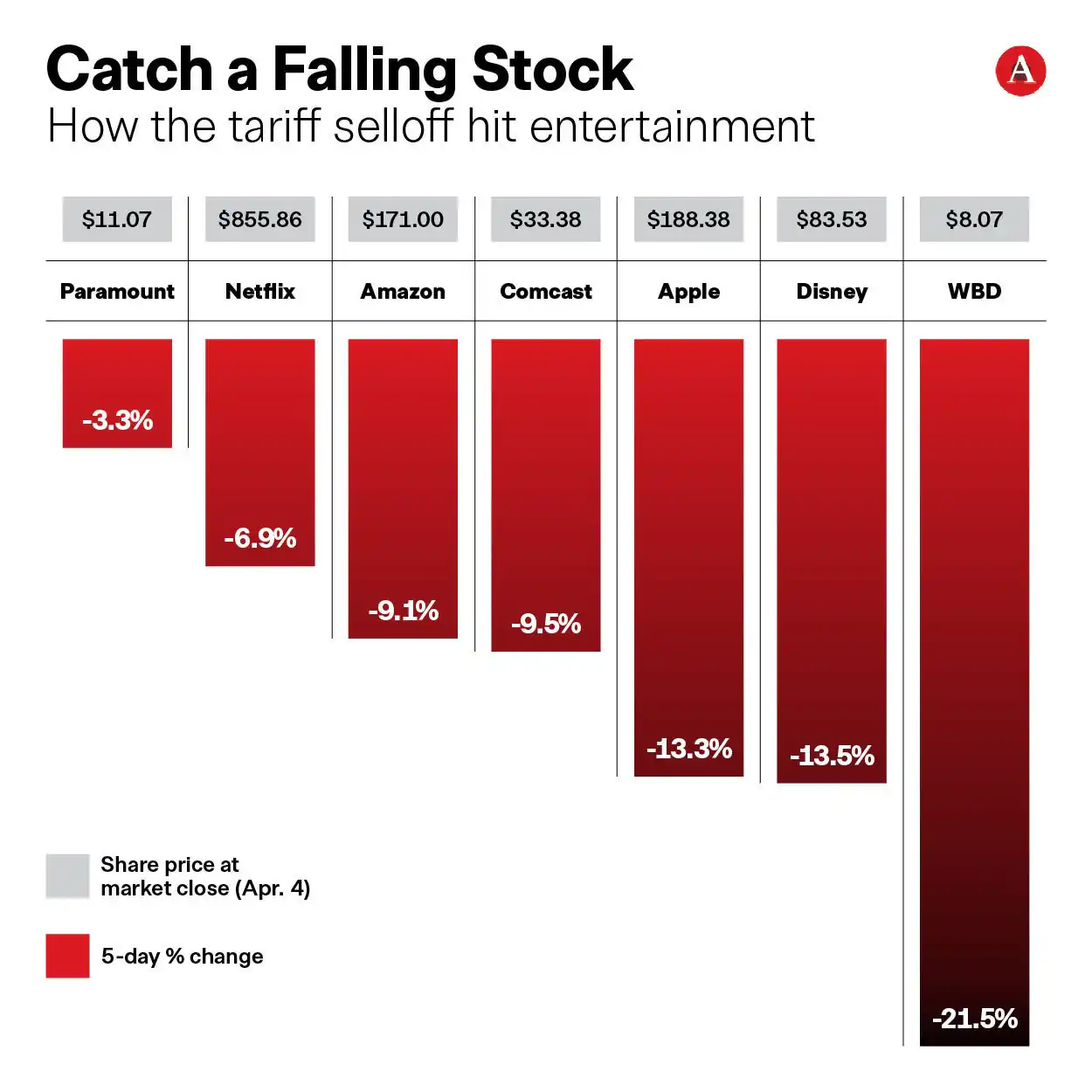
Although the stated goal of Trump’s policy is to encourage domestic
manufacturing, Hollywood’s existing U.S. production does not appear as if it will
benefit. In fact, the physical act of making television could get yet more
expensive in the United States.
Low interviewed several production executives past and present to support her dark vision, including one who points out that in order to get the kind of quality that tends to resonate with viewers, one has to invest in more than merely just human talent:
(C)ertainly a big percentage of the budget goes to consumable items. We
sometimes refer to them as ‘appetite accounts,’ in the sense of . . . How much
money do you want to spend on props? How much money do you want to
spend on set construction? Set construction is all labor and raw materials.”
If the cost of goods and materials all rise — off-the-rack clothing, fabric for
costumes, steel, lumber, you name it — the studio isn’t going to pony up and
expand the budget. “I don’t think Netflix, Amazon or NBC are going to say, ‘Okay, well, because
the fact that there are tariffs, and costs of goods have gone up, we’re going
give you an increase in your budget(.)
THE HOLLYWOOD REPORTER’s Alex Weprin had offered up a more comprehensive list of areas of concerns before the weekend with this Debbie Downer of an overview:
“Tariffs are the cliffhanger Hollywood feared, forcing both studios and consumers to tighten their belts,” says Scott Purdy, U.S. media industry leader at KPMG U.S. “Ad spend will take a hit while media companies downshift on content spend, potentially stifling industry growth. Streamflation might resurface as entertainment budgets shrink — fewer subscriptions, movie nights, amusement park visits and live events. The industry is buffering, waiting for the loading screen to clear.”
Indeed, while the entertainment business doesn’t run on imported goods in the same way a company like Nike or Toyota does, the tariff implications, recession fears and overall market turmoil will result in second and third order effects that will be felt far and wide.
And in a sign that clearly he’s been reading both the trades and the tea leaves on the heels of what we mused was one of the few bright spots of 2025 to date our ol’ friend Yosemite Zas yesterday fired this dart into the air, which the ever-diligent Rick Ellis of TOO MUCH TV pointed out in last night’s newsletter:
 Status is reporting that in a note to some employees, Warner Bros. Discovery said on Tuesday “the market volatility and reduced consumer confidence are causing increased economic uncertainty” and that “in response” it is enacting a plan “to minimize discretionary spending.” One immediate result: “Effective immediately, all travel that is not business-critical should be cancelled. This includes travel for team meetings, off-sites, events, conferences, and office visits.”
Like the budget-cutting that helped lead to the shutdown of the planned Television Critics Association tour, travel and other non-core expenditures are going to be cut to the bone as the world works its way through the consequences of these tariffs. Of course, the irony is that WBD CEO David Zaslav – like many media executives – was almost giddy contemplating the wonderful business-friendly environment that a second Trump Administration would bring.
In this case, maybe Yosemite was proactive, considering the tone of the piece that VARIETY’s Naman Ramachandran dropped yesterday:
China is reportedly considering a slate of retaliatory measures against the U.S. that could potentially devastate Hollywood’s access to the world’s second-largest box office, according to posts by two influential Chinese social media figures, per Bloomberg.
The potential measures, which include a possible reduction or outright ban on American film imports, were shared Tuesday on Chinese social media by Liu Hong, a senior editor at state-run Xinhuanet, and separately by “Chairman Rabbit,” the online persona of Harvard-educated Ren Yi, grandson of former Guangdong party chief Ren Zhongyi.
Liu, who serves as deputy editor-in-chief of the official Xinhua News Agency’s website, posted the information just hours after China vowed to “fight to the end” in response to President Donald Trump’s latest tariff threats.
But it was perhaps this more exclusive Ellis nugget that resonated strongest, if for no other reason that it referenced a process that I personally oversaw in less disruptive times:
I don’t think it’s hyperbole to say that America is not the most popular country in the world right now. And that anti-American sentiment is likely to grow if the ongoing tariffs spark a global recession. This is a problem for U.S.-based entertainment companies who are accustomed to having brands beloved across the world in large part because they are headquartered here. So how do they respond if that changes?
According to several sources I’ve heard from, both Disney and Netflix have created working groups that are trying to game out how to respond to a more negative reaction to American entertainment titles. Obviously, Disney’s worldwide footprint in multiple entertainment verticals is extremely exposed to negative reactions, but Netflix and other global streamers will have their own significant issues. And I would be shocked if other American media companies have not created internal task forces of their own.
 I oversaw a corporate-mandated project that FOX chairman Peter Chernin ordered when the company was expanding its media portfolio almost exclusively with the inclusion of that three-letter word as a first part of every entity’s name. FOX Kids. FOX Family. FOX Sports. FOX Mobile. And, of course, FOX News. And not just the network–the local stations’ identities were being retrofitted with similar branding and associations, histories and politics be damned. It was one of the few times I got to deal directly with Roger Ailes and his allies. And he was about as enthused to hear any feedback that his vision was not well received as anyone associated with Fat Orange Jesus was when they did their mercentary tour of mainstream news channels last weekend.
I’ve previously mused about the sordid details before so I’ll spare you the specifics, but the key takeaway most relevant to now was that the average consumer responds most to what personally impacts them, not to some indirect association with corporate philosophies. When your country’s usually more balanced leadership is calling out America’s callous stupidity and their own investment portfolios are suffering in concert with ours, the intangible impact of anything associated with America being tainted is far more likely to occur.
It’s upsetting enough to consider a world where your most lucrative international buyers may now no longer exist. It’s even more so when one considers the strong possibility that even where there are buyers that what we’re selling is now considered persona non grata.
When my team delivered the results of our FOX brand study it prompted a number of uncomfortable meetings between Team Chernin and Team Ailes. It was quite clear that Team Ailes had the ear of the Murdochs and they were determined to emphasize FOX–all caps, of course–no matter what the halo effect good or bad was. My primary employer FX was spared the ignominy of that particular word–though its new logo was clearly in the same font as the mothership–and chose to build a brand equity of its own. Over time it was able to stand on its own, and now, even as a Disney-owned entity, it’s comfortable in its own skin. But that evolution wasn’t overnight.
The question is–do those in charge now have the stomach and the fortitude, let alone the patience of their overlords, to chart a similar course? And if they do, wouldn’t that prove their manhood as much, if not more, than any feckless belief that tariffs are a good thing?
I mean, Maalox only can help so much.
Until next time…