
I’ve been accused by a few more impatient yet loyal readers of being overly wordy so in a rare moment of TL;DR acknowledgment I’ll put this question up front that I honestly am at a total loss to try to answer:
If it’s your show to run, do you prefer progress over process?
For those of you who actually don’t mind a little context, let me briefly explain that I’m having yet another existential crisis as a result of yet another rejection for an open position that at least on paper sounded like a true match for my core skill sets. It was a leadership role with a major company ostensibly seeking a seasoned pro to help guide eager emerging talents on their journeys toward their own career growth. And most importantly to moi, the salary range was several multiples of my current earnings, albeit a fraction of what I once was paid for my skills.
But what I came to painfully learn in two Zoom-terviews (yet another lament of this communication purist) is that the decision-maker’s highest priority was having someone who could educate subordinates on how to manipulate software to produce output that was aesthetically pleasing and debatably slightly more accurate than available alternatives, defaulting to traditional resources and methodologies in a practically synchopantic manner. It was clearly much more critical that the internal processing of storytelling was much more important to this person, and apparently the superiors that empowered him, than the actual story being created to produce the desired results. And as I later learned, this is hardly a unique case.
In the course of our discussions, my interviewer droned on about how competitors were “completely messed up” with their reliance on what they saw as dysfunctional corporate resources to fuel their creative engines, and laid praise on those who had the huevos to demand that they devote departmental resources to those who could act as de facto IT personnel embedded in their own budgets–ostensibly to give staffers the ability to produce more output quicker and, in theory, more cost-effectively. I did find it interesting that the examples he cited as success stories were with companies whose actual track records of late were marginal and whose works were never celebrated or elevated beyond their own walled gardens, save for an occasional chance to distill a homogenized version to humble-brag about at the few remaining conferences where folks still convene to network and commisserate.
And to them I put forth the same question that a cherished boss of mine once put out to his entire team when we all were actually trying to collectively figure out how to make a dent in an otherwise overcrowded industry–Are you building a clock or merely telling time?
The author Jim Collins shared that vision in a seminal business tome that recaps that premise thusly:
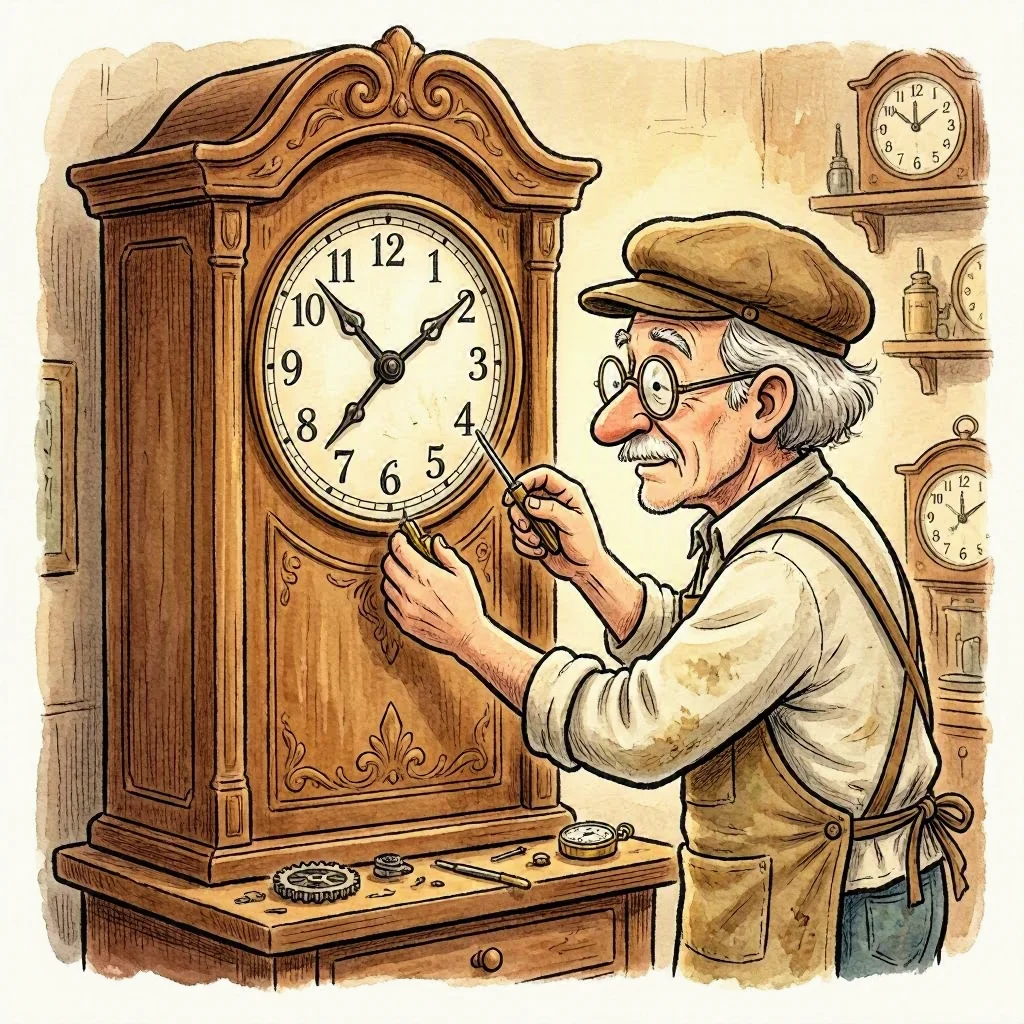 Clock Building is a concept developed in the book Built to Last. Leading as a charismatic visionary—a “genius with a thousand helpers”—is time telling; shaping a culture that can thrive far beyond any single leader is clock building. Searching for a single great idea on which to build success is time telling; building an organization that can generate many great ideas over a long period of time is clock building. Enduring greatness requires clock building.
It was with this mandate that I was tasked with building a team that was dedicated to clock building first and foremost. Mind you, we weren’t ignoring the concept of maximizing efficiency and making our output aesthetically better than what we had been working with. We spent countless hours vetting various data visualization and third party options from eager vendors desperately hocking their wares to what they saw what in sales parlance was a “glengarry” opportunity. We definitely pleased our superiors with those moves. But what got us all the promotions and job securities we collectively saught was our ability to uncover insights and findings that resonated with our audience and our clients. And establishing templates for creatives that endure to this day that has survived numerous leadership and ownership changes, not to mention generational shifts in how and what gets consumed in the first place.
At my later jobs while my colleagues were busy mastering their skills with the likes of Tableau and SQL I was charged with working with nore entrepreneurial vendors who were collaboratively developing with our team new and more enhanced ways to process data well beyond the limitaions of good old Nielsen. I spent a disproportionate amount of time with these brilliant upstarts refining dashboards and nitpicking where we saw something in the output that they somehow missed. Those companies didn’t get enough traction from the industry to thrive or even survive. But along the way we did produce information otherwise not available to us that managed to help keep a couple of shows on the air slightly longer and actually make our company money in the process.
I won’t dispute that the glossy sheen those that developed their data visualization skills that took our output and made it easier to comprehend was appreciated. But I don’t recall any of our superiors–and in later opportunties to interact with them any of their platform partners–relating that the decision to buy or renew was driven by whether the scatter plot we employed was clearer in cyan than in mauve.
Clearly, the concept of making pretty pictures is a profitable one. GRAND VIEW RESEARCH’s most recent spotlight confirms that conclusively:
 The global data visualization tools market size was valued at USD 9.22 billion in 2022 and is projected to reach USD 22.12 billion by 2030, growing at a CAGR of 11.4% from 2023 to 2030. Data visualization tools are essential for businesses and organizations to interpret, analyze, and communicate data insights, allowing users to create graphs, charts, and other visual representations of data, making it easier to identify trends, patterns, and relationships in data.
And yep, the reps at Tableau and SQL are cutting deals with those time tellers and indeed propping up those few remaining conferences with sponsorships of open bars and ice cream breaks. But as I’ve been told by those responsible for staging them lately, there’s more liquor and creamiscles to go around than in past years because of industry consolidation and the diminishing internal commitment to the staffs that survive. 
You might pick up on a tad of bitterness at the person who decided to yet again “go in another direction” than me. Yeah, there’s a touch of that. But honestly, I can’t fault him or those he praised with similar management styles. They’re doing what they’re being told to do, and being handsomely compensated for it at a time when so few remain who are. Like I used to. I can’t fault anyone for doing exactly what I did. I’ll contend if you’re noticing anything it’s envy, with more than a dash of lament. Lament that their roles in those companies that empower have relegated them to time telling far more than clock building.
And that really saddens me because I’ve seen how ineffective and short-sighted those tactics were from the companies I competed with when I was given the mandate to become a clock builder. The ones we helped put out of business in far less fractionalized and polarized times. In the wake of even more pending M&A–not to mention adoption of AI-enhanced best practices–I can’t help but wonder how imminent similar fates are for those who are choosing the paths that folks like moi are consistently being denied the chance to walk down once more.
I wish those who are all the luck in the world and hope against hope my predictions based on experience don’t come to pass. But we’ve all seen that they do tend to be more often than not, especially when that’s the message that those stellar state-of-the-art visualizations produce. Enjoy your journey while you can, but make sure you save enough in the process to prepare yourself for the inevitable. You can set your watch by that.
Until next time…