
Passover began last night for those who celebrate with a festive meal of storytelling and imbibing called a Seder. For decades, the list of those celebrated included me. That wasn’t the case last night, nor has it been since this decade began.
You see, a Passover Seder is traditionally a ceremony celebrated in a family home setting. The father, or at least the most Jewish-savvy person in the household, acts as the leader, the de facto rabbi. A child, or at least the most Jewish-savvy person who isn’t the leader, asks the “Four Questions”, which serve as the springboard for an extended retelling of what the holiday commemorates and why we’re all sitting around attempting to sing and narrate while there’s a wonderful aroma coming from the kitchen.
And while in more contemporary times, at least in this area, there are options for community gatherings on the second of the first two nights, one of which I will once again avail myself of, opening night is reserved for family gatherings. Many synagogues and organizations I’m aware of have tried to counterprogram Night One, but especially since the disruptive years of the pandemic none have resumed them. The assumption is that if you’re indeed dedicated enough to continue the tradition you should do so among people you believe are “safe”, or at least share some DNA.
Once again, at least in my case, no such option exists. What little actual family I have is mostly far away and, frankly, they haven’t been all that jazzed about seeing me at all. They mostly detested my ex and as a result I spent almost every Passover during our marriage with her family. Her family wasn’t all that crazy about her either but at least when it came to Passover they were somewhat enabling and forgiving. In that environment, I actually acted as both Seder leader and the asker of the Four Questions, and most of the actual service was cut due to time and impatience. But as someone who grew up in a more observant and tradition-honoring family I at least had the chance to educate those that were interested in learning at all, usually the smaller children of otherwise indifferent parents.
I was once that child for real, and the majority of the family Seders I attended growing up were with my father’s side of the family, if for no other reason than they lived in actual houses and had the room to host. My dad’s family was filled with colorful characters. My older uncle was an accomplished doctor and Army veteran so his presence alone elevated the proceedings. He and my younger uncle were both talented piano players who both at one point played Carnegie Hall. We never were without music or distraction at our gatherings, not to mention some darned good brisket and stuffed cabbage.
And my grandfather was an observant man who was practically an adjunct rabbi at his temple. So we went through that darn Haggadah with a fine-toothed comb. He’d provide a story for every passage we read, which often meant even if we began in late afternoon our actual Seder meal wouldn’t begin until well after sundown. He would take special pleasure in telling the story of Elijah the prophet. For those unfamiliar with it, Chabad.org provides a capsule summary:
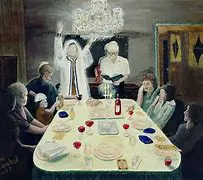 After the conclusion of the Seder’s Grace After Meals, there is a universally accepted custom to pour a cup of wine (the “Cup of Elijah”), open the front door of the home, and recite several verses (mostly from Psalms) wherein we beseech G‑d to pour His wrath upon our persecutors and oppressors. The Torah describes the night of Passover as leil shimurim,1 a “guarded night.” It is the night when long ago G‑d protected the Jews from the plague which slew all the Egyptian firstborn, and the night when G‑d’s protection over His chosen nation is most apparent. Opening the door expresses our trust in G‑d’s protection.
Which is why the year that I was entrusted to open the door still burns in my otherwise fading memory.
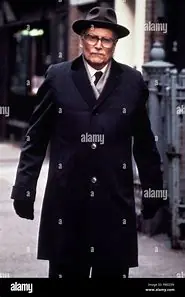 Because if on cue, if set up as a PUNK’D (or, in this era, CANDID CAMERA) sketch, on cue waddled in the oldest living member of my father’s side of the family, the one so removed even though his actual name was Louis Gottlieb, everyone merely called him “Uncle”. He spoke little English and was quite hard of hearing and dressed much like Laurence Olivier’s character in THE JAZZ SINGER. The look on both of our faces as he wordlessly walked in, hours late to the service he had been invited to and completely oblivious to the thought of an apology, drove the entire family into hysterics, which reached a crescendo when he sat down at the placesetting where Elijah’s cup was placed in front of, stared into the cup and asked “What? No Schnapps?”.
In a later era, after I had recently relocated here, a good friend of my best friend invited us both to his family’s first night. His Seder was large and traditional and also dragged on long into the evening. I had had a particularly exhausting day at work and was already on fumes. But knowing what a honor it is to be invited into another family’s home i did my best to soldier on and even willingly participated in the post-meal portion of the evening, if for no other reason than that was a requirement in order to get to dessert, particularly the coffee I knew I’d need to drive home, especially since I “respectfully” had some extra wine during the meal.
Another traditional narrative where the entire table reads passages is the detail involved with a song called ECHAD MI YODEA, which Wikipedia handily provides a description of for those who require it:
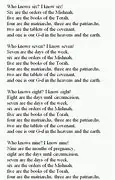 “Echad Mi Yodea” (Hebrew: אחד מי יודע?, lit. ‘One, Who Knows?’) is a traditional cumulative song sung on Passover and found in the haggadah. It enumerates common Jewish motifs and teachings. It is meant to be fun and humorous, while still imparting important lessons to the children present. Although it can appear to be simply a juvenile children’s song, an important message is being imparted to those present at the Passover table.
We went around the table clockwise, building on each ensuing number, each passing paragraph longer than the other. And midway through approximately Who Knows Eight or Nine, my eyes closed. Around Who Knows Ten or Eleven, my snoring apparently became audible. My friend was sitting next to me and across from our host who began to pick up on my disrespect. He drew the honor of reading Who Knows Twelve, and in a moment of inspiration closed his impassioned reciting with a deftly timed elbow to my ribs. I gurgled, and without missing a bit immediately launched into “Who knows thirteen”, the final and longest stanza of the song. I read it perfectly and the table applauded. I foolishly thought it was because we were finally going to get dessert.
These may not seem like significant or relatable memories to you but I suppose you can discern how much they mean to me. Which is why the lack of any recent ones that even come close to being worthy enough to retell brings me to almost non-stop tears. Tears that only grow longer and more gutteral every year where despite dropping more subtle hints, even offering to contribute to the menu out of my own pocket, no invitation for a first night Seder has come my way.
So I’m sharing these stories on a thankfully quiet weekend (no new tariffs or natural disasters that I’m aware of) in the hope that someone might pick up on the emptiness and worthlessless I’m feeling as I plow through this.
Seders typically conclude with the phrase “L’Shana Hab’A Ben Yershuyalim”, which translates to “NEXT YEAR IN JERUSALEM”, the pious hope that observant Jews toss out that expresses the traditional desire to be back in the homeland, which in ancient times involved a forty-year wandering through the desert. It just so happens this is the 40th year I’ve been in Southern California.
So I’m going to amend that a bit and for a change be less subtle with my wish: Bashne Habae Bechl Makom Hotz Makhan. Translation: NEXT YEAR, ANYWHERE BUT HERE.
Until next time…
If you paint a pride flag above the door of your Tesla, it will be passed over by the Democrats.
Next year…….in Nevada. Not Florida. They don’t say “gay” there.
G_d bless your President Trump……OUR President Trump
And I pray for you every day Steve, despite your wishes for me in Gaza.
I’m certain that MANY people “of our age” are feeling exactly the same way – only difference is that my immediate Jewish family consisted of me, my mom (not at all religious) and my dad (a COHEN, but as women, mom and me were excluded from services in our orthodox synagogue!) Because our family owned a bakery in Ellenville, NY (Cohen’s BTW which is still in business although there’s not a single COHEN in the place) we were closed for the entire week of Passover – when we would attend services at one of the Jewish hotels in the Catskills, or in later years, took our vacation to places that didn’t exactly celebrate the holiday.
I did NOT have ANY early family memories growing up in NY. I moved to CA in 1976, and it wasn’t UNTIL I was pregnant with my 3rd daughter in 1986 did I feel a need to revisit my Jewish identity.
My first visit to Temple Sinai in Glendale, California put me back on the road. Much to my surprise and GLEE – the RABBI WAS A WOMAN!! In fact, Carol Meyer was the very FIRST female rabbi in all of L.A. ! (Reform, of course)
From that day on, me and my 3 girls went to Friday night services (hubby is an x-Catholic atheist) We created family Friday night dinners, celebrated all 8 nights of Hanukkah and created very special Passovers with family AND friends (added the Orange on the Sedar plate – look it up!) for MANY years all the traditions, songs, FOOD were celebrated in MY home.
Flash forward 25 years… daughters are married – 2 to non-Jews, one is in Houston, the other is in Northern California – I’d call them Jewish “lite”.. the youngest one married a “nice Jewish boy” and MOVED to New Jersey! And while we can ZOOM the sedar, and all 3 families light the Hanukkah first night… in 3 different time zones… those very special at-home celebrations are a faded memory.
The Jewish community here in Camarillo is sparse and when I did attend Passover (at Chabad of all places) those lost memories just made me cry… but as they say, better to have memories and be sad, then to NOT have any memories at all.
I Guess!
The ONE thing I can be VERY “thankful” for from the last several weeks of working at a very toxic company, is meeting YOU – in person at first, now on-line today.
So, the next time you feel “passed over”… give me a call and we’ll suffer eating Matzo together, or at the very least share a FEW cups of wine!
L’Chaim!