
Whenever I come across the increasingly rare public touting of small screen “ratings” success I probably pay a lot more attention to the details than most. When you spend as long as I have concopting similar fodder, one can’t help but be curious if the same level of sophisticated storytelling creativity that I and my peers in more competitive times was being achieved. Yesterday we actually had two separate situations where the stories were so weak it took the messengees to point out where the messengers’ degree of transparency was lacking. And there wasn’t even consistency among them in their ability to spot it.
Apparently there are still enough folks left at Paramount who haven’t been solely working on swallowing Warner Brothers Discovery whole to take the time to give their growing success LANDMAN some public plaudits. Here’s how VARIETY’s Joe Otterson lazily regurgitated it:
 “Landman” Season 2 has struck oil, with its premiere episode bringing in 9.2 million views in its first two days of availability. Per Paramount, that figure is based on the total minutes viewed divided by the episodes total runtime. The second season debut of the oil industry drama launched on Paramount+ on Nov. 16. Paramount also says that the 9.2 million views is an increase of 262% over the series premiere in 2024, while sampling of Season 1 increased 320% since the second season premiere. The latter figure is based on the views for Season 1 for the past 28 days compared to the two days after the Season 2 debut.
Now contrast that with at least the attempt that his Penske-verse colleague, DEADLINE’s Katie Campione, made with her version of the same story that at least addressed a couple of the questions that folks like moi were asking:
 (T)he problem is that there is no publicly available data to compare those numbers to, since Paramount didn’t release two-day streaming viewership for the Season 1 premiere – and it seems the company has changed its audience metrics as well.
Deadline previously reported 5.2M same-day viewers for the Season 1 debut episode across both streaming and linear airings based on a combination of internal data and VideoAmp metrics, but Paramount did not specify streaming-specific numbers. While the series is a streaming original, the Season 1 premiere was simulcast on Paramount Network as well.
Since Season 2 is exclusively on streaming, Paramount ditched the VideoAmp data and is claiming this performance based solely on internal global metrics. And, for what is believed to be the first time, Paramount is deferring to what is increasingly becoming the industry standard reporting metric for streaming, which is the “views,” a.k.a minutes viewed divided by runtime.
In the past, including for those Landman Season 1 numbers, Paramount opted to report “active sub households,” which would capture the number of active accounts that watched the episode. This would not account for co-viewing, because the streamer doesn’t have a way to know how many people are watching on one screen. So, the “views” metric attempts to capture more closely exactly how many people watched. However, it is an imperfect measurement with several flaws. Namely, it assumes that every time a user watches a new piece of content, they make it all the way through every single time, which is ultimately inflating unique views. In reality, it’s more likely that some users might watch multiple times, while many never make it to the end the first time.
What’s interesting is that Samba TV previously reported that the Season 2 premiere was watched by 1.7M U.S. households on the day it debuted, which it says was down 39% from the 2.7M U.S. households that watched the Season 1 premiere in that time frame. Obviously Paramount is measuring global viewership, so Samba’s numbers don’t tell the full story, but that would seem to indicate that Landman is doing extremely well internationally and has been off to more of an underwhelming start domestically.
Deadline has asked Paramount for comment about the change in audience measurement.
Yes, those are crickets you’re hearing from the Melrose and Radford lots in response to Campione’s well-founded questions–and kudos to her for at least bothering to seek out another resource for validation. It was a similar tactic that her more seasoned and ever-intrepid colleague Nellie Andreeva employed later in the day when she was tasked with giving shout-outs to Apple as they tried to tout their own success:
Years of unprecedented secrecy, a hard to explain premise and a title many have to look up in the dictionary did not hamper Pluribus‘ launch as Apple TV‘s most viewed drama of all time. According to the streamer, the series from Breaking Bad creator Vince Gilligan broke the record previously held by Severance Season 2 for the biggest global drama series launch cross Apple TV’s more than 100 territories, led by the U.S., UK, Canada, Brazil, Australia, Germany, Mexico, India and France.
 In the U.S., the viewership high mark has been corroborated by the Nielsen Streaming Content Ratings, measuring minutes for Episodes 1 and 2 of drama originals over premiere weekend. Pluribus, starring Rhea Seehorn, debuted with two episodes Friday, Nov. 7. While official Nielsen data will not be available for a couple of weeks, Luminate reported earlier this week that Pluribus logged 6.4M hours with its first two episodes over the first seven days of release in the U.S., a strong showing that landed the series at #4 for the week behind shows that all had significantly more episodes available.
As I’ve mused previously, there was once a time where someone at Apple might have chosen to call out Paramount for their attempted obfuscation, not to mention reinforce what appears to be their relative domestic success. I’ve previously mused how that was S.O.P. when I was the one making the donuts for folks like Apple’s programming head Matt Cherniss, who didn’t miss the chance now as he did then to throw roses at the feet of his creative partners. And it sure seems like Andreeva got a little help from Apple, a Nielsen client, in helping to provide some degree of detail with actual numbers to back up their bravado.
In direct contrast, Paramount seems to be taking a page from the administration they have been spending an awful lot of time of late suckling up to. In a BULWARK piece from yesterday with the telling subject line Donald Trump Wants to Bullshit The Economy Into Greatness Andrew Eggar seemed to take particular glee in pointing out exactly how egregious his most recent eruptions have been:
(D)uring Trump’s goopy bilat with Saudi Arabia’s Mohammed bin Salman(,) Trump was waxing lyrical about all the foreign money pouring in: “We expect to be around $20 trillion, $21 trillion in one year, and that’s many times bigger than—in history the highest number was $3 trillion, and we’re going to be at $21 trillion.”He then turned to MBS: “And I want to thank you, because you’ve agreed to invest $600 billion into the United States. And because he’s my friend, he might make [it] $1 trillion, but I’m going to have to work on him. But it’s 600—we can count on $600 billion, but that number could go up a little bit higher yet.”
The important thing to understand here is that both these numbers—the $600 billion and the cool $1 trillion—are fake. They’re monopoly-money promises. Saudi Arabia is a staggeringly wealthy country, but its entire GDP is something like $1.2 trillion. The country’s sovereign wealth fund contains an estimated $925 billion. The idea that MBS plans to sink the entirety of his nation’s accumulated petro-lucre into building factories in the United States is laughable on its face.
And yet the White House’s messaging apparatus treated MBS’s fanciful promise as though it were a check they’d already cashed. “This massive $1 TRILLION investment will drive business in the United States, maintain American national security, create jobs and support American needs,” the official White House account tweeted. “The Dealmaker-in-Chief is at it again.”
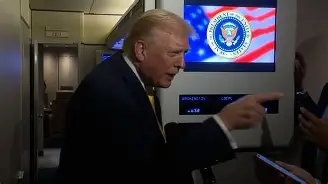
In her own small little way, Campione showed the same kind of spunk that Bloomberg’s Catherine Lucey and ABC NEWS’ Mary Bruce showed this week when they dared to question the “dealmaker-in-chief” on some otherwise niggly details. In those cases, the lack of solidarity and support offered up by anyone other than their colleagues well after the fact has been noted as alarming and sadly telling of the era of indifference and yes, fear, that we now clearly are in. Maybe it’s a blessing that Paramount hasn’t elected to publicly respond to her questions given what now seems to be acceptable behavior by anyone trying to advance a narrative that hasn’t been quite as fleshed out and made bulletproof as the ones my peers and myself concopted in our sausage factory days.
 I did recently make a valiant attempt to offer my services to the new head of Paramount research; I’d suspect you wouldn’t be surprised that, too, has been met with crickets. In the wake of that, I’ll reinforce that perhaps if not moi someone oughta be able to help her deal with the kind of probing questions that a Katie Campione is capable of asking. I can certainly handle reporters like her. And I vow not to call her Piggy.
Until next time…