
I’ve always been far more fascinated with the “whys” of research versus the “whats”. While I fully concede that in an industry where the bottom line IS the one with the “$” sign, the value of knowing what the underlying reasons for those results more likely are is eminently greater than merely being able to describe or even project the future numbers that might ensue.
Last week we mused about the latest results from Nielsen’s partial yet somehow perceived as definitive lens on viewing, the Gauge, which for the first time in its brief history revealed that YouTube was THE most popular destination for viewing video in a given month even in a hastily created reshuffling that until then had successfully found a way for legacy media companies to appear like they were still on top.
Yes, that made headlines in both trade and mainstream media, mostly because an overwhelming percentage of those covering this beat (myself included FWIW) fall into a demographic that still have difficulty wrapping our heads around the fact that a growing percentage of people, rapidly aging into cells where more purchasing power and influence lie, don’t readily choose to watch prestige or even escapist television. What we almost missed was another study dropped at roughly the same time that shed a bit more insight into exactly how entrenched that default viewpoint may be. As FAST COMPANY’s tech reporter Eve Upton-Clark reported last Thursday:
Gen Z isn’t just watching creators—they’re choosing them over traditional TV and movies.
That’s the big takeaway from Deloitte’s 19th annual Digital Media Trends survey. The report finds that 56% of Gen Z and 43% of millennials find social media content more relevant than traditional entertainment options, and about half feel a stronger personal connection to social media creators than to actors or TV personalities.
THE WRAP’s Sean Burch shared a bit more detail and some additional hypotheses with his readers:
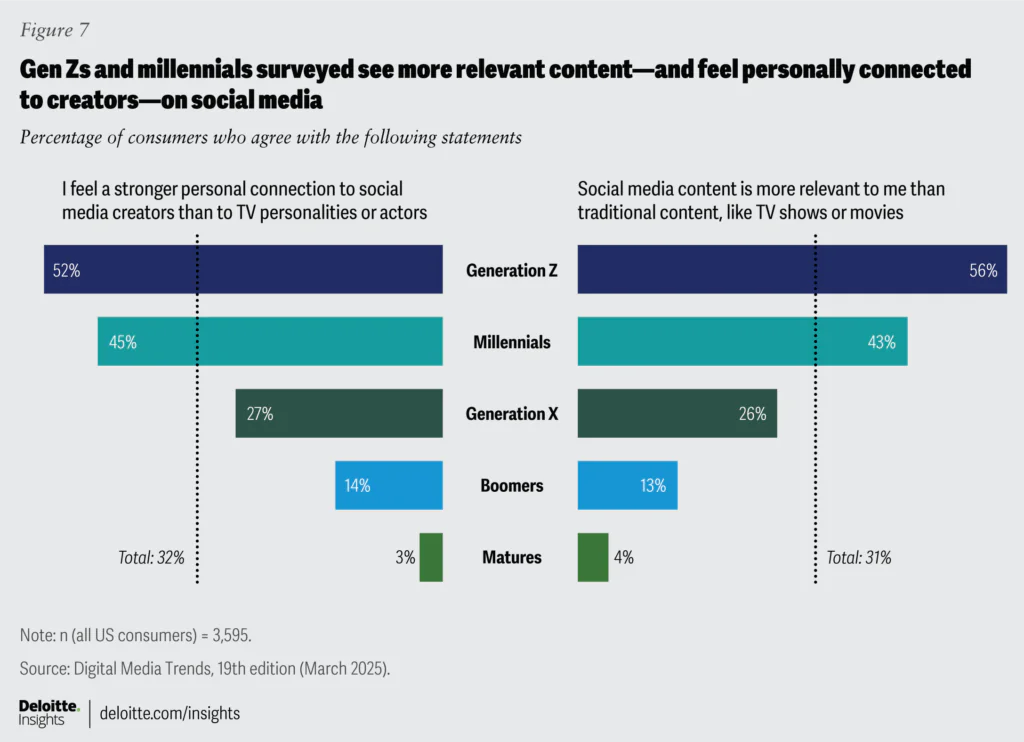 [Gen Z] respondents spend 54% more time — or about 50 minutes more — than the average consumer per day on social platforms and watching UGC; and 26% less time — or about 44 minutes less per day — than the average person watching TV and movies,” Deloitte’s report, lead by six of its analysts, said.
The report, based on a survey of 3,595 Americans in October, may not come as much of a surprise, considering the wild popularity of YouTubers, like MrBeast, who has 378 million subscribers. YouTube has also become the go-to hub for viewers to watch sports and political content, among an endless list of topics. And TikTok is also wildly popular among Americans, with a recent Pew survey finding the average TikTok users in the U.S. scrolls the app for 107 minutes per day.
Veteran HOLLYWOOD REPORTER scribe Alex Weprin coaxed even more context out of one of those authors that provided a buffet table’s worth of food for thought:
 “Think about the war for people’s attention and time that exists today, between traditional media and social media,” says China Widener, vice chair of Deloitte LLP and U.S. technology, media and telecom leader, in an interview with The Hollywood Reporter. “With Gen Z, they spend 54 percent more time — think of it as about 50 minutes a day, on average — more on their social platforms, and they spend about 43 minutes a day less in traditional TV and media. So when you just think about it in the context of where they’re spending their time, are they using both service types? Yes. But they are spending more time in the social media platforms than they are on the traditional platforms.”
We’ve almost accepted the fact that today’s media consumption is splintered–certainly, the levels of actual viewership for almost every individual program versus even a few years ago show that conclusively. These numbers–and when it’s a survey size this large even the fact that it’s skewed somewhat by self-reporting is mitigated–strongly suggest that grew up in an era where the internet and cell phones were even more ubiquitously available than TV and cable, their consumption more closely resembles sawdust.
And if that nugget weren’t enough to provide legacy media more than a little heartburn, Weprin et al revealed that the knee-jerk solutions of their frustrated beancounters that continue to be offered as potential panaceas aren’t exactly sitting well with these youngfolk either:
The Deloitte survey also examined the question of value, and found that consumers across the board are increasingly dissatisfied with the value provided by paid streaming services. Almost half say that they pay too much for the SVOD services they use, and 41 percent say that the content isn’t worth the price. Value-driven options, like free, ad-supported streaming services (FAST) are rising, particularly among younger consumers.
“There’s a level of frustration,” Widener says. “Prices are rising, this questioning of the value, and this turning to the free, ad supported services, if that frustration isn’t mitigated in some way relative to the increased costs, then the reality is, there’s going to continue to be this challenge, and it’s going to force a different business model conversation in the future, if ultimately, the services and the companies that own them can’t figure out how to thread this particular needle as it relates to these rising pricing pressures”.
A quarter-century ago, in the wake of the ill-fated AOL-Time Warner merger, I taught a class for UCLA Extension on media convergence, a class I was asked to create by the person in charge after she saw me report to a group of visiting media executives from Japan about how the NATPE convention was turning to online media distributors flush with venture capital money to fill the rapidly emptying spaces of traditional syndication companies that were folding or merging. We all had a good laugh about how ludicrous some of those efforts were, effectively touting old-school clearance headlines for market exclusivity on the potential to deliver local television signals “over the top” as more affordable efforts to cable and satellite were being explored. The visiting Japanese executives noted that such efforts were gaining traction in their country more because of the fact that they were creating and developing alternative content as well as distribution methods, let alone the fact that in those instances those creating it were working hand in hand with digital billboard companies and wireless carriers to allow its urban-centric targets to more easily access it. In particular, efforts around original anime were noted as ones that in their view were moving the needle. We used those insights as a foundation for a course we saw was gaining traction with continuing education students hoping to cash in on the possibility that their crazy ideas that they felt were never given a chance to be discovered might now have a more viable path to it. But as so many of those Web 1.0 efforts failed–most notably, of course, AOL-Time Warner–the course began to lose appeal. It eventually folded after eight years when new management and the reality of the times set in.
 Turns out we weren’t wrong, merely premature. And I got a hunch that if somehow a quarter-century now if this course were offered up by whatever might remain of continuing education at that time, we’ll look back at the conclusions from this study as just as premature. After all, if this is how the emerging generation feels now about content and value, imagine how THEIR offspring might eventually feel.
Until next time…