
The NBA season resumes tonight after a six-day sabbatical with a robust slate of ten games, including a highly anticipated litmus test for the league’s surprisingly front-running Detroit Pistons in both the spotlight and crosshairs of Madison Square Garden for a globally streamed showdown with league management and domestic media rights owners’ pre-season favorite for Eastern Conference supremacy, the New York Knicks. It’s arguably the marquee matchup of the night as the league begins what should be a spirited final third of its regular season where two-thirds of the league will be rewarded with at least one additional post-season game.
But at around the time where the Prime Video superteam starts to size up the competitors in Manhattan down in our nation’s capital the Indiana Pacers and Washington Wizards will resume their respective campaigns, who combined have fewer wins than either the Knicks or Pistons. It’s eminently debatable that either one of these teams actually has any interest in trying to win, and it’s hard to imagine even the most robust fan wanting to watch, let alone shell out a coupla hundred bucks to see who shows up to even try to play.
The Pacers, who last year took the Oklahoma City Thunder to a seventh and deciding game in the NBA Finals but lost their star player Tyrese Haliburton to a devastating enough injury that not only cost them that game but him his entire 2025-26 season, are already on record as giving up even before last week’s All-Star Break, as THE ATHLETIC’s Eric Koreen paid note last week:
(T)he league fined the Indiana Pacers (15-40) $100,000 for violating its player participation policy on Feb. 3 by sitting Pascal Siakam. There are layers to it, and if you’d like to engage with some dry legalese, here it is.
MEN’S JOURNAL’s Jeff Smith weighed in with needed context:
Indiana’s penalty was tied to…the league’s Player Participation Policy. During a Feb. 3 matchup with Utah, the Pacers ran afoul of that policy, prompting an investigation. After reviewing the case—including an assessment from an independent physician—the NBA concluded that Pascal Siakam and two other starters “could have played under the medical standard in the Policy, including by playing reduced minutes.”
But that was eclipsed both in egregiousness and finger-in-the-eye ‘tude by the actions of a way more defiant group, as Koreen continued:
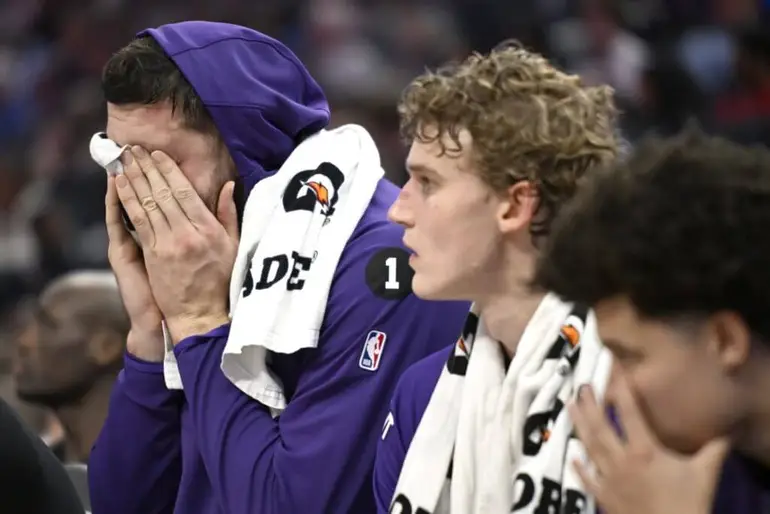 (T)he NBA’s fine of the Utah Jazz (18-38) was new, or at least newish. Utah decided to sit former All-Stars Lauri Markkanen and Jaren Jackson Jr., the latter of whom the Jazz acquired before last Thursday’s trade deadline, in the fourth quarter of close games in Florida — a loss to the Magic and a win over the Heat. The NBA declared itself sufficiently offput, and fined the Jazz $500,000…The Jazz have been at the center of this for a while now. In both 2022-23 and 2023-24, Utah traded away some of its better players and rested Markkanen, among others, to fall down the standings as the season progressed, going from Play-In Tournament contenders to lottery hopefuls. “Overt behavior like this that prioritizes draft position over winning undermines the foundation of NBA competition and we will respond accordingly to any further actions that compromise the integrity of our games,” NBA commissioner Adam Silver said in a statement.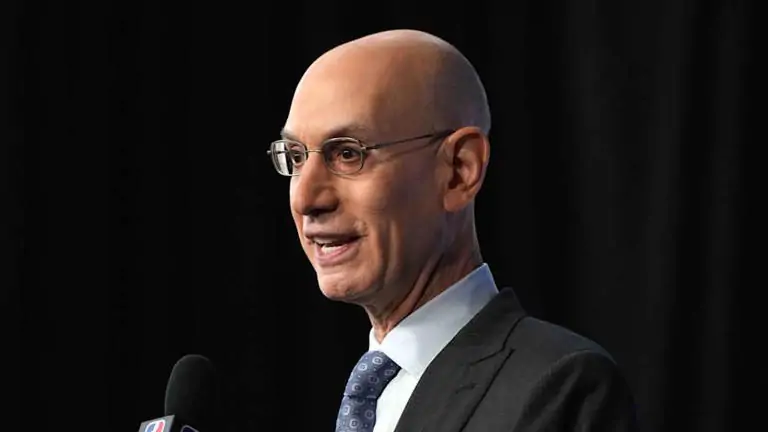
But as Smith further noted, that went down with Jazz management about as well as a heat wave in Sundance:
Jazz owner Ryan Smith jumped on social media almost immediately, pairing an eyeroll emoji with: “Agree to disagree… Also, we won the game in Miami and got fined? That makes sense…”
And since Smith has more than enough FU money to buy and sell Silver several times over, this became the overriding topic of discussion over the break. The game was being played in the home arena of the Los Angeles Clippers, who even after a recent winning streak still felt the need to trade starters James Harden and Ivica Zubac at the deadline, ostensibly building up assets for next season. Zubac was indeed traded to the Pacers, who at least seem to be looking forward enough to Haliburton’s expected return to allege they are doing same. Their opponents tonight, the Wizards, had already made a coupla such moves of their own for former All-Stars Anthony Davis and Trea Young, both conveniently injured and out for the year. Yesterday the Dallas Mavericks, whose feckless ownership allowed now-former general manager Nico Harrison to trade its franchise player Luka Doncic just over a year over in a hissyfit about conditioning for the oft-injured Davis, shut down their remaining franchise player Kyrie Irving for the season as well.
It’s got a lot of people offering suggestions on how to deal with all of this. Smith noted just a few:
As ESPN’s Shams Charania reported on NBA Today, league stakeholders have been in serious talks since November and December of 2025, “in the wake of the gambling scandals that happened in the NBA.” This was a nod to allegations of reported insider betting involving Miami Heat guard Terry Rozier, Portland Trail Blazers coach Chauncey Billups, and former player Damon Jones.
Among those conversations, one idea has drawn the most attention: a full-on tournament for lottery teams to determine draft order.
In that setup, traditional lottery odds would disappear. Instead of bottoming out to chase ping-pong balls, non-playoff teams would have to actually win games to earn the No. 1 pick. While the initial concept was reportedly referenced by Charania, via Barry Jackson of the Miami Herald, the longtime NBA insider revealed that a Board of Governors meeting in December 2025 brought more detailed pitches on three specific anti-tanking proposals.
Those three proposed anti-tanking measures are significant. Any of the options listed below could drastically alter the mindset of teams attempting to navigate for a higher pick, in differing ways.
- Limiting pick protections to either the top four or 14 and higher.
- The possibility of teams no longer being allowed to draft in the top four two years in a row.
- Lottery positions locking after March 1, instead of following the NBA regular season.
Heck, even my esteemed comrade-in-arms on our sister Double Overtime site (you do like and subscribe to that, don’t you?) felt compelled to weigh in last week with his own thoughts. After all, the Bulls haven’t decorated themselves in glory with their intentions about the balance of this season, either. But in typical Chicago fans’ fashion, he could offer up little more than frustrated lament. We believe at least trying to ferret out a solution is a better investment of time and typing.
And since I’m a soccer fan with my own emotional ties being tested this year as another league heads for its final third, I’m reminded on how they have dealt with the possibility of tanking across the pond. Yesterday Koreen’s ATHLETIC contemporary Elias Burke pointed out how dire that’s potentially becoming:
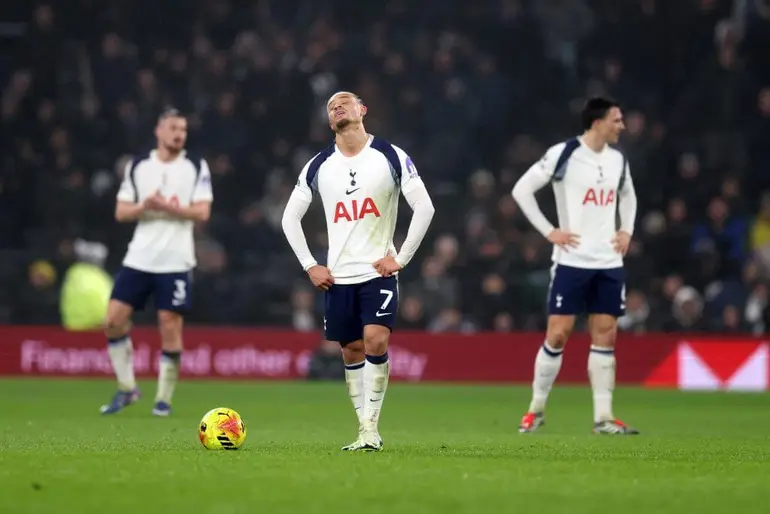 If Igor Tudor’s appointment as Tottenham Hotspur head coach tells us anything, it’s that the board are concerned about the prospect of relegation to the Championship. The 47-year-old Croatian twice rescued Udinese from relegation in Serie A, before plugging holes at Marseille and Juventus — ensuring Champions League football on both occasions. Tudor is a premium alternative to the likes of Tony Pulis and Sam Allardyce, who built reputations domestically on reviving disastrous seasons. While Opta’s data model indicates Tottenham’s actual chances of relegation are remote, at 3.36 per cent, they are just five points ahead of a resurgent West Ham United in 18th, having failed to win in eight league matches.
SPORTS ILLUSTRATED’s Barnaby Lane recently man-splained how that all works:
At the end of every Premier League season, the three teams finishing at the bottom of the table (18th, 19th and 20th) are relegated to the league below, the Championship. It’s fairly straightforward: The three clubs with the fewest points go down. If two or more teams are level on points at the end of the 38-game campaign, goal difference—calculated by subtracting goals conceded from goals scored—determines who faces the drop…The three relegated teams are replaced by three clubs from the Championship. The first- and second-place finishers earn automatic promotion, while the third spot is decided through the Championship playoffs.
 Dropping out of the Premier League carries a significant financial hit, though mechanisms of exist to soften the blow for demoted clubs. Relegation… slashes income dramatically. Clubs typically lose around two-thirds of their revenue due to lower ticket sales, reduced sponsorship deals and diminished broadcast income. To prevent financial collapse, the Premier League provides “parachute payments” to cushion the blow. These payments are structured over several seasons. In the first year after relegation, clubs receive 55% of the standard Premier League TV money. In the second year, that drops to 45%, and for teams with multiple years in the Premier League prior to relegation, a third-year payment of 20% is also included.
 It just so happens the NBA happens to own its own version of the Championship in the G League. There’s clearly precedent and incentive for the NBA to consider a relegation model of their own. And since each of the league’s teams happen to now own their affiliate, what would be at stake would ultimately be a second share of global TV revenue for the top G league teams. More than half of the G League affiliates play in the same DMA as their parent club; several play in the exact same arena. Many already have deals in place with their respective local media rights holders for a package of their games. So with some sort of parachute payment structure you can see that the bottom wouldn’t completely fall out on those that would be relegated.
It also just so happens that were the season to end today and the NBA followed the Premier League model the three teams on the outs–the Sacramento Kings, the Wizards and the New Orleans Pelicans (with the Brooklyn Nets and Pacers tied in the win column with the Pels) would be replaced by the Osceola Magic, the Cleveland Charge and a playoff team that could very well be the G League’s Western Conference leader in the clubhouse, the Stockton Kings. Not a single media market would be impacted, and one can assume that the majority of these team’s fan bases can use Google Maps to find their way to the games. And if for no other reason than novelty alone, I suspect that the level of interest in wanting to see those teams’ games would at least be on par with those of the NBA’s cellar-dwellers as they head into March Sadness.
And anyone who might be up in arms at the thought of a team based in New York City being relegated should take solace in the painstaking ways that Burke has offered up what-if scenarios to deal with the prospect of a London-based club such as Tottenham dropping down. It’s honestly a fascinating read. Not all of the ideas he amassed from a host of experts and executives are immediately applicable to the NBA. But they’re at least as worthy of anything that has emerged from the white smoke of Silver’s office–which so far is mere saber-rattling reminiscent of how the FCC intends to deal with THE VIEW.
I can’t pretend what I’ve proposed would stand up to scrutiny and any potential challenges unions and certainly media rights-holders might parochially cite. But I know I’m more interested in discussing that then how the Pacers and Wizards might perform tonight. And I suspect most of you would prefer that to any more wailing about the Bulls or Tottenham, too.
Until next time…