
Yeah, sure, CBS, you can call the second week of October a premiere week if you want to. Those of you with actual experience with ratings who are still around (well, at least until November) know darn well your bell is going off this weekend when you devote Sunday to the NFL and, in perhaps a tribute to the aging of your corporate portfolio, the VMA awards. Them’s real ratings potential for the first time in months.
The NFL is far and away the most impactful and monetizable television product out there anywhere, and they know it. They’ve spread their wealth across all four major broadcasters and three top streamers (apart from the counterparts to those broadcasters) and opening weekend is exemplary of exactly how omnipresent their footprint is. Want to see Taylor Swift’s fiance start what may be his final season? Bookmark YouTube TV on Friday night, and be prepared to be bombarded with offers for Sunday Ticket in the process.
So you bet they care about numbers, and the way you get to the top in any industry is making sure you leave no stone, pebble or silt particle unturned. Which is why when THE WALL STREET JOURNAL’s Joe Flint lobbed this lateral in his readers’ direction yesterday it caused more than a few eyeballs to open wide:
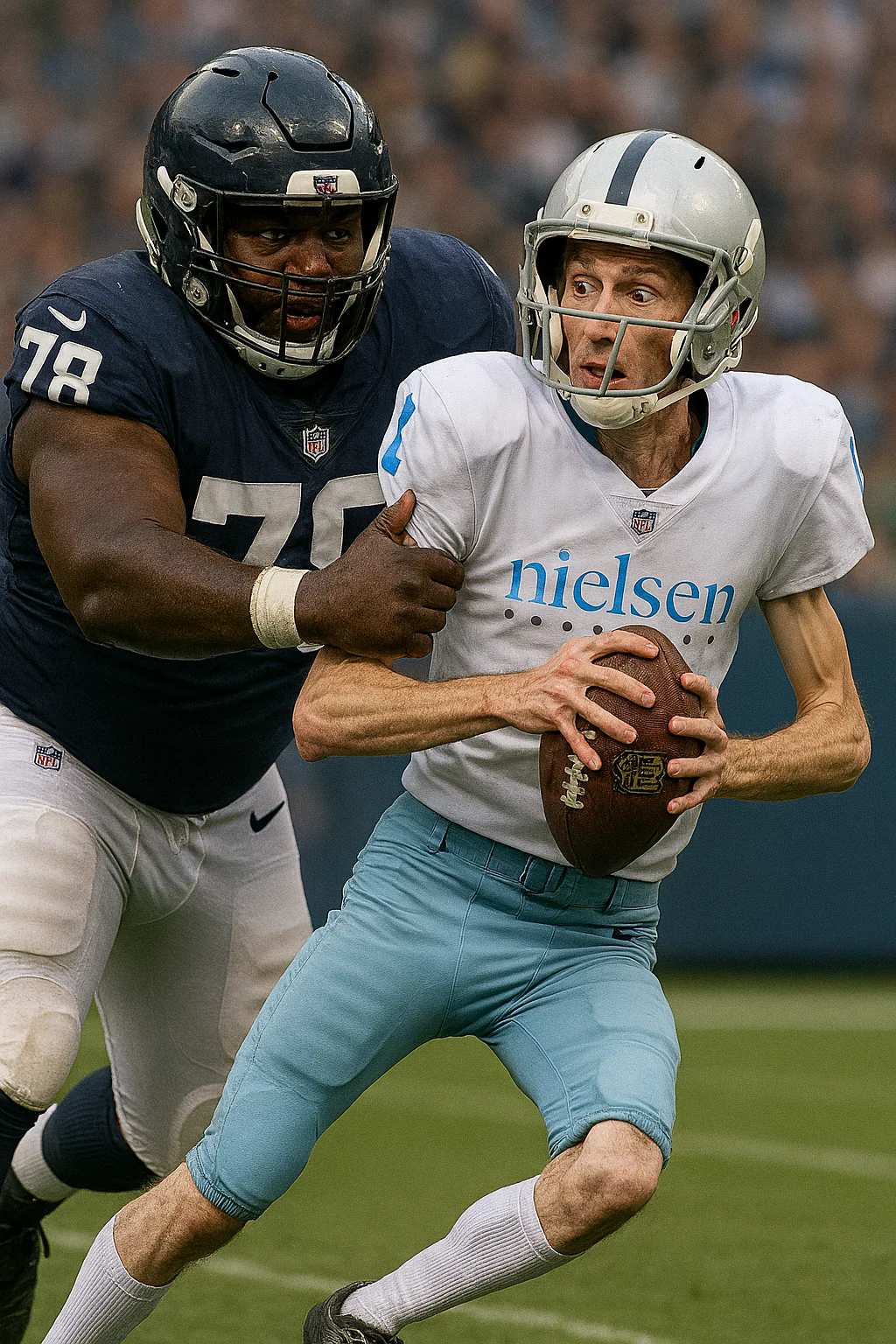 The National Football League is throwing a penalty flag at Nielsen, the leading audience-measurement company.
NFL Chief Data and Analytics Officer Paul Ballew said Nielsen is underestimating the audience for league games. Lower numbers can cost the league’s media partners ad revenue and hamper its rights negotiations.
“There are millions of viewers that we believe they are systematically undercounting,” Ballew said in an interview.
Public criticism of the leading audience-measurement company by a media client, even one as powerful as the NFL, is rare. It shows the challenges in quantifying viewership as the media landscape fragments and more viewers shift to streaming services from traditional broadcast and cable television.
But the difference between the NFL and, say, your typical Nielsen client is that they’re measuring the largest audiences of any content anywhere, and they’ve got access to alternative measurement sources that they know is doing a better job that the fine folks at Nielsen are currently doing. And while Ballew did his best to toss Nielsen some props for trying, he made it pretty clear that he’s anything but thrilled at their progress. And also unlike your typical Nielsen client these days he’s savvy enough to be able to tell the difference.
 Nielsen recently launched a new “Big Data + Panel” methodology, which tracks data from cable and satellite set-top boxes and smart TVs encompassing 45 million homes and 75 million devices on top of Nielsen’s traditional panel of about 42,000 homes.
Yet Ballew, who serves on Nielsen’s quality advisory board, said the Big Data panel doesn’t yet include first-party audience data from most of the streaming services that carry NFL games, which is crucial to the league and its media partners. Ballew also reiterated a longtime concern of the league and networks that Nielsen appears to be underrepresenting the number of people watching games together at home, a ratings category known as “co-viewing.” The league is also frustrated, Ballew said, by an increase in delays by Nielsen in releasing data and restatements of ratings, both of which can create uncertainty in the advertising marketplace.
The company has taken steps to improve its reporting of streaming usage and collection of out-of-home-viewing in bars and restaurants. Ballew praised the efforts as “significant measurement improvements.”
Nielsen has spent the better part of the 2020s on the defensive from a barrage of criticism from other clients, a saga the one-man show that is THE DESK.NET’s Matthew Keys recounted:
Two years ago, Nexstar Media Group issued a press release announcing an open request for proposals to help it find “a next-generation audience measurement partner.” Nexstar is the largest independent owner of affiliated major-network broadcast TV stations — many of its outlets are affiliated with ABC, CBS, Fox or NBC — and is also a majority owner of the CW Network, which has a programming relationship with the NFL.
“We believe current methods of audience measurement inadequately reflect our national reach and the effectiveness of the local activation we deliver to advertisers and marketers,” Michael Strober, then-Chief Revenue Officer at Nexstar, said in a statement. “We need to accelerate the pace of innovation in cross-platform measurement not just with national content, but with the content generated in every one of our local markets. We also must ensure that the best data is operational across the company.” (Strober left Nexstar last year.)
Paramount has also expressed concerns over Nielsen: The CBS broadcaster broke away from Nielsen last October after a contract to use its measurement data expired without a new agreement in place. The dispute between Paramount and CBS remained through the rest of the NFL season, which delayed the network’s reporting of viewership figures associated with football games aired on the network. (The NFL, which has a contract with Nielsen, reported CBS viewership figures for its games separately.) In February, Nielsen and Paramount reached a new agreement that expanded the measurement of viewers to Paramount’s streaming services Paramount Plus and Pluto TV.
All the while what’s left of the Nielsen senior management team has been touting the Big Data + Panel rollout as the solution for everyone’s woes and concerns, needing to reiterate those promises every time another client who couldn’t deliver on his or her goals was forced to move on. One would like to believe that something so crucial would have received the level of attention and competency that it merited.
But like so many other large global privately held companies have done when confronted with short-term goals, Nielsen has gutted the size and experience they relied upon for most of those eight decades and outsourced a majority of their technical development to overseas partners. This is the face of who Nielsen put in charge of their solution which they touted in a May 2024 press release:
 Nielsen, a global leader in audience measurement, data and analytics, announced that Partha Sengupta is Managing Director and leader of its new Global Capability Centers (GCCs). He will report to Nielsen President and Chief Financial Officer Warren Jenson. Sengupta will oversee the operations of Nielsen’s India GCCs and ensure its operations best support the teams who work there. He will work closely with Nielsen’s global leadership and teams to foster international collaboration and drive the business.
“It’s essential that we strengthen Nielsen’s global business in order to both innovate and scale our work, all with eyes on the ultimate goal: powering a stronger media industry,” said Warren Jenson, Nielsen’s President and CFO. “Partha will be a huge help in getting us there. He has exceptional experience running large-scale operations across many different industries. I look forward to working closely with him as we strengthen our global business.
If you’ve spent as much time as I recently have dealing with the likes of Sengupta’s counterparts at companies like AT&T, you’d probably be as dubious as I am that this would yield the kind of timely and transformative results Ballew clearly desires. And judging by the self-flogging that Nielsen executives were forced to undertake in response, it’s pretty clear that this “solution” fell far short of gaining sufficient positive yardage. Flint gave equal time to the anonymous lackey who was attempting to deal with this blitz:
A Nielsen spokeswoman said it is “confident this will be the most accurately rated football season in history.” She added that Nielsen is working closely with the league to innovate its data collection. Nielsen’s spokeswoman said that the firm has addressed and improved data-delivery times since the start of the year and that “continues to be a top priority for us.” The Nielsen spokeswoman said the firm has deals to integrate viewership data from Amazon, Netflix and YouTube and is in active discussions with NFL rightsholders ESPN, Fox, NBCUniversal and CBS. Nielsen stands by its co-viewing measurement, the spokeswoman said, but she acknowledged “we owe the NFL a deeper co-viewing analysis.”
The fact that even after all of the time and “effort” the best Nielsen can offer is acknowledgment that problems still exist is anything but morale-building to the remaining domestic humans who have to deal with disgruntled clients not even half as patient as Ballew. It even brought her boss out of mothballs to do some more tap-dancing around another of those big-picture issues with VARIETY’s Brian Steinberg in yet another story that dropped yesterday:
Nielsen is keeping track of so much more viewing data in the age of streaming that getting to a final count of TV audiences is going to take a little more time. The measurement giant, which recently won approval to include viewership data from smart TVs along with its usual panel of video consumers, says final tabulation of audiences that includes people who watch traditional linear TV as well as streaming services will likely take as much as two to three days following a specific premiere. Broadcasters have been accustomed for many years to releasing Nielsen viewership estimates as soon as the day after a program’s debut.
 “When you have this much data that people have to adapt to, well, it’s not going to be easy for you to take all the panel information and dissect it and analyze it,” says Karthik Rao, Nielsen’s CEO, during a recent interview. “When you start putting more out, it’s going to get more complicated.”
You bet it is, Karthik. In the immortal words of that crooning prankster Chris Martin, nobody said it was easy; nobody said it would be this hard. With the possible exception of just about every one of your clients and partners.
If I had this much at stake the very least I would have done is found a way to marshal some resources to assure that what I’m doing was holding up to internal scrutiny before I relied upon my stakeholders to do it for me. When one reads Rao touting “partnerships” with the likes of WPP Media, as he did to THE WRAP’s Loree Seitz yesterday, and then realizes that it’s a partnership with Amazon that has kickstarted the kind of initiatives that they uncovered with their own NFL numbers, it makes one question exactly what those GCCs on Sengupta’s watch have been doing all this while.
It makes the observations that Ballew shared with Weitz in a separate interview that also dropped yesterday as much shade-throwing as it attempted to be supportive:
“I think we should all feel better that as we go into this season, that we will have a more robust currency that is widely used in the marketplace, which will once again allow us to continue to go down that path against a fragmented media landscape of more accurate measurement,” Ballew continued. The exec also noted that there’s still “more work” to be done to achieve the most accurate viewership information, especially as it pertains to co-viewing for big games like the Super Bowl or holiday games. “It remains ‘a journey with Nielsen,’ is probably the right way to describe it,” Ballew shared. “
A j0urney that appears to continue to yield negative yardage.
Until next time…