It was exactly eighty-four years ago to the day that America awoke on a Sunday morning planning for Christmas shopping and a day huddled around the radio listening to Christmas music or NFL football, depending upon which religion you adhered to more. Pretty much like the one I’m trying to wake up to as this is being written (I’m still regretting giving into that dare to do tequila shots and then thinking I had the capacity for an hour-and-one-half drive through a mountain pass afterwardzzzzzzzzz).
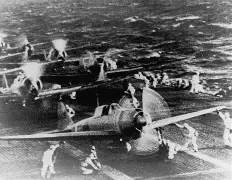 For a few thousand near the Pearl Harbor naval base outside Honolulu, Hawaii, of course it proved to be a morning like no other, shocked into awakening one way or the other shortly before 8 AM when 350 Japanese fighter, bomber and torpedo planes overwhelmed them with the first recorded attack on American soil. The next day, those radios got much more attention when Franklin Delano Roosevelt, roughly a year into his third term, declared it a “day of infamy” and announced that after nearly a quarter-century of relative peace America was once again entering a World War.
No, I’m not quite ol–er, seasoned–enough to remember that fateful day. But I did discuss it with my parents, mere children when that happened, and my grandparents, who had vivid recollections decades later. They told me of the determination that the country had for revenge and their immediate pivoting into despising anything even remotely reminding them of Japan. And they shared with me how of all things cartoons helped them cope.
In the days before television, cartoons were released in theatres and often exhibited as part of special weekend matinees where a decidely adult audience was usually present. Using the convenient defense that images in ink weren’t actually people, they were able to channel those boiling degrees of hatred into satire via characters that multiple generations had come to love. In a compelling 2014 piece available via MILITARY HISTORY.com, those halycon days were literally brought to life:
DO YOU REMEMBER time Daffy Duck gave a Nazi the hot foot? Or what about the classic cartoon where Bugs Bunny drops an anvil on a Japanese soldier? Can’t seem recall those ones, you say? Few can, actually…(D)uring the Second World War, the big Hollywood animation studios like Disney, Warner Bros. and MGM, cranked out an endless array of shorts like these featuring all of their popular characters (and a few new ones created just for the occasion). Produced at the request of the War Department, these lost films were used to sell war bonds, train GIs, or just to entertain the public.
While these were largely pulled from circulation after WWII ended a few endured in extremely popular syndicated TV packages that were the lifeblood of many a TV station, specifically those featuring Bugs Bunny and Popeye that Associated Artists Productions aggressively sold into early evening time periods in many cities. Among the more popular that snuck under the radar of scrutiny was this one, now readily available via the TOON TALES website:
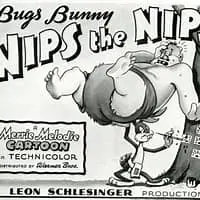 Bugs lands on a Japanese-held island. He tries to outsmart one Japanese soldier by dressing as Emperor Hirohito, but the soldier isn’t fooled. He recognizes Bugs from his Warner Brothers films produced by Leon Schlesinger. Bugs has trouble with a tough sumo wrestler but is able to outwit him by dressing as a geisha. Bugs finally rids the island of Japanese by driving up in his ice cream truck (which plays music from The Magic Flute!) and selling each one an ice cream with a secret grenade surprise.
But as the film’s Wikipedia entry details, the degree of racial profiling and stereotyping went far deeper than merely that:
The initial encounter of Bugs with a Japanese soldier presents an optical illusion, that the two share a body. Bugs’ head peeks above the haystack, while the legs of the soldier appear below it.[3] Then the owner of the feet confronts Bugs. The soldier has buck teeth, a thin mustache, dark eyeglasses, slanted eyebrows and curly, wavy hair…The soldier pulls out a sword and starts swiping at Bugs. He speaks in Oriental-sounding gibberish, consisting of short syllables spoken in a staccato voice.
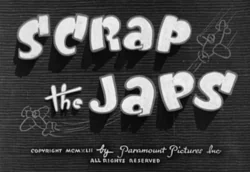 Here, judge for yourself. And while you’re at it, peruse some Popeye works with such provocative titles as YOU’RE A SAP, MR. JAP and SCRAP THE JAPS that were also readily available to TV viewers of that era. And then bear in mind that this was the era that the current occupant of the White House and many of his minions were raised in.
Now consider how similar the conditions are today that they were then. Once again we have Americans being attacked on their own soil, only this time it’s being done by a president who covets any comparion to Roosevelt, especially any that point to a third term. A leader whose behavior more closely resembles that of a World War II leader from the Axis. Ripe for satire in cartoons, of course. Today we have the luxury of that satire being available with mouse clicks in our homes via a season of SOUTH PARK like none of the other 27 before it–one that has resulted in record audience and cultural significance. War bonds may not be being sold, but a lot of other products are. And amazingly, it seems to have the target’s blessing. Or at least that’s what the editors of EVOLVE postulated in the wake of the show’s most recent episode:
In a recent episode of The Daily Beast Podcast, former White House Communications Director Anthony Scaramucci said, “They hate the satire. Trump does not find it funny, trust me.” Although Trump has publicly criticized late-night hosts and news media outlets, he has not been as vocal about the long-running animated series. Scaramucci explained that Trump’s media priorities influence his silence on the show. “His attitude is he wants to go after the news. If they’re putting him on 60 Minutes and they’ve muted all of these left-leaning journalists that attack him, that’s OK. And if they’ve got some joker making animation videos of him and Vance in bed with each other — which was really funny by the way — what’s the big deal? You know what I mean?”
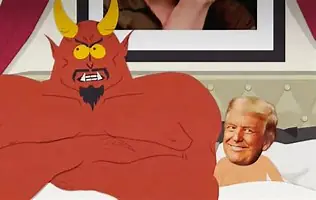 Comedian Patton Oswalt also commented on Trump’s reaction to the series during an episode of The Last Laugh podcast. Oswalt speculated that Trump’s lack of criticism may be due to the show’s commercial success. “Nothing shuts Trump up like money,” he said. “Trump can only be so angry at that, because what Trump ultimately will respect, even if it doesn’t respect him, is something where the numbers are through the roof, and the money is through the roof.”
Be thankful today as we did then that we have actual humans capable of channeling disdain in a somewhat more pro-social and healing way than their progenitors like Warner Brothers’ Schlesinger, Popeye master Max Flesicher and even Walt Disney himself did. Their attitudes are now being funneled through AI, which generates slop like this that nevertheless still resonates. The phrase “going viral” was never more apropos.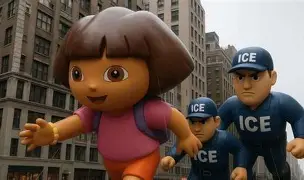
And be reminded that in light of any obsession that someone re-truthing something like that has to be mentioned in the same breath as FDR that Roosevelt did not live to see the war he was involved in end. We should only be so fortunate this time around.
Until next time…