
NOTE: As has become our custom since we launched this endeavor, we are devoting the last ten days of the year to reprising what we consider to the best of what we’ve mused about in the 355 preceding trips around the sun. But since we’re evolving and we pride ourselves on having a foundation steeped in the reality of actual numbers, as a new wrinkle we’re making our choices with an emphasis on which were outlier performers in terms of Instagram and Substack views.
When someone as enduring and prolific as Robert Redford passes, it’s hard not to get overwhelmed. Simply a list of the breadth and depth of his accomplishments and the realization that there’s been nary a moment of your own life that he’s not somehow touched is enough to take one’s breath away and yes, shed a tear.
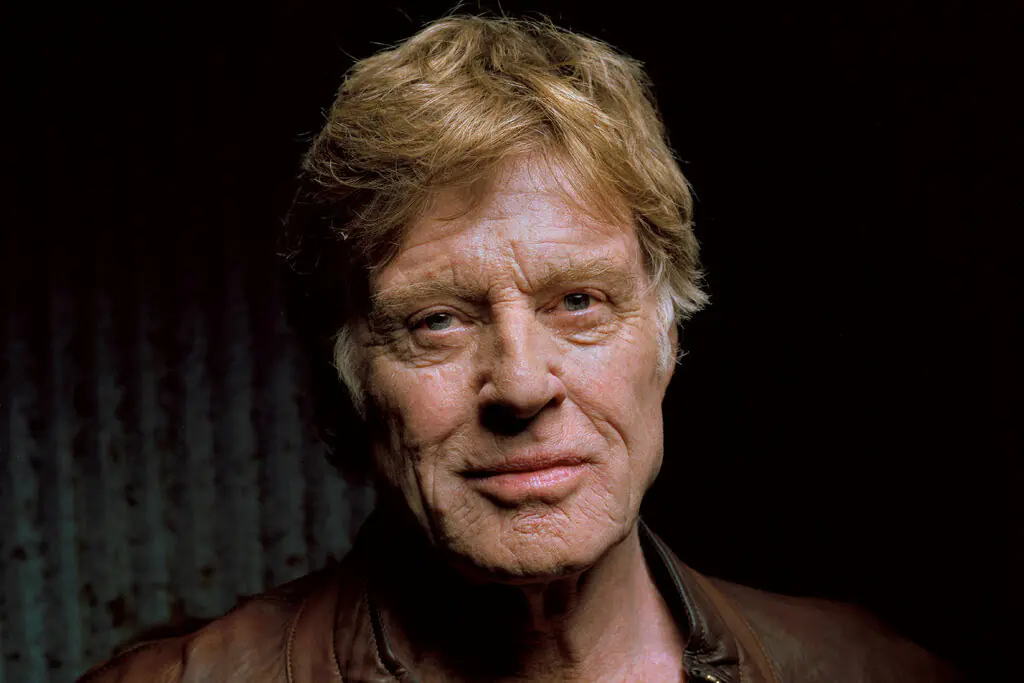 There was plenty of appreciation out there from practically anyone who has at least some point worked the entertainment beat in the wake of yesterday morning’s announcement that Redford had left this mortal coil, at least in body, at age 89. But for anyone who even has any aspiration of working in this medium, his vision and spirit will endure as long as AI doesn’t completely take it all over. And I’m sorry, I’ve yet to see any sort of platform that can produce anything as brilliant and good-looking as the actual Robert Redford.
Redford may not have been the most honored actor; indeed, THE WRAP’s William Bibbiani took particular note of that surprising fact in the appreciation he dropped yesterday:
It’s hard to imagine now but Robert Redford was only nominated for one Oscar for acting, in the Best Actor category for “The Sting.” He lost to Jack Lemmon in “Save the Tiger,” but was also up against Marlon Brando, Jack Nicholson and Al Pacino in three of their most iconic roles. It was a tough year, fair enough, but the Academy somehow managed to ignore his amazing work in “All the President’s Men,” “The Natural” and “All is Lost,” and Redford’s repeated snubs — at least as a thespian — remains one of their most glaring oversights (which is saying something).
But his impact as an omnipresent and versatile performer who connected with audiences on every level is arguably unparalleled, as Bibbiani further noted:
(Y)ou’d be hard-pressed to find someone who wasn’t a huge fan of Robert Redford. He was also one of those great actors who had a loving relationship with the camera, and it’s obvious the camera loved him back.
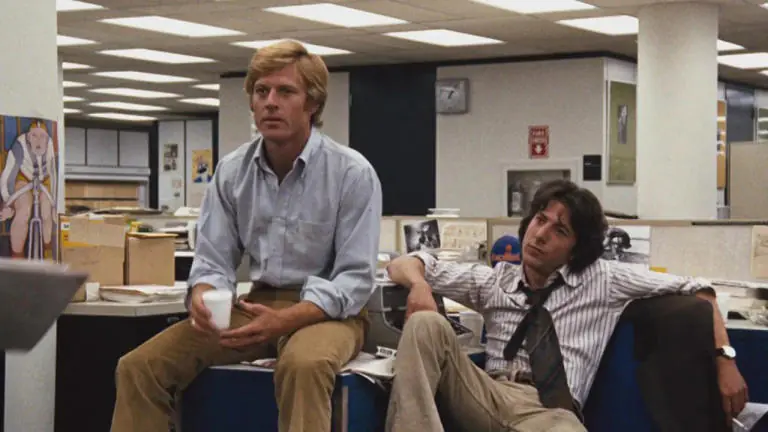 Redford played a lot of clever people. He was a brilliant con artist in the Oscar-winning mega-blockbuster “The Sting,” opposite his “Butch Cassidy and the Sundance Kid” co-star Paul Newman, who somehow matched Redford’s intelligence and sometimes had a little more swagger. Redford’s performance as Watergate scandal reporter Bob Woodward in Alan J. Pakula’s “All the President’s Men,” alongside Dustin Hoffman’s as Carl Bernstein, gave newspaper reporters their most dignified on-screen representative since Clark Kent.
He starred in one of the best spy movies, “Three Days of the Condor,” and he didn’t play a hunky action hero. He played a bookworm who got in way over his head.
He was a romantic leading man as well, with beloved roles in Sydney Pollack’s “The Way We Were” and “Out of Africa.” So universal was Redford’s romantic appeal that when he played a billionaire sleazebag offering Woody Harrelson a cool million to sleep with his wife, played by Demi Moore, the audience for the controversial erotic drama “Indecent Proposal” had to seriously think about it. I mean yeah, that’s not cool, but also… maybe, yeah.
Still, what Redford was able to produce from other people’s efforts arguably paled in comparison to what other people were able to produce from his. Continued Bibbiani:
 Redford was, of course, an accomplished director too. He won an Oscar for his debut behind the camera, “Ordinary People,” and was nominated again for the 1994 real-life TV scandal drama “Quiz Show.” His work as a director was sometimes impeccable, but he wasn’t always on his A-game. After his one-two punch of elegiac Americana, “A River Runs Through It” and “The Horse Whisperer,” he struggled to find financial success or critical acclaim as a filmmaker in his own right.
It was through QUIZ SHOW that I first encountered folks who directly dealt with the man. I developed what could best be described as a business friendship with producer Dan Enright, a central figure in the scandal as the rigmaster in the circus that was TWENTY-ONE, the actual quiz show that the film depicted, and the team that was working for him during the last years of his career and life. Many of them were sources for the PBS documentary where Enright finally expressed remorse and provided details on what he previously kept mum on. It was that AMERICAN EXPERIENCE episode from 1992, THE QUIZ SHOW SCANDAL, that first got Redford to take notice, and the subsequent research and development that he shepherded could only be described as a channeling of what he learned portraying Woodward. Aside from the subject matter, the level of detail and loving meticulousness he employed recreating the look and the feel of late 1950s New York City was spot on, and the casting of David Paymer in the role of Enright, at that time as endearing as he was conniving, was sheer brilliance.
And while Redford himself wasn’t making a lot of successful films beyond that nomination, he was empowering thousands more to do so, as MARKETPLACE’s Lukas K. Alpert remembered:
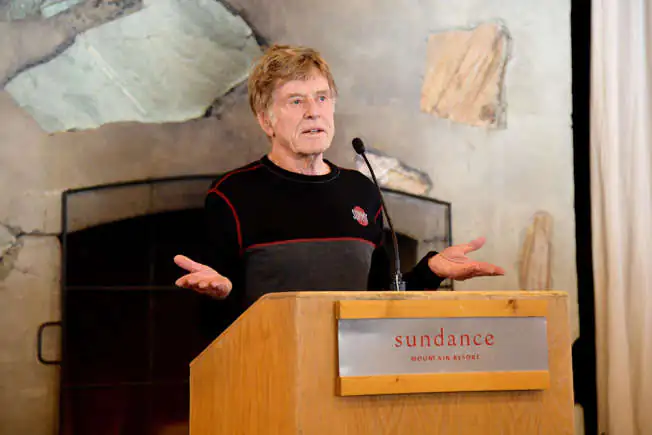 (H)is championing of the Sundance Film Festival may have had a more lasting effect on how Hollywood does business…What started out as an effort to attract film projects to Utah soon transformed a snow-covered part of the state into a mecca of American cinema — the U.S. version of the Cannes Film Festival — and a major pipeline for independent films to be shown in movie theaters around the world.
The festival was born in the late 1970s as a way to attract filmmakers to make movies featuring the majestic mountains and sweeping vistas of Utah…By 1981, Redford had founded the nonprofit Sundance Institute — named after his character in the film “Butch Cassidy and the Sundance Kid” — to help support independent filmmakers and work with them to develop their projects. That year, the festival featured 10 movies in what film critic Roger Ebert described as “a cinematic summer camp.”
In 1985, the institute took over the festival and it was renamed Sundance. That year it featured 86 films, including John Schlesinger’s “The Falcon and the Snowman,” Roland Joffe’s “The Killing Fields” and John Sayles’s “Brother From Another Planet.” “The Killing Fields” would go on to be nominated for seven Oscars and win three, the start of a long run for the festival as a springboard for major films. The institute would go on to nurture the careers of many highly successful directors, including Quentin Tarantino, Darren Aronofsky, David O. Russell, Ryan Coogler, Robert Rodriguez, Chloé Zhao and Ava DuVernay.
Anyone who has ever had the urge to be behind a camera, especially those who have been fortunate enough to be in front of them, owes a debt of gratitude to Redford for starting that ball rolling. Any award anyone has one has to be shared at least in part with him. You know who you are.
 I’ll expand that list of thankers to anyone who has ever dealt with TV networks as well. Because the one time I crossed paths with him was at a Western Cable Show shortly after he launched The Sundance Channel, a joint venture with Viacom’s Showtime Networks that, as Wikipedia notes, went forward with a skeleton lineup: five cable systems in New York City; Los Angeles; Alexandria, Virginia; Chamblee, Georgia; and Pensacola, Florida. In a marketplace that literally was overflowing with new niche networks as digital cable and satellite TV was rolling out, every content provider was doing its darndest to get attention; my employer FOX Family brought out ADDAMS FAMILY patriarch John Astin for a series of autograph sessions in the wake of its retrofitting that included a tepid remake of the OG classic that gave Astin a needed paycheck in the role of Grandpapa. Viacom countered with Redford. I dare say they won that battle for attention.
Well, apparently “Bob” (as he insisted people call him) knew Astin from their days as working actors on early TV series and was ushered to the head of the line I was working with eager attendees. Astin was surprised and overjoyed to see him; after they embraced and caught up he magnanimously introduced some of us mortals to him. I was carrying a thick presentation touting the ill-advised boyz and girlz channels we were ostensibly competing with the likes of Sundance for shelf space with. Ever the curious executive, Redford noted he had seen our signage and asked to take a look at our deck. Like just about every starry-eyed fan, I was certainly not going to say no. He skimmed through a couple of our introductory pages and I could see his undeniably riveting eyes roll into the back of his head. He politely handed it back and with his trademark smile said, “Good luck”.
Sundance went on to eventually become available to as many as 71 million households and still exists, albeit in a watered down zombie channel form as part of AMC Networks where it now runs licensed acquisitions such as CRIMINAL MINDS and SANFORD AND SON. boyz and girlz channels (yes, that’s how the brand consultant insisted it be spelled) never even made onto the five cable systems Sundance started with.
Hey, if even I have a Bob Redford story, that’s proof positive how few degrees of separation he had with his audience. We’ll honor his memory every day we watch something he did or influenced. That being the case, I’d contend there’s really been no sunset after all.
Until next time…
POSTSCRIPT: Redford was certainly not the only famous person to pass in 2025, and I do tend to take note when this happens. My grandmother got me into the habit of reading the NEW YORK TIMES backward beginning with the obituary pages because she wanted to be sure someone she knew wasn’t in there–with her own name being number one on that list. And when my high school buddy Rich Sandomir moved from the paper’s TV critic to one of their lead writers in the genre it rose to habitual, and as the years go on I’m now finding I’m beginning to double-check familiar names as much as my grandmother once did.
Robert Redford was far and away the most popular musing of 2025; a tribute I suppose to his longevity, appeal and impact. But I’d be less than honest if I were to suggest it impacted me more than the passing of another gentleman who profited off of Dan Enright, Mr. Winston Conrad Martindale. That musing was slightly more personal, and it brought to mind a more enjoyable chance encounter than I shared in the Redford piece. Fortunately, he was just about the most significant connection I had–at least among humans–to leave this mortal coil in this about-to-conclude trip around the sun. I am well aware that’s anything but true for many of you readers, I know lately I’ve been sending the sadly insufficient RIPs and prayer emojis more than I’d prefer. Allow me one more–that 2026 produces even fewer opportunities to send them.