
NOTE: As has become our custom since we launched this endeavor, we are devoting the last ten days of the year to reprising what we consider to the best of what we’ve mused about in the 355 preceding trips around the sun. But since we’re evolving and we pride ourselves on having a foundation steeped in the reality of actual numbers, as a new wrinkle we’re making our choices with an emphasis on which were outlier performers in terms of Instagram and Substack views.
- March 14, 2025
Ever since streaming services reached critical mass I’ve advocated for the technology to take full advantage of its potential to offer someone the unvarnished potential of a live, nightly pulpit for something other than a politically skewed newscast. But whenever those who had access to actual data would evaluate the proposition it inevitably pointed to that otherwise logical ambition being, like many of my bright ideas, half-baked at best.
While apples-to-apples comparisons are difficult to uncover, a preponderance of evidence points to the fact that an overwhelming majority of viewing of late-night talk shows occurs outside the live-plus-same day linear window. In January LATE NIGHTER’s Sid Rosenzweig published some sobering figures on the viewership of original episodes of the three 11:35 PM nightly chatfests. Collectively, Stephen and the two Jimmys reached just 5.5 million viewers, all declining year/year, with more than eight in ten of them falling outside the crucial adults 18-49 demo. Conversely, their respective You Tube channels have more than 60 million subscribers and on any given night nicely trimmed and mercifully ad-light monologue clips will generate more than a million views within 48 hours of its release–which on the West Coast sometimes precedes the actual airing of the entire show. You don’t need to be a research expert to figure out that those coveted young adults that do watch are watching on their terms and timetable. Just like I chose to watch the premiere episode of Netflix’s EVERYBODY’S LIVE WITH JOHN MULANEY, which debuted Wednesday night live to 190 countries at just about sunset LA time, and which I finally caught yesterday afternoon.

I applaud Netflix’s tenacity to make another attempt at this, especially since their prior stab was one of their few true missteps. In 2016 Chelsea Handler was given an opportunity to see if she was better suited for streaming than she was for E!, yet for a variety of reasons (many, I’m told, related to cost-consciousness besides the party line of global distribution complications which Handler fell back on), it was pre-taped and only released three nights a week. It also was pretty poorly received as Wikipedia reminds; its more ambitious first season notched just a 41% approval rating and a 4.4/10 ROTTEN TOMATOES score. After a second even less favorably received attempt at a reboot the following year Handler was, as she claims she so often has been in real life, unceremoniously shown the door after a disappointing relationship. Last May Netflix got the gumption to try again; this time actually going live globally and investing in the talents of John Mulaney, honed in years of stand-up and several well-received guest host stints on SATURDAY NIGHT LIVE. I watched what turned out to be a test strip and was pleased with what I saw; apparently, so was Netflix, as it essentially ran back the retro aesthetics and trappings that scored many positive reviews and better-than-anticipated sampling for the first of what will be twelve weekly stabs.
Yes, weekly. As Mulaney attempted to explain in his monologue, Netflix has a lot more on their plate these days, even in the world of live day-and-date programming (hi there, WWE RAW). Wednesdays appeared to be a compromise both to avoid the nights where their scripted fare tends to drop (Thursdays and occasional Fridays) as well as Saturday itself, a theory numerous fans and pundits espoused was Netflix’s ultimate goal but for the moment is being avoided because of Ted Sarandos’ immense respect for SNL czar Lorne Michaels–for as vulnerable as they may be, they won’t go down that path at least until Michaels decides to retire. But if what we saw this week is any indication of what lies ahead, I’m not sure even his successors need to break a sweat.
I fell in line with the more positive reviewers who expressed feeling let down from the uneven and sometimes rambling effort that took place on this atypically rainy Hump Day. NPR’s Eric Deggans captured it well:

A lot of the show’s vibe was first revealed in Netflix’s six-night experiment last year, John Mulaney Presents: Everybody’s in L.A.: the roomy set with ornate doors for guests, announcer/onstage foil Richard Kind, appearances by the autonomous delivery drone Saymo and the spot-on choice of theme music, Wang Chung’s 1985 hit “To Live and Die in L.A.”
But while last year’s debut was an entertaining jumble of esoteric ideas – kicked off with a masterful monologue on the absurdity of Los Angeles – the first episode of Everybody’s Live on Wednesday felt a bit more aimless. Mulaney’s monologue was the high point Wednesday, as the star referenced his past struggles with addiction. “It’s my live, jazz-like unpredictable talk show,” he cracked. “I can’t do coke or Adderall anymore, so I’m making it your problem.”
VARIETY’s Alison Herman added her own conflicted thoughts to the mix:
After producing six episodes in eight days, Mulaney took 10 months to retool the series into something less hyper-regional but no less idiosyncratic. “10 months is the perfect amount of time to forget how to do this show,” Mulaney joked in his monologue. But the next hour made clear the comedian and his collaborators forgot, and in fact changed, very little from that initial sprint. That’s great news for fans like myself, having named “Everybody’s in LA” one of the best shows of last year in my annual roundup. It’s nonetheless surprising how non-expository Wednesday’s technical debut was. The presence of Saymo the delivery robot, for example, went unexplained. Mulaney’s four-wheeled friend needed no introduction for those who watched the bug-eyed apparatus develop into a full-fledged character last spring, but neophytes dropping in on a major launch from a worldwide streamer may have been left scratching their heads. Mulaney may have cracked that the name change came after focus groups showed audiences didn’t like LA, but nothing else about the show felt focus-grouped or planned with mass appeal in mind.
That wasn’t the only time that Mulaney attempted to use focus groups for a laugh; an ambitious sketch featuring a recruit of actors who have portrayed Willy Loman in productions of DEATH OF A SALESMAN from the London and regional theatre stages, which included the likes of Christopher Lloyd, to local high schools (including one particularly ambitious young woman gender-switching the role) reacting to everyday life experiences was chuckle-worthy but nowhere near on the level of even a post-12:30 SNL sketch of late. Equally marginal was a thinly disguissed Tracy Morgan cast as “King Latifah”, which in the wake of last Saturday night’s WEEKEND UPDATE spot featuring Mikey Day as “Lord Gaga” seem to be like an outright ripoff. If indeed Netflix is at some point going to try and replace SNL it’s not going to be with this staff and format.
But being that it is live and does have some runway left, there is both time and opportunity for this to improve. And Deggans gave folks like me who wanted to see something more entertaining than a half-hour of phone calls that didn’t even match the level of interest of last spring’s test shows some hope with reminders of how successful late-night shows of the past evolved:
On his NBC show Late Night, David Letterman was brilliant at parodying all the conventions of talk shows at the time while subverting them – pushing his guests to show real anger or discomfort on air and indulging odd stunts like running over random objects with a steamroller. Mulaney’s work now reminds me of the time when Conan O’Brien took over Late Night after Letterman and spent a while developing a different comedic voice centered on being smartly silly. I’m not saying Everybody’s Live has a similar tone, but you do get a sense that Mulaney is trying a lot of things that seem mildly amusing and subversive to see how it all plays out in front of an audience in real time.
And when things did work, they worked wonderfully. CNN’s Alie Rosenbloom highlighted the potential that one segment in particular offered:

Joan Baez appeared on the debut episode of John Mulaney’s new Netflix talk show “Everybody’s Live with John Mulaney,” and took the opportunity to speak her mind. The famed folk singer and activist paused Mulaney’s show “to set the context” that she finds herself in after the comedian asked her a question about her friendship with the late Martin Luther King Jr. ” You said I could say anything I want out here,” Baez said, after receiving reassurance from Mulaney. “We’re all here to be silly and have fun, as long as we recognize the fact that our democracy is going up in flames and we’re being run by a bunch of really incompetent billionaires.”
That particular effort, underscored by some deft set-ups from a naturally curious Mulaney, evoked memories of when Dick Cavett was counterprogramming Carson with similarly unapologetic and atypical guests as well as the usual array of promotion seekers. I for one would rather see more of the likes of Baez, and if they really want to evoke the memory of Larry King or Phil Donahue as the call-in segments attempted you could always augment your guest list by having them be the callers. I’m also told there’s this thing called Zoom that works pretty well in a pinch. Might make for better TV than watching folks shift uncomforably on a couch. Could even give folks a reason to actually watch it live–something that current late night TV simply doesn’t provide. Isn’t that the real promise and potential of an alternative like Netflix that defines a generation of viewers who make their own rules?
I’ll say this much. You’ll have a better chance of at least getting me back. Right now, I’ll get back to you whenever.
Until next time…
POSTSCRIPT: For as much praise as we heaped on the platform for making another stab at a format that had been among their few unqualified failures, over the course of Mulaney’s arc the end results proved to be equally underwhelming. Despite a public reassurance that indeed Netflix had given him a two-season order at the time, DEADLINE’s Peter White reported in June that he was atypically downbeat and ambiguous when he showed up as one of podcast pioneer Mark Maron’s final WTF guests. And a numerical recap that LATENIGHTER’s Jed Rosenzweig authored weeks later once the 1H25 Netflix data dump came in spoke volumes as to why that somber tone had been taken. 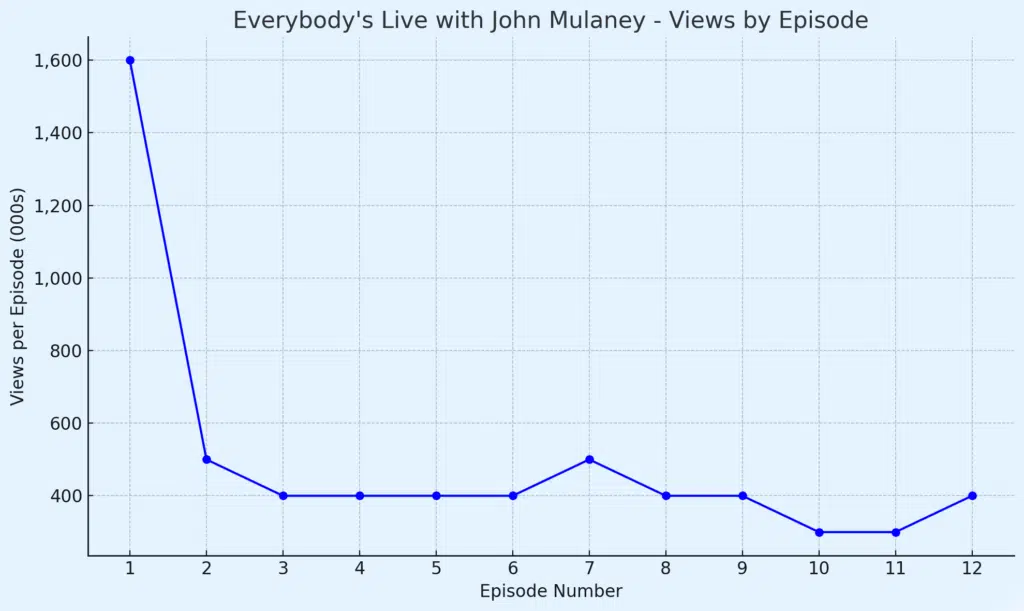 Since then, radio silence from both camps. And now that Netflix is tripling down on more proven and less costly podcasters from the ranks of Spotify and Barstool with no-frills versions of Mulaney’s more ambitious leanings I’m seeing the word “writeoff” in my particular crystal ball. But since you’ve made it this far, I’ll tease you with this–one of my forthcoming Nostradumbass predictions next week will posit that the idea of a live streaming interview show is anything but dead, and as fate would have it someone far more experienced than Mulaney may very well be ready to dive headfirst into those waters. Betcha can’t wait, right?