
To a generation of baseball fans the news that came down this week about the messy divorce between ESPN and MLB wasn’t a total surprise. The fact that BASEBALL TONIGHT is no longer a regularly scheduled program, let alone the appointment viewing it was in the 90s, should tell you enough about the network’s growing indifference to a sport that the cold hard reality shows has declining and aging national ratings, let alone a void in finding traction among Generations Z and A for relevance. So the news that FORTUNE’s Chris Morris reported yesterday was effectively dog bites man:
 ESPN is stepping out of the batter’s box. The Disney-owned cable channel and Major League Baseball are ending their 30-year partnership, and ESPN will no longer carry MLB games after this season, including the Home Run Derby and Wild Card playoff round. The split comes after ESPN attempted to renegotiate a deal that is set to end with the current season. While the league had the right to air 30 regular-season games as well as the aforementioned matches from 2026 to 2028, the price tag on that was $550 million per year.
“In recent years, we have seen ESPN scale back their baseball coverage and investment in a way that is not consistent with the sport’s appeal or performance on their platform,” MLB said in a statement posted on social media. “Given that MLB provides strong viewership, valuable demographics, and the exclusive right to cover unique events like the Home Run Derby, ESPN’s demand to reduce rights fees is simply unacceptable. As a result, we have mutually agreed to terminate our agreement.”
Still, the level of animosity and flame-throwing that came from the league and its leadership in the wake of the network’s decision was alarming. SPORTICO’s intrepid Anthony Crupi offered up these fact checks in a piece he dropped yesterday:
 MLB commissioner Rob Manfred’s assessment of ESPN’s place in the hierarchy doesn’t jibe with reality. In the letter Manfred sent to MLB owners on Thursday morning, he states that ESPN “was available in 53.6M homes” as of December 2024. According to Nielsen, the commish undercounted the house by more than 10 million subscribers; as of this month, ESPN and ESPN2 were both in 64.2 million households.
Manfred’s missive also included a curious statement about the overall state of pay-TV, which continues to lose share to streaming platforms. (In the past five years, approximately 42% of subscribers to the legacy bundle have cut the cord, with virtual MVPD packages reducing the impact to a 26% loss.)
“[We] do not believe that pay-TV, ESPN’s primary distribution platform, is the future of video distribution or the best platform for our content,” Manfred wrote, which is remarkable in light of the fact that 80% of MLB’s national TV games are televised by three cable networks (ESPN, FS1, TBS). In taking a jab at ESPN, baseball’s top executive also threw shade on two partners who still have another three years left on their respective contracts.
Crupi also offered up an intriguing and objective defense for ESPN with far more accurate numbers:
For ESPN chairman Jimmy Pitaro, a lifelong baseball fan, the numbers just didn’t add up. MLB wasn’t pulling its weight-at least not to the tune of $550 million per year in rights fees-and ESPN’s move to opt out of the two final seasons of the contract may be interpreted as an act of fiscal discretion rather than an austerity measure.
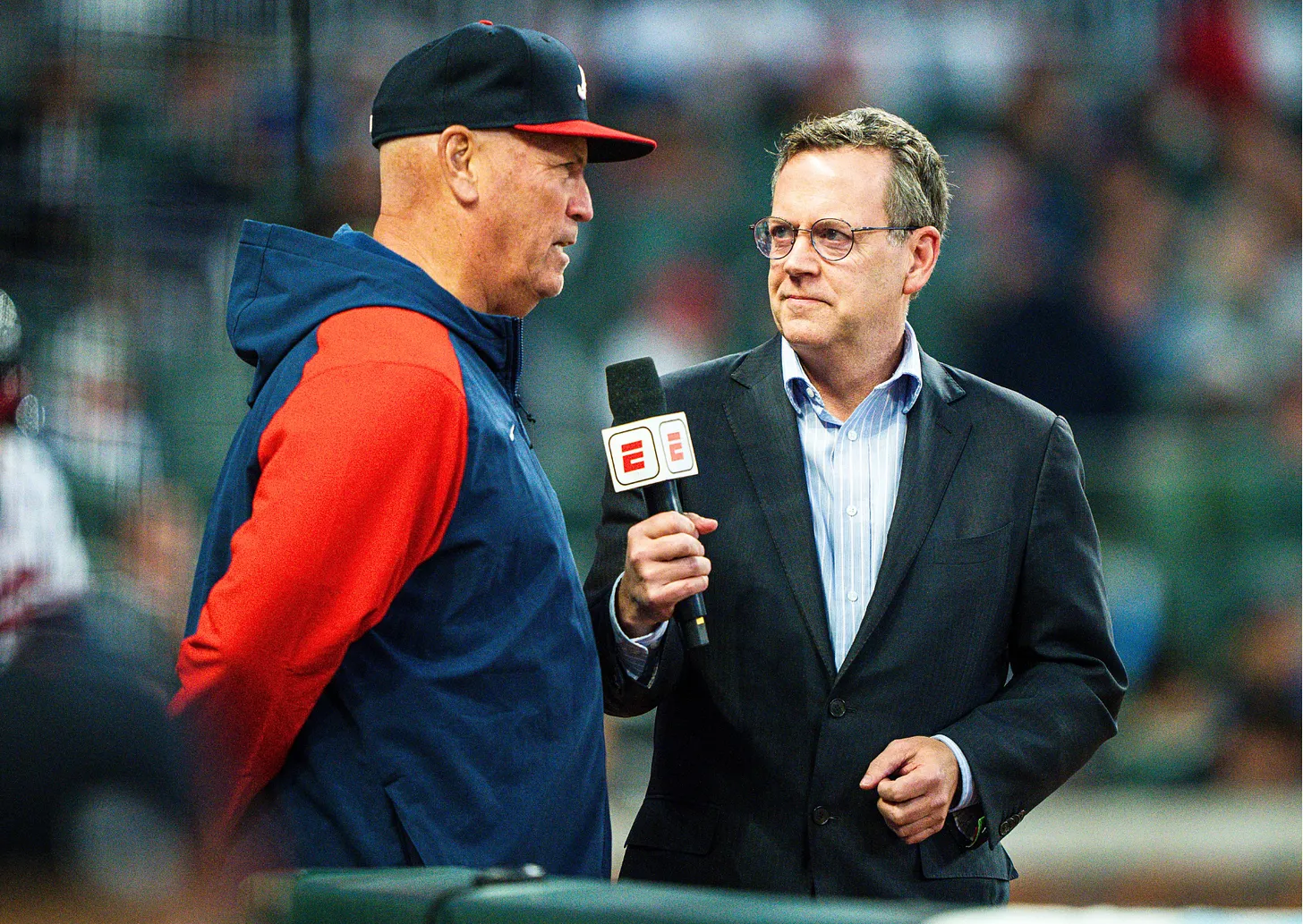 Perhaps nothing bears this out like the ad sales receipts. According to iSpot data, MLB games in 2024 accounted for 2.2% of the total national linear spend on the ESPN flagship, which translates to $58.5 million over the course of the season. While that’s not a negligible sum, it’s also eminently replaceable. The MLB package last year was ESPN’s 10th-biggest driver of ad sales revenue, trailing the likes of the NHL ($62.8 million), as well as the studio shows Get Up ($79.5 million) and First Take ($96.6 million). That advertising in MLB games only clawed back around 10.6% of ESPN’s annual rights fee is less an indictment of baseball’s older demos and the general state of the impressions market than it is a function of basic cable economics.
And therein lies the crux of the problem. The core audience is old and the growth opportunity is more global than domestic. There’s no women’s game or Caitlin Clark wannabe looming out there (and if there is, she’s playing softball). Don’t think a WNBA game of the week with windowing such as what the NBA is offering up for Sunday night over the next few weeks can’t fill a good deal of that revenue void.
It’s understandable that Manfred is feeling, well, a little hurt. Hell hath no fury like a jilted lover. But again according to Crupi, he’s apparently ready to mingle again:
Manfred told the owners that his team has been “in conversations with several interested parties around these rights over the past several months” and that he expects to have “at least two potential options for consideration over the next few weeks.”
There’s ample speculation that a globally-oriented streamer such as Amazon Prime Video, which has a growing stake in the sport’s rights via its alliances with several existing RSNs, or Apple TV+, which currently has a Friday Night package that still reviles old farts who can’t quite grasp why those trusty RSNs aren’t carrying the game those fans are conditioned to seek out, would be a viable play. But Apple already has MLS for its summer volume play, and even Amazon doesn’t have unlimited funds these days–James Bond didn’t come cheap.
So allow me to present an argument that might just entice an entity that is being initially dismissed as one that could be a wild card. Allow me to present Paramount Global/CBS.
 For all of the nostalgic second-guessing around the failed attempt to recreate the halycon days of NBC’s weekend games of the week with Peacock that came and went with little fanfare in 2023 it should be remembered that there was a three-year run in the early 90s when CBS had that honor. Just their luck that those years coincided with some god-awful years for the sport’s top three markets. But there is a history with the network, not to mention an even more storied one with CBS Radio. They may not have that these days, but they do happen to have assets like duopoly stations–independents and CW affiliates desperate for content–in no less than 13 current MLB markets (including Sacramento). They also have both linear (CBS Sports Network) and digital (CBS Sports 24/7) destinations where content currently relegated to MLB Network could easily be repurposed. And, the last time I checked, an audience profile far more aligned with the sport than any of those digital-first options.
And assuming they can get the monkey of the current administration’s pettiness off their backs, they will soon have in charge one Jeff Shell, who just happened to be the architect of the regional sports network cobbling at FOX after being lured to that camp after he attempted to put ESPN into that business at a time when it would have been far more fortituous for them only to see corporate priorities for the national business win out. So one would be hard pressed to find anyone who’s out there who’s more motivated to get back at ESPN–other than, of course, Manfred.
Besides, there’s a bigger picture play that will shortly be at stake, as OUTKICK’s Bobby Burack reminded:
According to the New York Times, MLB wants “to go to market with all its inventory” in 2028 to maximize its leverage. That would require the league to find someone to take ESPN’s package for just three years, making the product less desirable for potential new broadcast partners. For Fox and TBS, that’s not a problem. But again, that doesn’t guarantee the networks will view the package worth what ESPN did when it first signed the agreement.
 Paramount competes with both on the local and national level, and FOX will soon be entering the streaming wars as the epitome of an afterthought. And very quietly they have developed an attractive way to package volume content, using a wraparound alternative for its Champions League soccer coverage that pivots into a supplementary microchannel called CBS GOLAZO!. MLBN has attempted to do the same with its prime time offerings but with far less traction.
So what if the following arsenal of alliances was on the table:
- CBS broadcast gets rights to a summer package of national Sunday Night Baseball from 2026-28
- CBS broadcast gets TBS’ post-season rights and alternate years of World Series coverage in 2029
- CBS local gets over-the-air rights to games in the cities they own stations (including digital Dot Ones in those markets where they don’t have independents, such as Denver and Minneapolis), and aligns with MLB to sell over-the-top subscription packages for these games (a la Victory Sports).
- CBS Sports Network and MLB Network combine operations and nationally air selected games from those local channels on a regular basis (akin to what ESPN did non-exclusively with RSNs).
- CBS Sports 24/7 and MLBN create an MLB TONIGHT-branded subchannel to air wraparound shows in the vein of GOLAZO and, of course, pivot to the live games.
- Paramount Plus offers all of this–and potentially more–for a nominal monthly upcharge, and makes it all available where its global footprint may reach. (And don’t think this all wouldn’t help populate LANDMAN in Japan.).
Oh and let’s not forget the halo effect that making these entities all the more relevant and desirable would have on carriage and distribution fees.
Maybe there’s not a $550M/per year potential even with all of this factored in. But I’d strongly contend there’s more than $58.5M.
So there’s my modest proposal, gents. You all know where to reach me for clarification. For now, it’s time for everybody to kiss up and play ball.
Until next time…