I don’t get out all that often these days, but it’s far more because of my fiscal health as opposed to my physical health. I’m about to head yet again into the minus column in net worth, and if you can’t fathom how disruptive a prevailing feeling that is, more power to you.
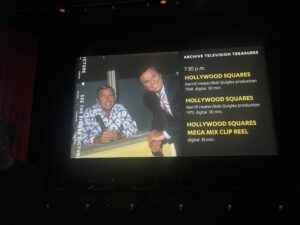 But last night was one of those rare occasions where no matter which health deficiency one was suffering from the power of attraction and value proposition wasn’t insurmountable. A dual celebration of the 60th anniversary of the classic HOLLYWOOD SQUARES and the respective centennials of its longtime “master” Peter Marshall and its flamboyant center square Paul Lynde, was held in the Billy Wilder Theatre in beautiful downtown Westwood, steps from the UCLA campus which archives classic and mostly non-You Tube uploaded content spanning the gamut of entertainment history. And to steal a phrase from a longtime competitor of theirs, the price (or lack thereof) was right.
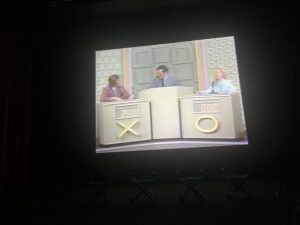 Marshall, Lynde and a majority of those who were the main drivers of the series’ first iteration are indeed gone, but that doesn’t mean their surviving colleagues and, most importantly, a surprisingly diverse mix of demographics of fans filled the theatre to see two episodes of the daytime version that served as the destination of choice for kids pretending to be sick so they could get the chance to be mesmorized by a full day of game shows in much the same manner that many of their moms were on a regular basis. The respective episodes from 1968 and 1973 were complete with commercials of the era which reminded those capable of appreciating it how much different it all was as compared to day. Multiple breaks within a half-hour were jammed with misoygnist, judgmental commercials for rug spray, bathroom air freshener, facial cream and margarine–not to mention a spot featuring notorious anti-gay activist Anita Bryant hocking discounts on Florida oranges. Juxtaposed in hindsight with a show that showcased a talent in Lynde who was at the time trying in vain to lead a closeted and ultimately tortured life that contributed to his premature death at age 55 shortly after the OG Squares finally ceased production after more than 4000 network and syndicated episodes it was humorous and poignant all at once–and a reminder to those still breathing indeed how far we have come. It’s your call entirely if you consider it progress or regress.
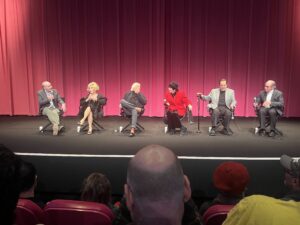 The capacity crowd tended to lean toward the latter, not to mention the arms of companions and/or canes necessitated by age. But their minds and memories for the most part were still razor sharp and provided some wonderful fodder in an engaging, albeit brief post-mortem. The more recognizable personalities were Squares-adjacent but nonetheless game show-reliant personalities of the era, the still-effervescent Jo Anne Worley, the one time femme fatale of 60s theatrical comedies and remarkably spry nonagenerian Ruta Lee and the still-active impressionist Rich Little. A bit more wrinkled and slower-moving (fer sure) than many of us would choose to remember them, especially those far less ambulatory than moi who seemed captivated by the mere idea of being in the same room with them.
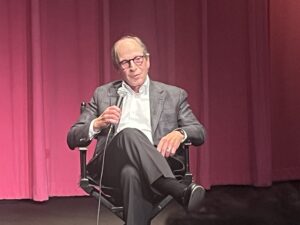 For me, the main attractions were one-time producers Harry Friedman and Jay Redack, both of whom I had the pleasure of collaborating with at various times in my own career. You might recognize Friedman’s name from his lengthy and Emmy-laden run as showrunner of the current versions of JEOPARDY! and WHEEL OF FORTUNE, and you’d be hard-pressed to find a more decent and generous human being in any facet of this business than he. His first significant game show experience was as a writer of the “zingers” that were given to celebrities as potential bluff answers to the game that relied upon contestants’ abilities to agree or disagree with celebrities’ responses to questions often phrased in ways that would drive network standards and practices executives into exasperated fits. Far and away the most nuanced and spryest member of the panel, his revelations of how much detail and planning went into that were the more captivating and informative nuggets that were shared.
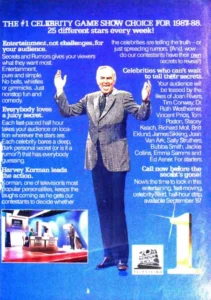 Redack, a bit more seasoned and it would appear a tad more sauced than Friedman was last night, was the actual showrunner for creators Merrill Heatter and Bob Quigley during the 70s and was later brought back for one of the show’s less successful reboots that featured Whoopi Goldberg as the center square. Our paths crossed in between those gigs when I was hocking a pilot for a show produced under his own banner called SECRETS AND RUMORS, a flimsy format built around celebrity gossip that attempted to elevate longtime CAROL BURNETT SHOW sidekick Harvey Korman into an emcee. I was assigned to shepherd Korman and Redack through New Orleans’ French Quarter where a thirty-foot billboard featuring a grinning Korman dominated the side of a building which he first noticed while the three of us were crossing a busy streetcar-laden boulevard. Korman somehow chose to blame me for it and in mock indignation loudly dressed me down in the middle of onrushing traffic, with a clearly compromised Redack doing his best to keep drivers at bay long enough for all of us not to be run over. Both men were substantially taller than I and I somehow wound up in between them while we lumbered through the Quarter after partaking of various cocktails and transvestite strip bars. The ever-recognizable Korman shouted to anyone who would listen “Look, we’re a W!!”, sending Redack into uncontrollable hysterics and me into a face far redder than even his was. It was far and away one of the most surreal and enjoyable nights of my life.
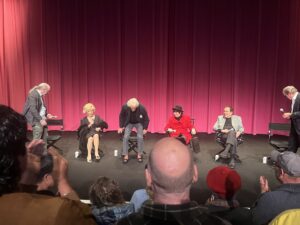 But it seemed like everyone in attendance–and Lord I knew plenty of them personally (at least I used to)– had similarly unique and ethced-in-stone memories, even if was just how connected they felt as mere fans of the likes of Worley, who appeared on literally dozens of game shows after her career-defining turn on the hit comedy-variety series ROWAN AND MARTIN’s LAUGH-IN, Lee, who also had a turn as Alex Trebek’s dice-rolling glam gal on his far less defining but not forgotten SQUARES lead-in HIGH ROLLERS, and Little, a frequent TONIGHT SHOW guest whose spot-on imitation of Johnny Carson would send the typically reserved host into hysterics and helped cement him as a Las Vegas staple who is still regularly performing these days well into his eighties. Maybe they’ve forgotten a few of the niggly details about their respective careers–heck, Redack was adamant that Sarah Silverman was telling dirty jokes on the 70s version despite the fact she was in her first decade of life at the time. But the fact he was more than willing to spill tea more accurately about a lot of others gave him a pass.
My lasting memory of the evening was the reminder that show business wasn’t always just business, and that was especially evident from the accessbility the grateful talent gave us all as well–not to mention Marshall’s surviving children and his lovely widow Laurie. People actually cared to learn our names and knew who we were married to, who and why we were divorcing and where our kids were going to school. What doctors we were seeing and what we were being treated for. What restaurants they had been to that they actually liked or not. As the on-stage participants expressed with unanimity the OG SQUARES was a family, even for those who were only occasionally part of it. For those I’ve known who were associated with subsequent versions far weaker connections emerged. Collectively over four actual series attempts and a couple of ill-advised spin-offs they barely added up to the longevity of the one that started it all 60 years ago. I’d contend there’s a common thread here as to why that was the case. How many of them ever formed a W with their colleagues?
Until next time…