
It’s been a pretty celebratory week so far if you happen to be a Democrat–slightly more so if you consider yourself a progressive. THE GUARDIAN’s Joseph Gedeon was downright gushy with his report of how it began on Monday:
House progressives, long dismissed as the Democratic party’s leftwing outliers, are heading into the next Congress in larger numbers than ever and vowing to push the new Democratic majority to the left. The Congressional Progressive caucus said on Sunday it will welcome more than 25 new members, including a record number who won in red districts, expanding its ranks to more than 105 lawmakers.
The caucus had 100 members in the last Congress. It endorsed nine candidates in competitive red-to-blue races and six won, including in seats Trump had previously carried…Six Democratic Socialists of America-backed candidates also won House seats in safely Democratic districts. Several were present at the press conference, including Darializa Avila Chevalier and Claire Valdez of New York, Donavan McKinney of Michigan and Chris Rabb of Pennsylvania.
But the progressives are not the only bloc growing. The centrist New Democrat Coalition, already the largest House Democratic caucus with 114 members, is expected to add about 39 members, 30 of them from flipped seats. The two groups overlap, but the New Democrats’ growth is concentrated in swing seats.
Throw in the significant wins in gubernatorial races and of course dear Nithya, and to me that’s more than enough reason for whatever shade of blue you consider your tsunami to be to be taking a win and looking forward. But if your or your obsession’s name is Angie Nixon, you’re not exactly popping balloons.
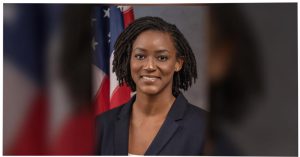 Nixon came agonizingly close to upending incumbent Republican Ashley Moody in the battle for Marco Rubio’s old senate seat in Florida, losing by slightly less than a quarter million votes in a battle that saw more than eight million cast. As THE ASSOCIATED PRESS’ detailed map confirms, she controlled the major population centers in the state’s major population areas–most notably Broward (Fort Lauderdale), Osceola (Orlando) and Leon (Tallahassee) counties. Alas, these markets’ respective toruses and the far more red-skewing exurbs were still red enough to return Moody to D.C. When the verdict was handed down last week, per CBS NEWS’ Manuel Bojorquez, she was understandably disappointed but nonetheless forward-thinking:
Speaking to supporters in her hometown of Jacksonville, where she held her election night gathering, Nixon acknowledged her defeat while making it clear she intends to remain politically active…Nixon expressed disappointment with the election results, acknowledging that her campaign had been outraised and pointing to Florida’s voter registration gap, which favors Republicans…”So Ashley Moody, you better get it right because we are coming for you,” Nixon said, referring to the next Senate election in 2028.
And as IDAHO LEARNING NEWS’ byline-shy editorial team added over the weekend, she’s already figuring out ways to address that affordability gap with a uniquely accelerated timetable to do so:
Moody, a Republican and former Florida attorney general, had been appointed to the Senate in 2025 after Marco Rubio resigned the seat to become secretary of state…. Nixon is launching the Never Scared PAC as her next political move. The new Florida organization is meant to keep her campaign’s voter and volunteer network active, and this article explains what Nixon plans to do next after the defeat…That context matters because this was not the end of a full six-year Senate cycle. Moody will face voters again in 2028, leaving a relatively short window for both parties to decide whether the next contest will look like a rematch or a different kind of campaign.
Sounds like a sound plan. But to an uncomfortably large and vocal portion of that support base, the typical orange groves of the area have been replaced with sour grapes. Ironically for fruit lovers, Don Lemon was the face of one such lament via Substance:
Angie Nixon confirms reporting that Chuck Schumer gave her ONLY $5000 from his Leadership PAC. She also reveals the DSCC only gave money to her campaign the DAY BEFORE the election “It was a failed opportunity, a missed opportunity…we need to have some tough conversations.”
And Salon’s senior writer Alex Galbraith took the whining up a few notches with this outright wail from late last week:
Florida narrowly missed the quake, with Republicans winning all the major statewide races by the thinnest of margins…no Democratic Senate candidate has come close to winning since Bill Nelson lost his reelection bid in 2018. Angie Nixon felt different. The Jacksonville organizer and bookstore owner ran a proudly democratic socialist campaign, advocating for universal healthcare in a state beset by multiple insurance crises and affordability issues.
But a close look at the rest of the Florida races reveals the culprit in Nixon’s narrow loss. Despite a gerrymander meant to calcify Republican supermajorities in the state and a political stiff in the form of David Jolly at the top of the ballot for governor, the GOP lost seats in the state legislature. The energy in Florida and, remarkably, throughout the South, was with anyone running against Republicans. The blame for Nixon’s defeat lies almost solely with national Democrats and their stubborn refusal to back Nixon with either messaging or money.
Look, Chuck Schumer is not someone anyone should fall on one’s sword for unless you happen to be staunchly Jewish or hail from Brooklyn (unless, of course, you found your way to Vermont at some point). Were he not such a willing and necessarily complicit stooge for AIPAC funding given the way his constituency votes, he might have the sechel to pass the leadership baton. But right now he’s got a pretty damn cushy gig and he’s almost understandably reluctant to give it up.
That conceded, it pains me to see how absolutely convinced Nixon’s team seems to be that his stinginess is THE reason she wasn’t elected. My kneejerk reaction based on decades of experience was to not so gently remind such thinkers that in my research experience I haven’t seen a causal effect between amount spent and votes cast. But that doesn’t mean it didn’t happen somewhere off my watch. And upon further review, indeed it has. THE EMORY ECONOMIC REVIEW’s Roger Chen authored a pretty exhaustive piece shortly after the 2020 election:
At first glance, there is a substantial claim that money directly affects an election’s outcomes. From 2000 to 2016, more than 90% of the highest-spending candidates in their respective districts were elected to the House of Representatives with only the 2010 elections dropping the rate down to 86%¹. Senate elections of the same time period also demonstrate similar, albeit with a slightly lower win rate of around 80%. Outside of just congressional races, money also acts as a predictor of the Presidential Elections. Out of the last eight election cycles, only the most recent 2016 election was won by the lesser spender, meaning that Donald Trump was the first presidential campaign to spend less money and still win, since Jimmy Carter last beat Gerald Ford in the 1976 election.
Further examination of academic literature further adds evidence that supports the initial claim. Multiple papers show a direct correlation between election spending and candidate recognition, especially for non-incumbent candidates. This means that those campaigns with the largest expenditures tended to be more likely to be remembered by their electorate³. Alongside recognition, there are also substantial claims that larger campaign financing leads to a larger percentage of votes won in the election. One paper found that a congressional candidate could increase their margin of victory from 3% to 60% by simply spending an extra $180,000⁴.
That sure seems to support what is driving the sort of reaction that’s clogging my social media feeds. But Chen’s next graf is to me one that has been pushed to the side:
(A)s indicting as these claims may seem, they may be a classic case of mistaking correlation for causation as there are various external factors that determine the amount of funding a candidate receives… the specific political affiliation of a region is a crucial factor when determining how much financial support a candidate may receive. If a Democratic representative was running for office in a traditionally red district, it is likely they will not win.
JSTOR’s Steven Sprick Schuster authored an even more academic and research-steeped piece just before that that points out a few more asterisks whose pica size needs to be increased:
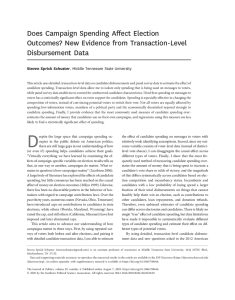 This article uses detailed, transaction-level data on candidate disbursements and panel survey data to estimate the effect of candidate spending… I find that spending on messages to voters has a statistically significant effect on voter support for candidates. Spending is especially effective in changing the composition of voters, instead of convincing potential voters to switch their vote. Not all voters are equally affected by spending; low-information voters, members of a political party and the economically dissatisfied respond strongly to candidate spending.
It would be accurate to assert that given where Nixon’s support was weakest Schuster’s study could certainly be used to beat Schumer et al over the head with in abject frustration. But even he strikes a cautionary note in his coda:
(T)he most commonly used measure of candidate spending overestimates the amount of money that candidates use on their own campaigns, and regressions using this measure are less likely to find a statistically significant effect of spending.
Translated: Simply flooding the smaller, cheaper areas where in hindsight Nixon could have been pushed over the edge with upbeat ads championing her platform was not necessarily the panacea that so many insist is why at the moment she’s on the outside looking in. It is those sorts of stubborn outliers for whom the tactics we so consistently reference as the playbook for Cambridge Analytica were so effective on in turning the tide of swing states and especially key counties that tilted the scales in the Republicans’ favor when most traditional polls right up to the final weekend indicated otherwise.
Turns out Galbraith was perhaps most spot on with his dual-pronged pitchfork that referenced money AND messaging. A particular type of messaging works best when the main goal is to induce someone to fill out a ballot as a movement might desire. A high-minded and decent candidate only carries so much weight in the real world.
Since Angie is currently seeking a gig, if she’s indeed the greatest Nixon to hit politics since Watergate then heck, nominate her to be Hakeem Jeffries’ replacement. There’s nothing legally stopping that besides protocol and I have a strong hunch her energy and optimism will counterbalance Schumer’s dour ‘tude. If people like Galbraith and Lemon think she’s the bee’s knees, then have at it, boo.
Or maybe if it’s determined that Nixon needs just a little more seasoning to be ready for her Cecil B. DeMille close-up just let her hit the MS NOW car wash and maybe book a panel appearance or two on REAL TIME WITH BILL MAHER. James Talarico’s busy now; someone’s gotta fill the void. And hey, if she needs an agent, she need look no further than Galbraith. The same day his SALON.com piece dropped was the same day that the venerable site whose legacy goes back to the AOL.com era announced it was going out of business. 
Ya see what’s possible when you attempt to compromise and strategize?
Until next time…