
I’ve recently been helping a friend compose his memoir about our times with different divisions of a company called Metromedia that preceded our mutual times together at FOX. As part of the process I’ve been helping his much younger though curious writer with background which forced me to trigger memories of exactly what I did to keep the distribution end of the company afloat during the corporate transition. And while I’ve previously mused about how the inexplicable success of the silly syndicated comedy SMALL WONDER kept us viable, I’ve neglected to mention that it was the rights to roughly 100 made-for-TV movies that provided a steady supply of revenue and sales opportunities for our team. Especially after we were able to successfully position them as cost-effective and necessary compliments to often more expensive titles whose demographic appeal didn’t necessarily align with the opportunities presented by primarily independent stations in prime time and on weekends against sitcoms, dramas and live sports. They had competed with similar challengers in their original outings and often produced credible, and sometimes stellar, results. And they often provided similar efficiencies for savvy stations who seamlessly worked them into their offerings. Our clients would often regale us with insider information as to how if we delivered eighty percent of a theatrical title’s rating for a third of the cost their beancounters were happy and everyone got to keep their jobs a little while longer.
 In the wake of Nielsen’s opportunistically timed release of a trove of 3Q26 data regarding how movies performed on measured streaming services, I was reminded of the fact that such relative context is valuable when one is trying to assess true success or failure. THE ANKLER’s Sean McNulty provided a Top Ten list in yesterday morning’s WAKEUP that reflected how even now those seemingly disparate worlds are actually more closely aligned in performance than one might initially want to believe.
Q3 2026 TOP 10 MOVIE U.S. STREAMING VIEWERSHIP CHART
- Super Mario Galaxy (PEACOCK): 21.7M views
- Project Hail Mary (AMAZON): 21.6M
- Masters of the Universe (AMAZON): 19.2M
- The Whisper Man (NETFLIX): 19.1M
- The Last House (NETFLIX): 17.8M
- 72 Hours (NETFLIX): 17.3M
- The Sheep Detectives (AMAZON): 17M
- Toxic: A Love Story doc (NETFLIX): 11.7M
- Why Did I Get Married Again? (NETFLIX): 11.2M
- The Devil Wears Prada 2 (HULU & DIS+): 10.9M
McNulty was careful to provide a series of caveats that, if nothing else, reminded his readers that there were a host of qualifiers–among them, the gnawing reality that a view is not necessarily a viewER. But what was indisputable was that six out of the top ten–including all of Netflix’s top five performers–were straight-to-streaming premieres.
But in the eyes of self-described data nerds like the needlessly pseudonymed Entertainment Strategy Guy and his partner in niggliness Brandon Katz that merely provided them the opportunity to draw a line in the sand and proclaim that, in their inexorable view, Netflix pretty much sh-t the bed.
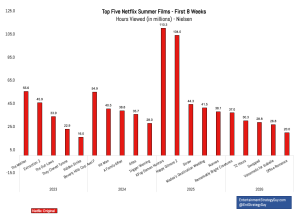 Not a single Netflix original film released between May and August this year opened above 20 million U.S. TV hours, per Nielsen. That benchmark usually serves as the EntStrategyGuy’s floor for a streaming hit on Netflix. None of these films enjoyed a hit-cementing single week of 20-plus million hours during their runs.
Zooming out, the picture looks even worse. In 2026, Netflix’s five biggest scripted summer films posted the lowest average (28.6 million hours) and median (28.8 million hours) eight-week viewership totals of the past four years.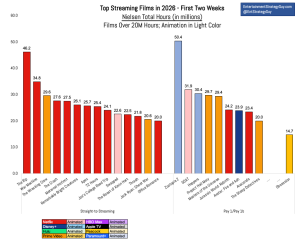
And as Katz continued his agenda and bias became even more obvious:
(O)verall, I think it’s fair to say this was a quieter summer season than we’re used to seeing from the market-leader. You might not realize that given the language commonly used in public analysis…Netflix is the only major streaming service to publish weekly first-hand viewership data and annual engagement reports. Naturally, some headlines borrow their first-hand framing. Other streamers benefit from their comparative lack of transparency. They may occasionally announce vague performance platitudes such as Apple TV’s Mayday becoming its “biggest film debut on the platform to date over its first 18 days,” and that it ranked No. 1 with left-handed viewers in its first weekend. (Fine, I made up that second one). But, for the most part, they keep first-hand viewership shrouded in mystery to avoid bad press.
It’s painfully evident that Katz may have at least graduated from the total bullcrap of intended viewership that his previous employer Parrot Analyticss utilized; he’s now a director at a firm called Greenlight Analytics. But he still hasn’t spent a day as a buyer or seller, and that lack of experience both colors and discredits his narrative. Streamers which do not rely heavily on advertising revenue utilize key performance indicators as their metrics of consequence; viewing hours is merely one of them. Equally if not more significant is their ability to retain or even recruit subscribers and drive consumption of additional titles. And since a heavy chunk of the balance of Netflix’s more popular inventory are original and acquired comedic and dramatic series the likelihood that titles designed to appeal to that demo more than likely do a way better job along those lines than theatricals.
 I don’t come to those conclusions merely on what Netflix shared with myself and my Sony colleagues by necessity. I also base this on that aforementioned information from the station community during those halycon Metromedia days and the dozens of duplication and flow studies I commissioned when I was on the buying side of the equation at what became the FOX owned-and-operated stations. We used that information to better schedule titles in later runs as well as optimize on-air promotion between them. Today’s data scientists at every streamer use even more accurate platform-specific and proprietary analyses to achieve the same sort of results.
Not even when Katz attempted to explain away why he feels so ignored did any of those topics get addressed. But he did sort of hint at some level of self-awareness when he tossed out this dismissive aside:
TL:DR version: Streaming-exclusive movies are asked to do different things than theatrical movies, but that doesn’t mean they should escape judgment. Both still need to draw enough eyeballs to justify their cost within the proper performance contexts.
Indeed they do. But the contexts are defined by the end user, not by “entertainment strategists” that don’t even try to consider what actually does matter, or worse still chooses to be willfully ignorant in order to drive clicks. You develop that nuance with experience or at least the desire to learn from those that have it. My lines are open in case for anyone who might want to avail themselves of it–and it’s pretty clear in this case Mr. Katz and his nameless comrade might benefit from it.
Let’s go, Brandon.
Until next time…