
Another day, another reboot. Those streaming services certainly seem to be on autopilot in so many ways. I’ve come to grudgingly accept the fact that in this era algorithms far more than human analysis determine which shows get prioritized for promotion and KPIs rather than actual ratings–or whatever the automatons call their respective metrics of consequence–are the tools of ignorance employed for the post mortem. But I’m a lot less tolerant when the “development process” to determine what actually gets made in the first place inevitably pivots to pre-existing IP because the titles and characters have some degree of familarity and the thought of reviving interest and engagement in OG versions laying dormant within libraries is cited as an impetus for it.
After my marginal (to be kind) experience with THE VARNELL HILL SHOW, Paramount Plus’ attempt to return to the world of the 90s niche hit MARTIN, I was quite concerned that Netflix’s revival of A DIFFERENT WORLD would suffer from the same sort of issues that have plagued these sorts of reboots, reinventions and reimaginations of once-cherished sitcoms and the inevitable comparisons to their beloved OG versions.
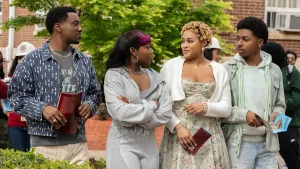 I’m very pleased to say that for once a re-whatever has been pulled off with the kind of writing, casting, execution and attention to detail that made the 1987-93 version appointment viewing such a beloved portion of must-see TV for NBC. It’s all ivery much in evidence in the 1o episodes of the reboot that I breezily binged last night. In hindsight, I probably shouldn’t have been all that surprised , since the original version was itself hastily retooled after its first season. It was originally designed as a spinoff of and a companion piece for THE COSBY SHOW–merely the singularly most impactful prime time series of the 20th century IMO. It followed its “good girl” daughter Denise Huxtable to Hillman College and indeed introduced her to a “different world” than she had been used to growing up in privilage as a doctor’s pride and joy. As such it was guaranteed to become television’s second-most viewed series on those factors alone. But then the actress who portrayed Denise, Lisa Bonet, decided to expand her career and life boundaries in ways that didn’t align with the high moral standards of Dr. William H. Cosby E.D. –a nude theatrical scene and getting pregnant were deemed verboten. So Denise was written out of the storyline after season one and the show was retooled to focus exclusively on the Hillman denizens.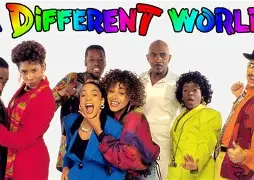
In hindsight, the disassociation with Cosby was the best thing that could have happened to the program–along, of course, with the fortitutous choice to cast Debbie Allen as the de facto show runner. Allen just happened to be the younger sister of Phylicia Allen Rashad, who as Claire Huxtable was considered pure gold by Carsey-Werner and was fresh off the surprise syndication hit FAME that a few years earlier occupied the same Thursday night time slot that the Cosby-produced duo did. She also brought direct experience as an alum of Howard University, arguably the crown jewel of all historically black colleges and universities. She centered the series around the distinctly voiced and complex Whitney Gilbert, endearingly brought to life by the captivating Jasmine Guy, and her quirky but earnest eventual romantic partner Dwayne Wayne, who Kadeem Hardison elevated to a level of respectability not seen by similarly envisioned “black nerds” like Steve Urkel and Raj Thomas that were otherwise popular at the time. They are both back for this go-around, and serve as the jumping off point for what is effectively “Hillman: The Next Generation”. THE HOLLYWOOD REPORTER’s Angie Han picks up the narrative:
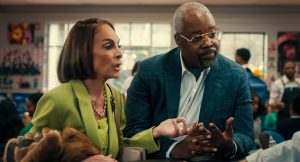 (O)ur new protagonist is a literal descendant of the old protagonists. College freshman Deborah (pronounced Deh-BOH-rah, never “Debra,” and played by the irresistibly radiant Maleah Joi Moon) is the youngest daughter of Whitley (Jasmine Guy), now a cosmetics mogul, and Dwayne (Kadeem Hardison), now the school provost. She’s also something of the family’s black sheep, the well-meaning but impulsive one who can’t seem to stop getting into trouble.
Said trouble often though not always involves Shaquille (Cornell Young IV), a childhood friend turned serious NFL prospect and fellow Hillman freshman, who just so happens to be the son of Whitley and Dwayne’s college buddy Ron (Darryl M. Bell). Around these two families, creator Felicia Pride, along with returning director Debbie Allen, builds out a whole updated universe that’s rich with Hillman history at every turn: from the returning characters (among others, Cree Summer’s Freddie recurs as a professor), to the buildings named after non-returning characters (Vernon Gaines Library, Walter Oakes Stadium), to the dialogue referencing the decades-old exploits of all of the above.
VARIETY’s Aramide Tinubu added some additional nuance and shout-outs:
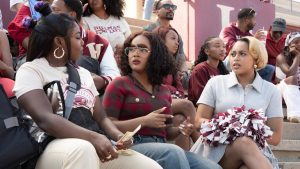 Artistic but flighty, Deborah ends up at her parents’ alma mater when an unfortunate incident gets her NYU Tisch School of the Arts acceptance rescinded. Timely and fresh, the new series distinguishes itself from the original while paying homage to everything that made its predecessor so iconic. The 10-episode first season, which chronicles an entire school year, opens amid the chaos of move-in day. Deborah is attempting to make sense of her schedule, but she isn’t the only one trying to find her footing at Hillman. She rooms with Rashida Duvall (Alijah Kai Haggins), a no-nonsense scholarship student from Compton who quickly grows frustrated with Deborah’s nepo-baby, scatterbrained antics. Rounding out their trio is Hazel (Kennedi Reece), a sweet, naive young woman, completely sheltered by her conservative upbringing but determined to follow her Michelle Obama dreams. In the boys’ dorm, Shaquile Johnson , Deborah’s old flame and Ron Johnson’s only child, hopes to put the Hillman football program on the map. Turning down a Division 1 university for Hillman, he finds himself rooming with Kojo (Chibuikem Uche), a Nigerian-Ghanaian U.K. transplant and Amir (Jordan Aaron Hall), a queer Harlemite piecing his life back together after a misstep or two.
It is both the loving attention to the clearly beloved first edition and the diverse and inventive casting of this one that makes this version so appealing. There’s literally someone for everyone to identify with and root for, and one can’t help but do that. If I know anything about Gen Z–and granted I’m not the expert–I know they desperately want to see representation that connects with themselves and accurately reflects the world they contend only they really know. What I come away with is a similar appreciation for such a cornucopia of personalities that I did with FAME at a time when I was part of that generation. Allen’s imprinteur on that show–especially once it left NBC for its groundbreaking run that reinvented first-run syndication freed from the shackles of broadcast network nervousness–was unmistakable, and she clearly has applied that keen eye and appreciation here. Netflix has wisely left her to her own devices, and the results are leaving even the most cautious of critics cheering in its wake. A prime example is how THE WRAP’s Diedre Johnson reacted:
Not every reboot lives up to the hype but Netflix’s follow-up to the beloved series may do just that. It has a sexy new cast (check), the return of fan favorites (check), enthralling torn-from-the-headlines storylines (check), a more realistic look at the life of a Black student navigating a Historically Black College (HBC) (needed), a more transparent look at Black culture on a Black campus (appreciated) and not a laugh track within earshot. TV newcomer and Broadway actor…Moon plays their youngest scion with willfulness on steroids, setting a dynamic with her parents and others that plays throughout the season. And things don’t always look good for the girl with the wealthy parents. Apparently, she is at Hillman for previous academic mistakes. She is intelligent but not too mature, smart but has learning difficulties, talented but not focused and so on (not unusual challenges for college students). Moon nails Deborah’s assertive but insecure nature with no look-at-me acting within the 30-minute show space.
And much like its previous incarnation, this edition of A DIFFERENT WORLD has been teed up for success. Today’s equivalent of a cushy “:30” slot is a highly promoted presence on a platform that has rejuvenated far less worthy series with infusions of eager chillers drawn into once-ignored titles by eye-catching thumbnails. This is getting the usual level of priority homepage placement that a premiere gets on Netflix–and kudos to the schedulers (take a bow, Andy Kubitz) for slotting this on a non-holiday weekend when just about every college anywhere is now in session. These days, viewers in college dorms with unique IP addresses watching on tablets indeed count for platforms. If I know anything else about Gen Z—again, I’m no expert—is that they do love to binge on those devices when they’re given a reason to do so. I will contend I far more about that then I do about what they consider to be representation. I can’t fathom that this isn’t going to work.
Thank you, Hillman College, for restoring my faith that it’s indeed still possible to do a reboot the right way after all. You’re a different world that I actually want to be a part of.
Until next time…