
Heat waves and an aging prostate don’t help my sleep cycles or my migraines, so I confess to slightly more doomscrolling lately than might otherwise be recommended by any legitimate medical professional. In these challenged conditions in a darkened room with binaural beats playing on my CozyBand headphones, I go out of my way to avoid the more obvious triggers for additional pain and consternation such as the array of schmendricks that devote WAY longer TL;DR rants and run-on sentences that even moi toward bitching and complaining about the world’s greatest golfer and sharter that I sometimes default to. And yeah, I pay for it bigly when that happens.
So I’m actually grateful when I happen to land on stories like the ones I did last night that actually reference a discipline and a career path that I have been fortunate enough to have been part of for the majority of my adult life that has been either eliminated or eschewed by seemingly countless companies. Call it audience engagement, analytics or heaven forbid merely research–just don’t oversimplistically call it data science. Actually connecting with the users, consumers and fans that REALLY determine success and failure has lately far too often been treated as an afterthought or a source to manipulate a parochial narrative.
The first was courtesy of AWFUL ANNOUNCING’s Sam Neumann which originally dropped last Friday:
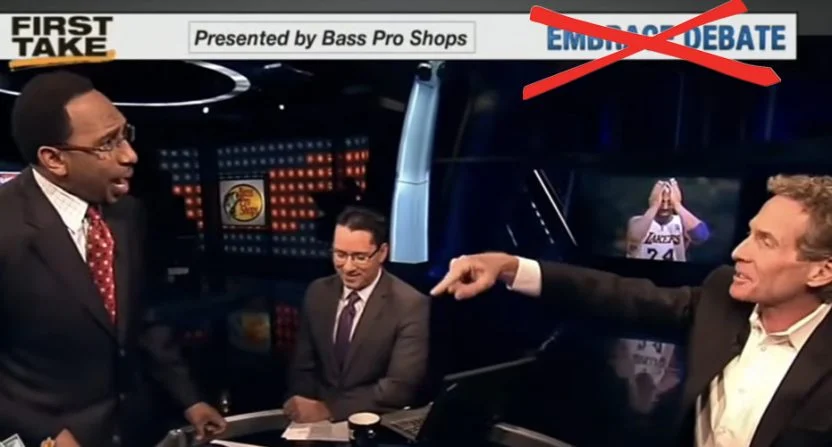 ESPN is trying to distance itself from the studio format that built its daytime lineup for the better part of two decades, according to new reporting from Puck’s John Ourand. At a Bristol town hall this week, newly elevated executive Mike Foss told a room of roughly 100 staffers and talent that he wants the network to “embrace authenticity” rather than manufactured conflict.
Foss, promoted two months ago to executive vice president and executive editor of sports news and entertainment, brought internal research showing ESPN’s brand of synthetic debate isn’t resonating with viewers the way it used to…The distinction Foss drew was between talent being genuinely combative on their own and producers pairing people up specifically to manufacture disagreement. In his write-up, Ourand pointed to shows like Pardon the Interruption, where hosts are just as likely to be found agreeing with each other as they are to be closer to what he wants going forward.
Awful Announcing has learned that the meeting itself was a standard monthly gathering Foss holds regularly, though turnout ran well above normal with football season approaching. Notably, the room included a wave of first-time attendees from NFL Network, now that the dust had settled from the layoffs that hit that group particularly hard. Awful Announcing has also learned that a return to a more highlight-centric SportsCenter came up as a specific example of the kind of show Foss wants moving away from manufactured debate and toward their authentic individual identities.
 What made this especially uplifting news was that this was a return to an era where I knew and envied an ESPN research culture run by highly respected and empowered researchers such as Artie Bulgrin, now happily retired with arguably too much time to be frustrated by his Mets, and Barry Blyn, the heir to his legacy who has since moved on to help steer Amazon Prime Video’s increasingly robust sports portfolio with similar levels of insights and actionable recommendations. Their successors were almost never sourced in any sort of reporting or regurgitation as much as these gentlemen are, and the one lament I have in this case is that Ourand–a veteran of cable trade publications–didn’t reach out to the team that worked on Foss’ study for background as his colleagues typically did to the likes of Bulgrin and Blyn–and at times me when I was working on attempting to compete with this monolith with far less internal support and respect than they received. So even seeing ESPN research cited at all was a most encouraging throwback. The fact that I wholeheartedly agree with Foss’ playbook is secondary to the fact that he invited research to the big boys’ table to help him write it.
And with algorithms being what they are, it then led me to a post that I embarassingly admit is more than a few months old from SOURCED WIRE’s nameless platform:
Philanthropist Connie Ballmer gave $80 million and an anonymous donor contributed $33 million, nine months after Congress clawed back $1.1 billion in forward appropriations from the Corporation for Public Broadcasting.
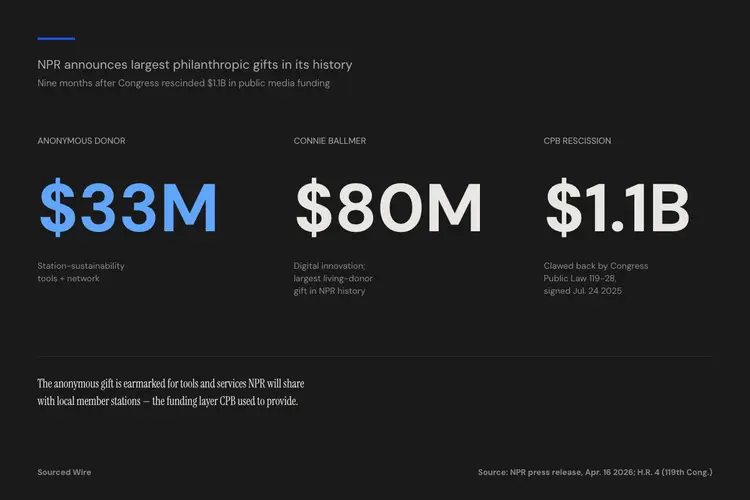 In the press release, NPR said Ballmer’s $80 million will support digital innovation and audience-building work. The anonymous $33 million will go “towards strengthening and increasing the sustainability of the NPR Network, enabling NPR to build and acquire tools and services that will be shared with public media organizations serving communities across the nation.”
That distinction matters. NPR’s own direct federal funding was roughly 1% of its budget. The CPB appropriation flowed primarily to NPR’s 1,000-plus member stations — some rural stations received more than half their revenue from the federal grant — and to shared infrastructure those stations could not afford to build individually. The $33 million anonymous gift is explicitly earmarked for that infrastructure layer: audience analytics, fundraising tools, and digital services built once at NPR headquarters and distributed to member stations.
The anonymous donor was not named. NPR did not disclose whether the $33 million is a single gift or a series of pledges, or whether the donor has given to NPR previously.
 That’s a shame. I would love to celebrate this personat least as much as I celebrate the ESPN teams of past and present. Instead, I’ll have to at least shout out NPR President and CEO Katherine Maher for at least remembering that having some sort of interaction that moved beyond awarding a tote bag for donations was worthy of being considered a tentpole of whatever attempt at resurrection she’s hoping to pull off.
My bad that this all apparently went down sometime around April 16th. Maybe if someone like Heather Delaney Reese had noticed I might have picked up on it sooner. Considering the poilitical ramifications of such empowerment I’m quite surprised she didn’t.
Because research–especially when it’s done by the right kind of people with a sufficient amount of internal support–is a LOT more interesting and meaningful than any sort of synthetic debate. Mike Foss figured that out. Maybe Reese and her fellow blatherers should follow suit?
Until next time…