
 A highly auspiced and exceptionally well compensated competitor of mine who was the first of us “research gurus” to earn the title of president used to troll those of us who weren’t quite blessed with a strong portfolio of networks by mocking our attempts to show we were much more competitive with his by referencing our efforts to show we had audience that good old Nielsen couldn’t quite measure as “frankenmetrics.”. At the time–around the beginning of this century– he was perhaps justified with such smug arrogance. The main issue we were all dealing with was merely audience fragmentation across literally hundreds of insurgent and upstart digital cable networks our employers were dizzily launching. Individually a majority were insignificant, but collectively they were gaining enough traction for said employers to be simultaneously optimistic and fearful. Dr. Frankenmetric mostly chortled at our challenges and was especially dismissive of any data or custom studies we’d produce to try and demonstrate the reality of what we all intuitively knew was going on based on our own behaviors and especially those of our kids and their peers–the ones who were teaching us how to navigate DVRS and these ever-evolving cellphones in our pockets.
As we all know, as the 21st century went on and a new generation of target viewers evolved fragmentation eventually expanded to non-linear media and alternative video entertainment options. In the first year of the second quarter of that century that we are now in that splintering is even more obvs than ever–one only need look at the massive and inexorable declines in the size and demography of traditional media, not to mention the collective devaluing of those cash cows-cum-albatrosses that we all willingly serviced, for proof. The big picture question for those now tasked with the duties Dr. Frankenmetric and the rest of us once were–with mostly significantly smaller titles and compensation–is where did the people go and can we actually still find ways to reach them with our content and especially the ads that accompany them?
 Well with Dr. Frankenmetric now happily retired this has opened the door for new media gurus to step in with fresher and more open approaches, and since most of us no longer have the staffing and budgets to support such herculean efforts that means someone like the Philadelphia Freedom warrior Evan Shapiro, he of the eponymous ESHAP consultancy and the self-proclaimed media cartographer needs to step in and do the heavy lifting. And so he did this week with the timely release of what he would contend is a much needed reframing and as comprehensive a lens as anyone has yet been able to provide on just WTF is actually going on. With the provocative clickbait TRADITIONAL MEDIA: AN AUTOPSY, he addressed a Paris crowd and his subscribers with this:
These 👆 are the results of a massive, Media measurement mission: Create a global cross-screen index to track the total attention of today’s consumers, regardless of which screen they use, across all the generations of the planet.
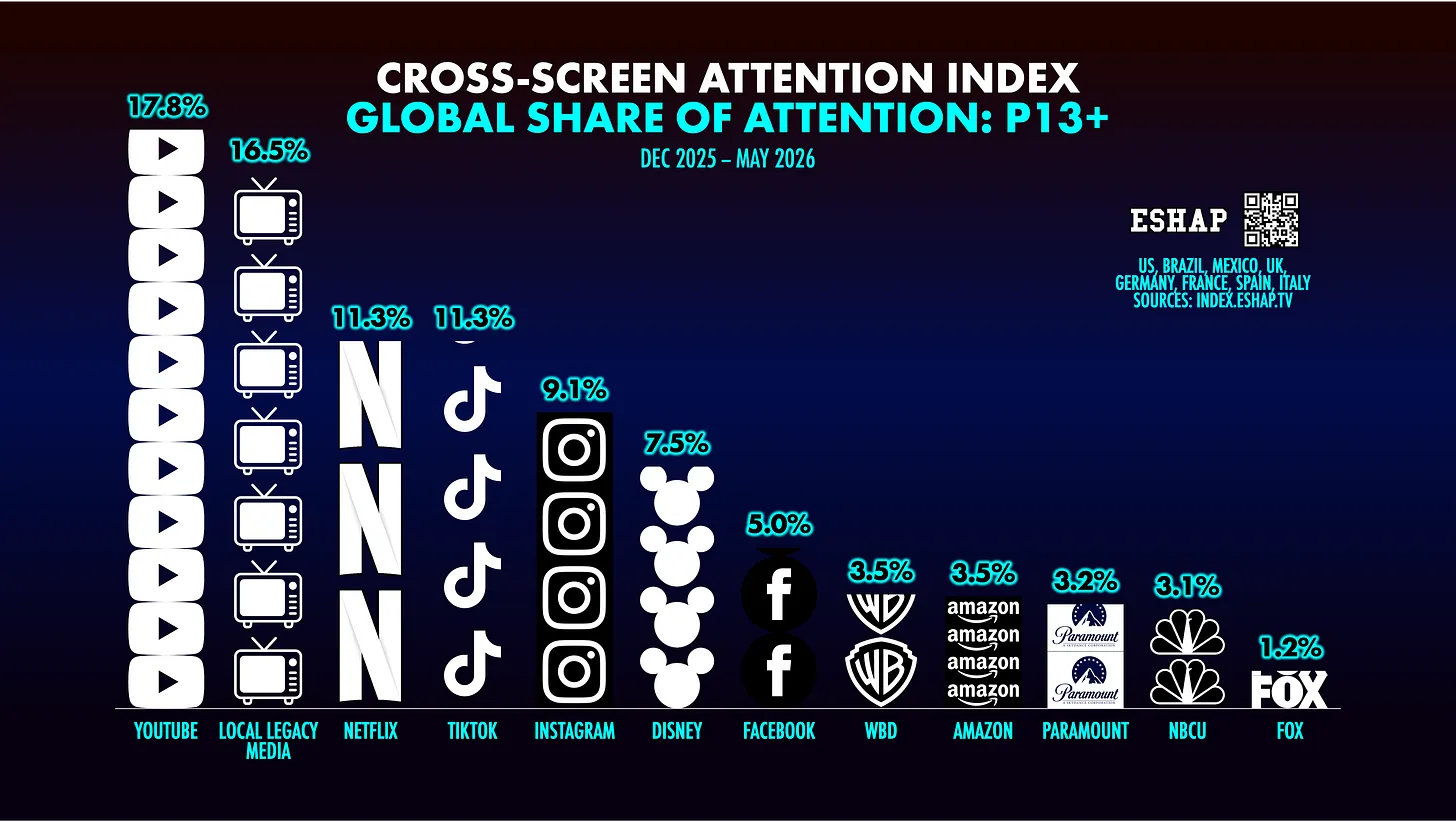 THE ESHAP CROSS-SCREEN ATTENTION INDEX — a FREE, interactive dashboard for global attention, across eight countries (US, UK, Brazil, Mexico, Germany, France, Spain, and Italy) — is NOW LIVE AND ONLINE.
Shapiro has employed what is arguably the most egregious and liberal utility of “Frankenmetrics” ever to achieve this result. As he confessed in his newsletter, he threw a lot of ingredients into this particular food processor:
To achieve this, the ESCAI incorporates a Sovereign Boundary Model: with hard, quantitative ceilings locked down entirely by local, currency-grade telemetry logs (Nielsen, BARB, Médiamétrie, Comscore, Sensor Tower, etc.). Rather than asking consumers to estimate their viewing hours, the index uses this codified telemetry to establish absolute macro volumes.
Behavioral data from GWI Consumer Diaries is introduced strictly as a coefficient matrix to map friction points and calculate the mathematical overlap when two devices are running in the same room.
He further qualifies his findings with some pretty stringent qualifiers that at least attempts to be fair and balanced:
(L)egacy currencies rely on passive boxes in empty rooms — counting televisions playing to heads buried in phones as “active viewers.” Instead, we use behavioral data to verify actual human presence and device co-activity. By injecting human reality back into blind hardware metrics, The ESCAI enforces the absolute laws of human physics and accounts for time as a non-elastic, zero-sum commodity — a closed market sponge.
 To a research purist, this all could be arguably an anethema. Not all of these resources are fully accredited and admittedly incomplete even within their own regions, let alone the global footprints many now service. And nowhere to be found are currencies that apply to specific networks or programs that can at the moment be used to negotiate advertising deals, which is of course the main focus of any media company these days.
But in a world where said advertisers have chosen to accept self-reported scorecards from monoliths like Netflix and Amazon, and as we’ve reminded you on numerous previous occasions they all have their own parochial key performance indices to determine which shows get renewed or not–goalposts that continue to get moved arbitrarily and frequently often depending upon what side of the bed a top executive woke up on–a Cross-Screen Attention Index is both a welcome and frankly necessary purview to help us all actually make sense of where we are and better prepare for where we are headed. Even if it’s potentially a brick wall.
As usual Shapiro is aggressive and unapologetic in his diagnoses. Here are some of his more provocative takes:
- While Local & Global Traditional Media in all eight countries continue to draw attention from local consumers, their businesses have become senior living societies — disproportionately dependent on the shrinking minority of their populations over the age of 55.
- For the supermajority of audiences in all eight regions (people 54 and younger), YouTube now dominates our collective attention.
- However, TikTok is coming on, fast. In the US and many other regions, TikTok is now #2 with consumers under 55 for total attention paid each month, #1 with consumers under 35, and actively threatening YouTube’s attention title with all consumers under 45.
- Netflix is strong in many of these regions. Yet, they appear vulnerable to phone consumption around the world.
- Netflix loses to YouTube in every region. More urgently, they are now behind TikTok for total cross-screen attention with consumers 13-54 in the US, the UK, Brazil, Mexico, Germany, France, Italy, and Spain.
- For audiences 13-44 Netflix loses the battle for attention to Instagram in five of the eight regions: Brazil, Mexico, Spain, Italy, and the United States.
- When we collapse Facebook and Instagram into a de-duplicated Meta metric, Meta sweeps Netflix in all eight regions for users 54 and younger.
- On the interactive Cross-Screen Index, we allow you to toggle the data to combine or separate IG and FB into one metric for Meta. However, we measure Instagram and Facebook separately in this report, as they have dramatically different user-bases.
- 53% of Facebook’s user-base in these eight countries is over 55, whereas 90% of Instagram’s audience is 54 or younger.
- YouTube still beats Meta in all these regions among consumers 13-54, but not by much.
- Global Trad Media in The Index — Disney, Fox, Disco Bros, Paramount, NBCU — play differently in various regions, but their total lack of cross-screen strategy has them losing badly to Global Big Tech platforms in all eight territories.
- All of the Trad US Media giants fail to secure even one #1 or #2 spot among people 13-54 in any of the eight regions that we cover — including their home territory.
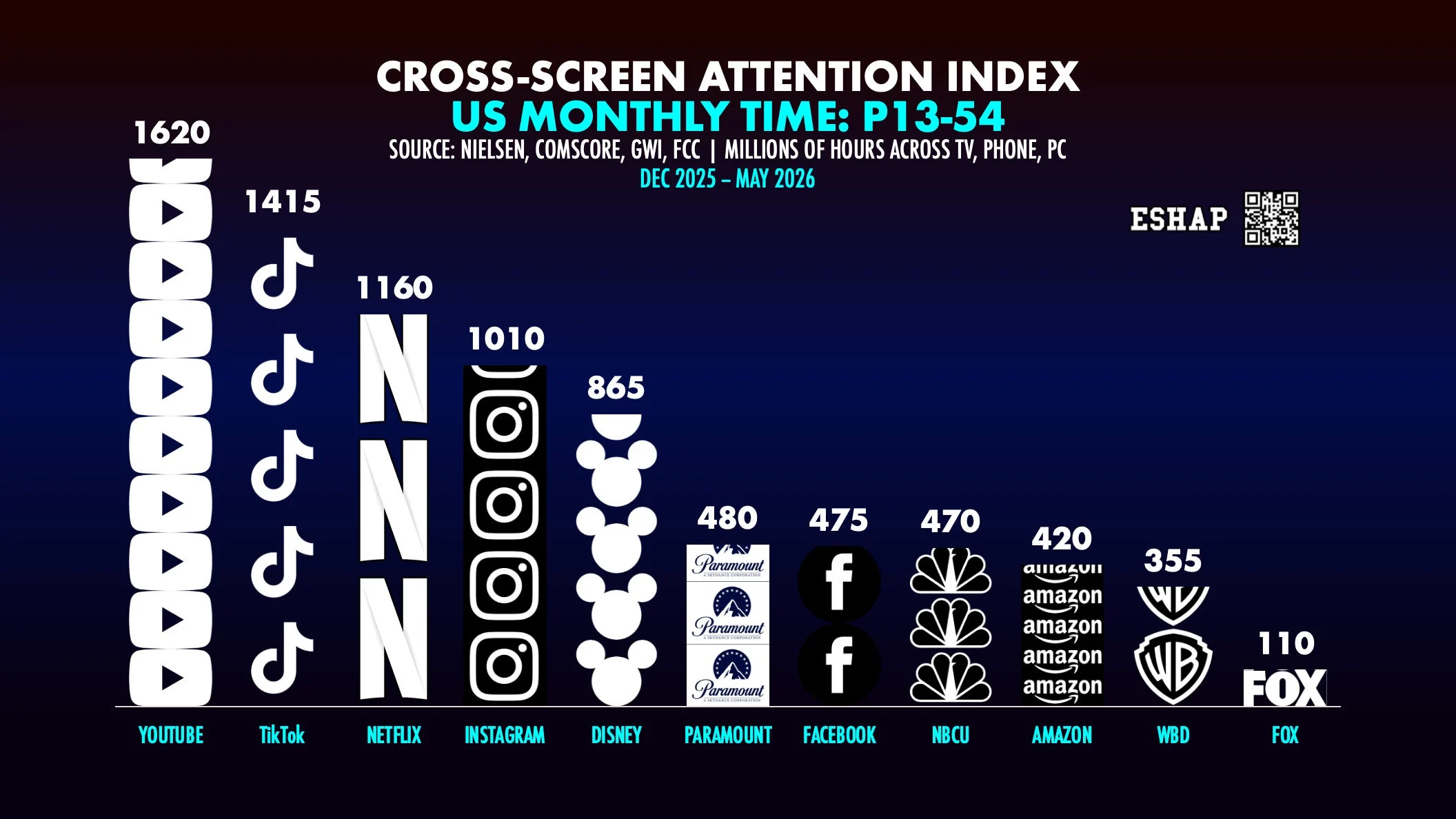 Do take a closer look at the trends he unearths as he parses the data down to emerging generations now only beginning to gain relevance. What’s already a big deal today bodes to be a way bigger deal tomorrow.
 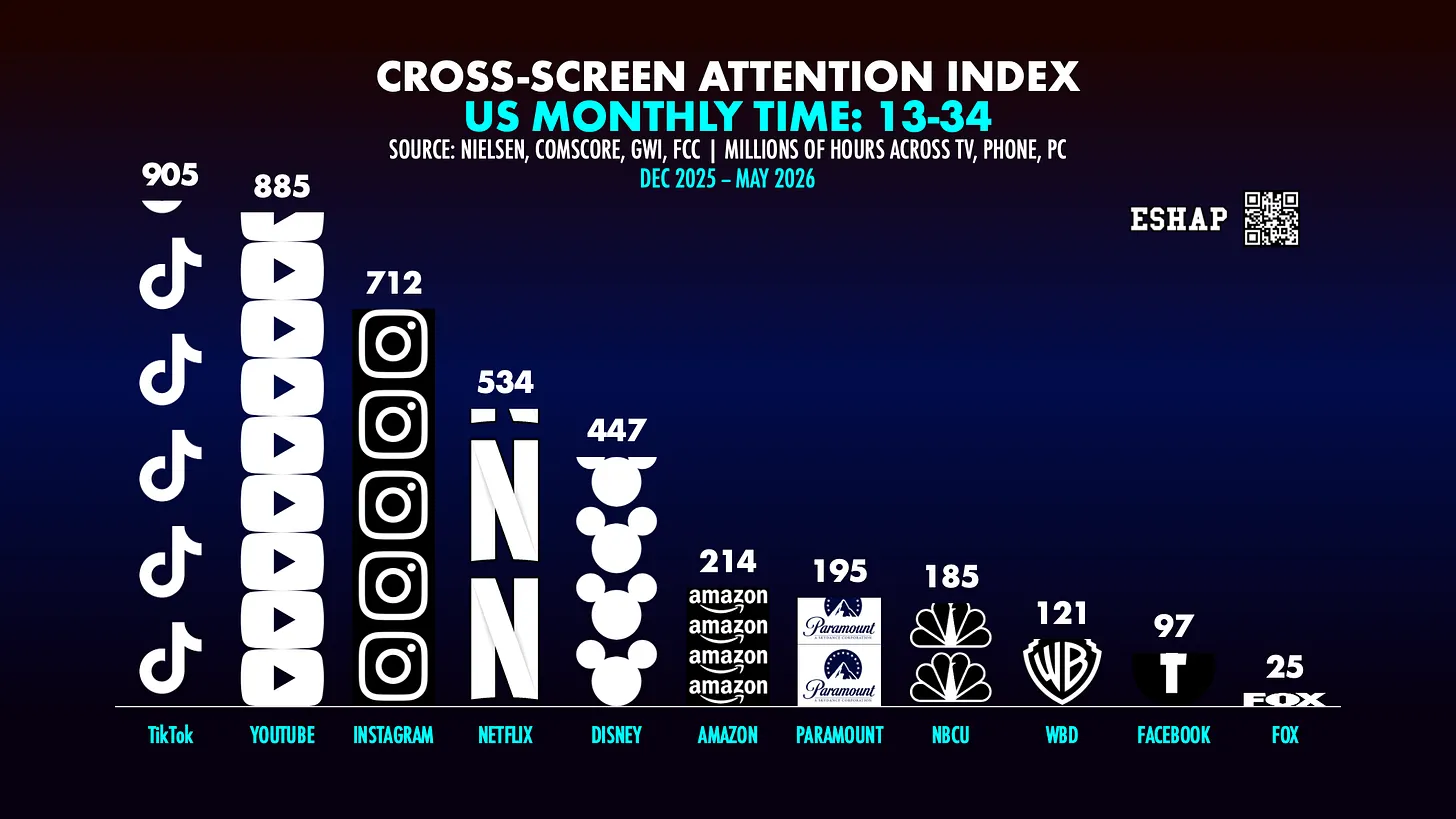 Maybe many of us won’t necessarily be around for the end result but your kids and grandkids will.
 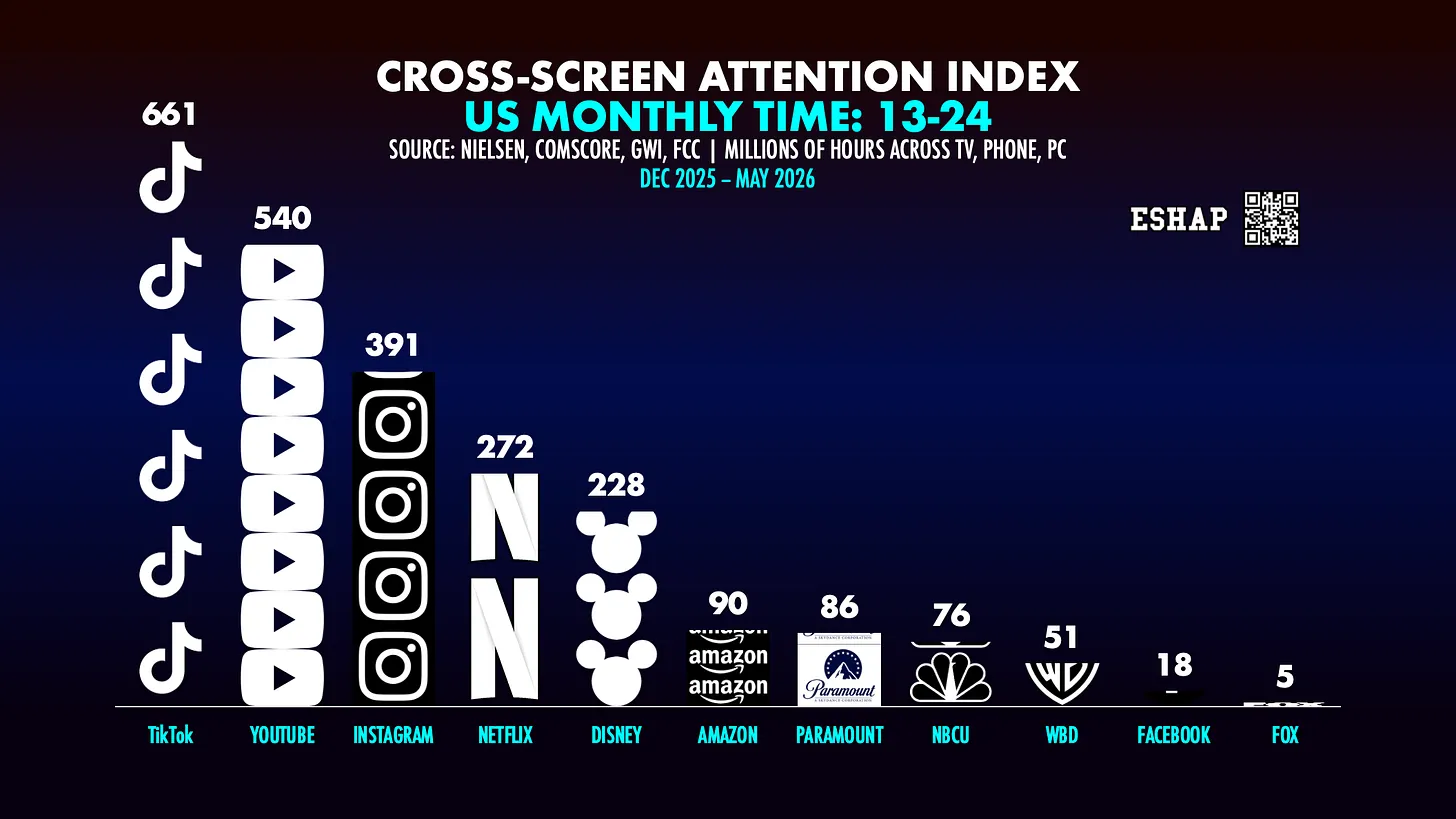 For as evolved as we seasoned folk may choose to believe we are we’re practically dinosaurs compared to them. And we’re not merely using an Audience of One qualitative study to prove it.
You at all curious as to why we’re seeing headlines like this one that THE WRAP’s A.J. Katz dropped earlier this week?:
 Netflix will add video programming from some of the world’s highest-profile magazine and digital publishers to its streaming service marking the latest effort by the company to expand beyond traditional TV and film while giving subscribers more reasons to stay on the platform between marquee releases.
Beginning Aug. 3, Netflix will carry a curated lineup of entertainment, lifestyle, food, travel and celebrity-focused videos from publishers including Penske Media’s PMX division, BuzzFeed Studios, Condé Nast, Hearst Magazines, People Inc. and Tastemade. The programming will be available to subscribers in the United States, Canada, the United Kingdom, Ireland, Australia and New Zealand.
Look no further than the draconian conclusions that Shapiro posited above as a likely roadmap. I can’t more strongly suggest if any of this piques your curiosity at all you should give him the courtesy of investing roughly the cost of a caramel macchiato–not even a venti size–to take a somewhat deeper dive into all of this.
Consider that doctor’s orders.
Until next time…