
It just so happens that last week was yet another milestone that came and went with such little fanfare even I didn’t notice it. On Wednesday we began our sixth year of these musings. Back in days when television shows were actually syndicated that was the sign that the series had reached a mature enough level to have reruns and originals air simultaneously and, in theory, the show was at the point of turning a profit. If you’re even an occasional reader, or simply someone seasoned enough to know how poorly that concept has aged, you know that’s no longer true–and a quick look at my three-figure net worth is all I need to confirm how accurate such a conclusion would be.
 If I’ve learned anything from this effort it’s to be true to a concept I picked up from a once-insurgent sports talk radio host named Jim Rome–have a take, and don’t suck. As Rome did during his earliest years, somethimes in order to do that you have to be like a bull in a china shop, pushing back even when people clearly have different views and think you’re an idiot for having yours. And I will own up to the fact that I’ve been more than a tad aggressive in postulating my narrative about the demise of Stephen Colbert’s CBS late night fixture. Starting with when the news of his cancellation first broke last July I’ve been steadfast in advancing what I believed to be the reality that economics played more of a role in sealing his fate than did politics. And in the wake of the handwringing and “boycott threats” that reached a fever pitch through last Thursday’s series finale–and seemed not to be dying down through the holiday weekend–I felt compelled to remind people literally crying over what they lamented as the death of democracy that if it were your tuchas on the line with shareholders and superiors and had to make the call as to what you’d do you’d probably have come to the same conclusions that the CBS braintrust did, the saber-rattling and demented victory laps of the bus driver-in-chief rounding up Colbert onto a bus headed for “retard land” along with his still-surviving ex-competitors notwithstanding.
I still essentially maintain that viewpoint, especially since until yesterday the folks that attempted to form a counterargument were generally weak, naive or outright uninformed, framing their interpretation of CBS’ sketchy math via their own political lens–fiercely skeptical if liberal, blindly supportive if conservative. In both cases, IMO I see such viewpoints as incomplete and amateurish.
But as he has on so many other occasions, the prolific and very much non-sucky take of Evan Shapiro dropped a Memorial Day analysis on his Substack and just about everywhere else I post that eschewed his usual “media cartography” and funky graphics of his ESHAP MEDIA WAR AND PEACE-verse for the simplicity of a bulleted, annotated and succinct analysis with the soberingly all-caps headline COLBERT WAS PROFITABLE. It’s to the point and reflects quite a bit of curation of various sources only one who has the depth of experience and degree of appetite for numbers–not to mention the contacts and resources–as Shapiro could do. We share the former qualities and skill sets but I own the fact that I do not have the latter–once again, that three-figure net worth gets in the way of more high-minded efforts on my part. And I suppose that’s in part why Shapiro gets to travel the world and spread his Evan-gelical insights more successfully than I do these days. 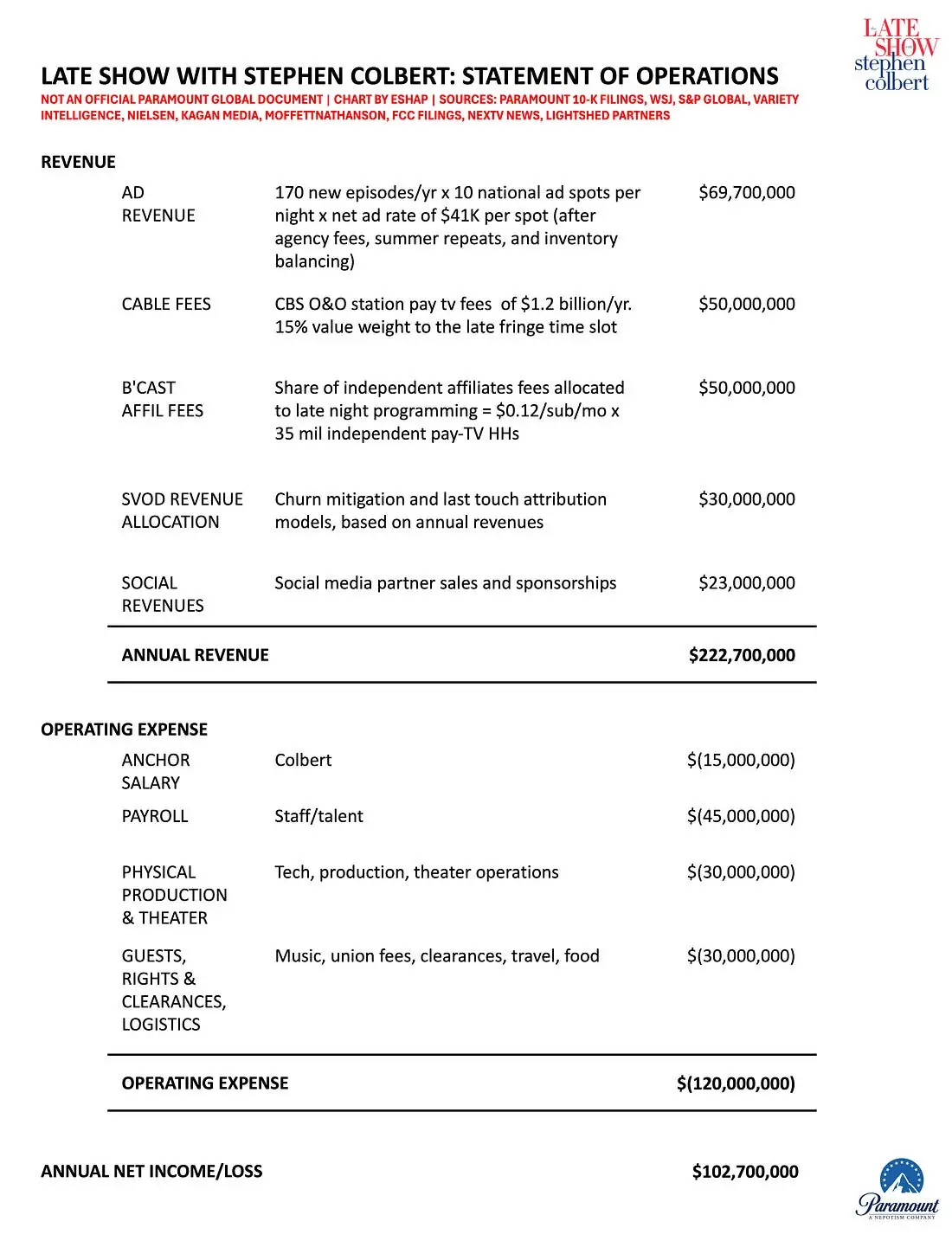
Let me lay appropriate praise on him once again by commending how he systematically and objectively delved into this with points I had never seen in anyone else’s versions–certainly not the feckless toadies at CBS, but not even from the supposedly more thorough and pointed writers for business and trade publications. Shapiro took note of and provided detailed receipts of more ancillary revenue streams that his experience as a corporate media executive trained him to be aware of. He also took the network fo task for essentially not even having an accurate handle on exactly how far out of control the production costs were. His conclusion: they didn’t lose $40 million last year, they made $102 million. Predictably, I’ve received this analysis from a variety of folks–some actually friends–in the last few hours, both as a “TOLDJA!” as much as a share.
 But I’d be less than transparent if I didn’t pick a couple of nits with this nonetheless. For one, he glossed over the revenue the CBS owned-and-operated stations were generating from their own in-show inventory, which considering they are actually the profitable portion of the network probably should have been included at the same time the more esoteric backed-into revenue sources such as retransmission fees was being introduced. Had he chosen to go down that rabbit hole, he might have seen as I did when I was asked to testify against a prominent TV station that sued my former employer that many stations conflate how time is sold and how revenue is ascribed by program when they move off the clock. For decades Big Three affiliates have adopted that structure by pushing the official start time of late night talk shows to 11:35 PM ET/PT–which means anyone buying local spots that air in the break between 11:30 pm and 11:35 pm are sometimes technically being posted on a quarter-hour time period delivery that is driven two-thirds by Colbert. In the case of that litiguous station, they showed they ascribed revenue proportionately to program P and Ls in such proportions. Unless Shapiro had access to data from the stations’ CFO, that was a road not traveled.
 For another, those affiliate fee assignations are based upon historical assumptions that are both parochial and subject to review when new management takes over. Depending upon particular corporate priorities at the time, given that CBS affiliate relations had evolved into co-mingling its retransmission rights with the ability to air the Paramount cable networks it is entirely possible that that formula could have been tweaked to help buttress more struggling entities. The concept of moving numbers from one Excel cell to another is not new or unprecedented. I personally was involved with two such maneuvers. When Turner created Cartoon Network and wanted to show a better story to the cable and investment communities they ascribed a net cost of zero dollars to the extensive amount of library product they “purchased” from the division I was working for (Turner Program Services). Turner corporate made that call as the fiscal year planning process was already under way, which left a sizable gap in my division’s prior projections. We did not hit our financial goals as a result, and the development area I was tasked with trying to do something with became a sacrifical lamb in the process–not long after, I became one myself. So yeah, I know a thing or two about that finagling.
 I saw it happen again when I was a more senior executive at FOX Cable Networks when FX was still struggling for both full distribution and commercial relevance. The regional sports networks were raking in money and driving negotiations for the balance of the portfolio. A newly installed head named Jeff Shell, urged on by his trusted ally and San Vicente Boulevard jogging buddy Peter Liguori–my boss–shifted some percentage of fees from new deals being struck with the likes of Cablevision, DirecTV and eventually Time Warner (the deal that cemented FX’s legitimacy by finally placing it on New York City-area systems after seven years of having to exist without it) to FX’s books.
One of the rising stars of those boots on the ground efforts for FOX Cable Networks was an overperforming account executive who just so happened to be among the few surviving executives from the rubble of Shari Redstone’s crumbling empire who was in place as Skydance and Redbird Capital were circling like vultures to examine how Paramount was conducting their business. Jeff Shell was Redbird Capital’s point man on such matters. Say what you will about Shell’s inabilties to avoid social temptation that ultimately has made him a pariah (well compensated nonetheless), but his attention to and ability to tweak numbers is unparalled in at least my book. Yeah, I know there’s all sorts of supposed laws that would make a conversation between him and someone who rose to prominence under his watch supposedly verboten. But since Shapiro seems more than comfortable with the assumption that Larry and David Ellison served up Colbert’s head on a platter to curry favor with the farter-in-chief, it’s certainly within the realm of possibility that this sort of backroom gerrymandering could also have been going on here.
Finally, there’s the whole concept of the three, five or ten year plan–something else I used to get deeply involved in as part of budgeting processes at just about every stop on my journey, and given Shapiro’s experience as a leader at NBC Universal I suspect he participated in more than a few of his own. You look at trajectories over the past several years and then project how you believe that will evolve over time. We’ve clearly established that Colbert’s audience had been declining and aging in concert with linear television in general for years. Even Shapiro conceded this point:
I will be the first to admit that late night talk shows, as they currently exist, are not long for this world. Neither the viewership nor the costs are keeping pace with current consumption trends. More people see the clips on social media than watch the shows themselves. The median age of the TV audience is (approximately) 112.
So to anyone out there still thinking that Colbert could have lived to fight another day in his quest for truth, justice, and the American way I’ll merely ask this–what do you think that plan that’s a staple of any budgeting process I’ve been part of looked like? And if you were looked in the eye by an incoming chief executive who asked you for your recommendation, independent of any political views he may have been espousing, how would you have responded?
Maybe to some of you delaying the inevitable just long enough for Colbert to continue to give voice to your own obsession with accelerating the (hopefully) inevitable departure of DJT from the leadership of what’s left of the free world is what drives your entire reason for existence lately. If that’s the case, that’s on you. You probably wouldn’t last very long in any position of corporate responsbility.
 In which case, you’d probably need to be as complete, passionate and auspiced as Evan Shapiro was when he pivoted from such a world into the niche that he now has become a leader in. And you’d definitely need to be as articulate and definitive as he was when he skewered the Ellisons and their unquestionably pathetic dismantling of CBS NEWS that soon could destroy CNN. I rarely cheer when I read anyone’s blog, but I confess to letting out a few whoops for how Shapiro systemically articulated everythng they’ve done with the inexperienced, incompetent and generationally arrogant Bari-um Enema’s help. And on these points there is absolutely nothing I disagree with him on.
And I’m downright sympatico with his coda and finger in the eye that ended his piece:
I’ve written this piece and done this simple, rudimentary programming accounting on The Late Show, to demonstrate to Paramount investors, to regulators scrutinizing the Disco Bros deal, and to senior managers at Paramount that, based on every aspect of available evidence: The Ellisons are too dishonest and too incompetent to be trusted at their word, ever….(W)e can all just throw our hands in the air and say “there’s nothing to do about it,” or, when we see this level of dishonest incompetence, we can (get this) call it out…They likely would never admit it, but I’m told that The Ellisons read this publication (it’s forwarded to them). So today’s post is just a small reminder for Larry and Kid Nepo: I see you. I know what you’re doing. It’s total bullshit.
Amen and ditto, ESHAP. I can only hope at some point, even in the recesses of their minds, the Ellisons choose to join me in dining on the crow and humble pie your work encouraged me to chow down on. As I further hope you’ll agree that nobody’s perfect, so I hope you’re open to my musing–and maybe provide me their e-mails so I can get noticed by them as well.
Until next time…