
Because I’m both a slave to data and a cockeyed realist, I’m painfully aware of where I actually rank in the pecking order of media pundits. Somewhere between pawn and minnow, based upon the statistics I have at my disposal. And that’s in spite of the obsessive attention to the size of images that may or may not get picked up by certain social media platforms. I’ve yet to see any conclusive data that would suggest that actual engagement is actually tied to the specific image that hits anyone’s particular inbox, and I’m still waiting for the persistently pushed back come-to-Jesus meeting that would set in motion the alleged solution my so-called “expert” business partner contends is why neither one of us is making dime one from these musings. The latest excuse revolves around persistent bouts of depression, so I suppose I should at least try to be a little understanding. Yeah, tell that to those who I’m in debt to.
I did have every intention of personally digging into what I felt would be an especially appealing tome that was released earlier this week from the fine folks at Tubi. When it was reported that they had made available the latest installment of an annual report they commission on exactly how and why streaming consumers make the choices that they do, I was quite excited and ready to plow into a bevy of otherwise niggly details to unearth intriguing nuggets worthy of your time. It’s what I’ve done professionally for decades, and honestly it’s still one of the few joys in life I still allow myself to have.
 So imagine my disappointment when I hit the landing page of The Stream 2026: When Intention Becomes Attention and when prompted to enter my email address to access the download I was greeted with an error message informing me that they do not accept addresses from a standard domain like yahoo or gmail. Especially ironic for a service that prides itself on being accessible to everyone since it’s free.
Mind you, I’m nonetheless an unabashed fan of Tubi, and I’ve previously mused about them with respect and apprecation. I see their Nielsen Gauge numbers continue to slowly but surely inch up to levels that are fully competitive with far more grandiose and money-losing platforms that are now scrambling to fast-forward mergers with almost ridiculous financial upside assumptions. And at one time I considered some of their key executives friends and colleagues. Indeed, I provided a recommendation for its current head of programming when he was seeking to transition from a similar role at Sony’s late and most definitely not lamented version, Crackle. That person has been instrumental in curating the lineup of content that has resulted in creating the kind of traction and attention it has gotten, not to mention an especially nice sale price when FOX took over full ownership a couple of years back. I still respect the heck out of him and the platform, even though every attempt at outreach since Sony left me has been met with crickets.
So it’s in that spirit, and the grudging acknowledgment that either the reach and/or the choice of domain that allows some of my more respected and wider-reaching experts allowed them to be able to have at the deck. TOO MUCH TELEVISION’s Rick Ellis is apparently one of those “haves” and yesterday he provided his readers with a detailed annotation that confimed a great deal of my pre-existing confidence that Tubi indeed has a pretty solid handle on what their viewers like and why:
This survey was conducted online within the United States by The Harris Poll on behalf of Tubi from November 24th, 2025 to December 2nd, 2025, among 2,500 respondents ages 18+ that stream video at least one hour a week and live in the United States.
There were a lot of interesting data points, and some of them are a bit surprising:
* 55% of viewers report streaming TV or movies for 1–3 hours in one sitting, and are even more likely to report streaming 3+ hours in one sitting. Even more noteworthy is that viewers say they’re purposefully opting towards bigger screens like televisions as a way to denote quality streaming time, as opposed to time spent scrolling on a mobile phone.
* In terms of overall engagement, 90% of viewers say they are most engaged while streaming TV or movies compared to 82% for live events and 79% for social media.
* The desire for intentional engagement also extends to the streaming format that viewers prefer. Ninety percent of viewers surveyed reported that on‑demand streaming (i.e. selecting the content when they want it) captures higher attention than channel‑based streaming (78%) and cable/satellite (71%) (i.e. shows or movies playing at a set time).
* Sixty-five percent, up 15% year over year, say they feel part of a community based on the movies and shows they watch. Movies (44%) and TV shows (38%) lead fandom categories, with viewers purchasing apparel (50%), subscriptions (37%) and live experiences (30%) to demonstrate their loyalty.
* 97% of respondents interested in watching content released more than 10 years ago. The primary driver is quality, with 63% citing superior style and storytelling as the top reason for revisiting older titles. Twenty-four percent, up 7% year over year, do so to stay engaged in cultural conversations. Seventy-nine percent believe streaming services should remind them of content they used to love, not just promote new releases, and 67%, up 6% year over year, say losing access to comfort content feels like losing part of their safe space.
* While 84% of respondents say it only takes a few minutes to decide what to watch when viewing alone, 58% report it takes at least 10 minutes to land on a choice with a partner. With 43% of viewers primarily streaming alongside a significant other, aligning on entertainment preferences may be more consequential than ever: 61% agree they’re more likely to date someone who shares their taste in movies and TV shows, and nearly a third (30%) say they’ve ended a relationship because their tastes were too different—an 8% increase year over year. Sixty-seven percent are unwilling to share their streaming login unless the relationship is serious.
* Sixty-seven percent agree digital creator content feels more original than most traditional TV and movies, and 63% say watching creator content feels no different than streaming a TV show. Thirty-seven percent want platforms to bring existing creator content onto streaming services, 36% want creators cast in original programming and 33% want ads for creator content featured on platforms. Seventy-eight percent wish they could watch new creator content without paying an additional fee.
* Comedy (70%), action (68%) and crime (66%) remain the most popular genres, while growth opportunities are emerging in independent film (36%), coming-of-age programming (34%), young adult content (31%) and creator-led programming (31%). Demand for originality is rising: 76% would prefer original content over remakes or franchise extensions, up 12% year over year. Seventy-seven percent want diversity and representation when they stream, up 5% year over year and 9% since 2024, and 76% want more programming from independent or smaller creators. For Gen Z, 78% would prefer original content over remakes or franchise extensions and 79% want diversity and representation when they stream.
* 74% of respondents have (or would) cancel a subscription due to a price increase and 67% have skipped watching a new show or movie once they realized they would have to pay for a subscription streaming service.
And while I have heard this statistic before, it’s worth highlighting that according to internal Tubi data, 95% of the viewing on its platform is on-demand, not FAST channels. Pluto TV’s FAST viewing percentage has traditionally been a bit higher, but on-demand is a much bigger part of the AVOD business than many people realize.
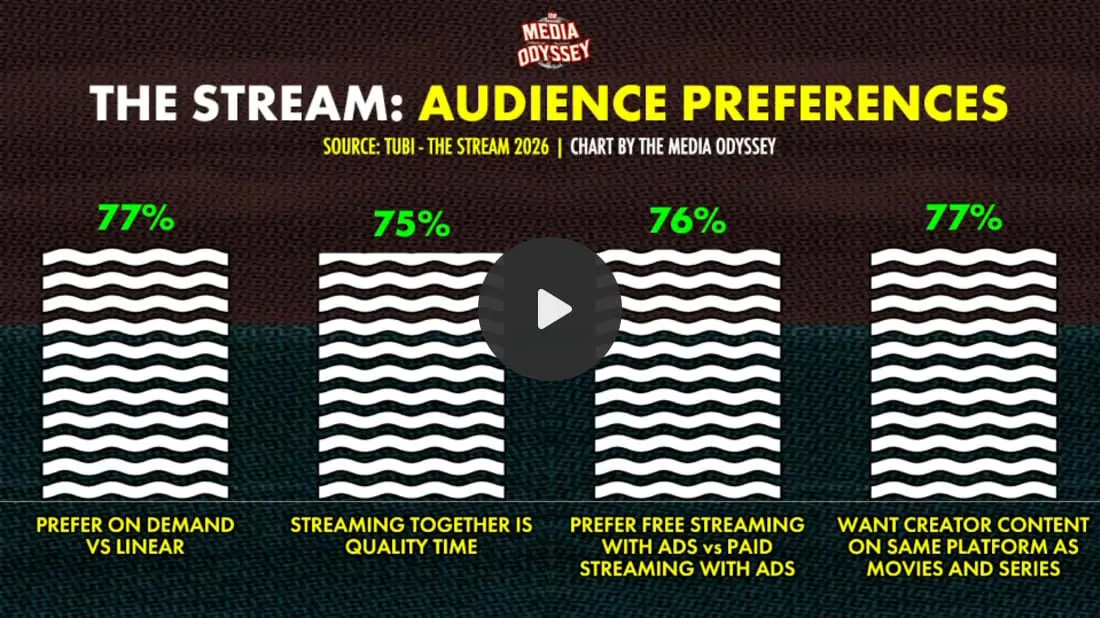 The even more potent pulpit that Evan Shapiro offers to his MEDIA WAR AND PEACE subscribers took its own crack at it this morning. It’s more than worth your time to watch, and he has far prettier graphics to boot.
The bottom line is that I see any transparency any streaming service is willing to offer as to exactly what is working and what isn’t as both rare and needed, especially as the larger ones continue to obfuscate and deflect in manners consistent with our current White House administration. Netflix graciously dumps an aircraft carrier worth of consistently reinvented data on its programming every six months; it’s created a cottage industry of numbers nerds who chase after it like a dog goes after a moving bus to produce something resembling a coherent distillation. A handful succeed; most ramble. But it’s still a lot more thn we get from the likes of Apple, which at best will merely reference proportionate increases and relative rankings within its walled garden. If the first three words out of your mouth are “COMPARED TO WHAT?!?!?”, welcome to my club.
I offered up Ellis’ bullet points and Shapiro’s takes fully aware that it’s a grim reminder they’re apparently deemed more valuable to Tubi’s desired promotional blitz–conveniently timed for release at the cusp of the New Fronts–than moi. I fully encourage you to like and subscribe to them both–I do, and heck, if I can find the cache to do it, so can you. They both offer an awful lot more than just this.
And for sh-ts and giggles, I’m even gonna provide you with you the landing page that stonewalled me in the pious hope that maybe you’ve got a special enough domain and/or title where you can get your own paws on the actual report. If you do, I’ll kindly ask that you perhaps forward me a downloaded PDF copy on the sly. Like I confessed earlier, I know where my place in the media ecosystem actually lies. I just hate being reminded of it.
Unti next time…