
Back when I was a youth we took our lead from Britain for pretty much everything artistic. Were it not for them, I wouldn’t have had the privilege of experiencing The Beatles, The Rolling Stones and the mini-skirt (well, looking at it). For that matter, go back a generation and you wouldn’t have had the privilege of experiencing me. In the mindset of the demographics that mattered most, what qualified as popular was redefined, and those that would otherwise scoff simply had to accept it.
Well, based on the news that came down yesterday from across the Pond, it’s perhaps high time for those now identifying as stick-in-the-muds to take our lead from from the Brits once again. DEADLINE’s Jake Kanter was among the many that dropped this dime (farthing?) yesterday:
 YouTube has continued to upend the natural order of UK television by overtaking the BBC on a key measurement of audience reach, according to an analysis by Deadline. In an unprecedented moment, YouTube passed the BBC in monthly audience reach figures published by Barb, the UK’s official ratings body. The Google-owned video platform began being measured by Barb in the final three months of 2025, and in each of those months, its reach was higher than that of all BBC television channels combined.
Barb’s figures, published on its website, showed that YouTube had a reach of 51.9M viewers in December, more than a million ahead of the BBC’s equivalent figure of 50.8M. Barb’s audience reach figure measures the number of people who watched a television service for at least three consecutive minutes in a month across TV sets, smartphones, tablets, and personal computers.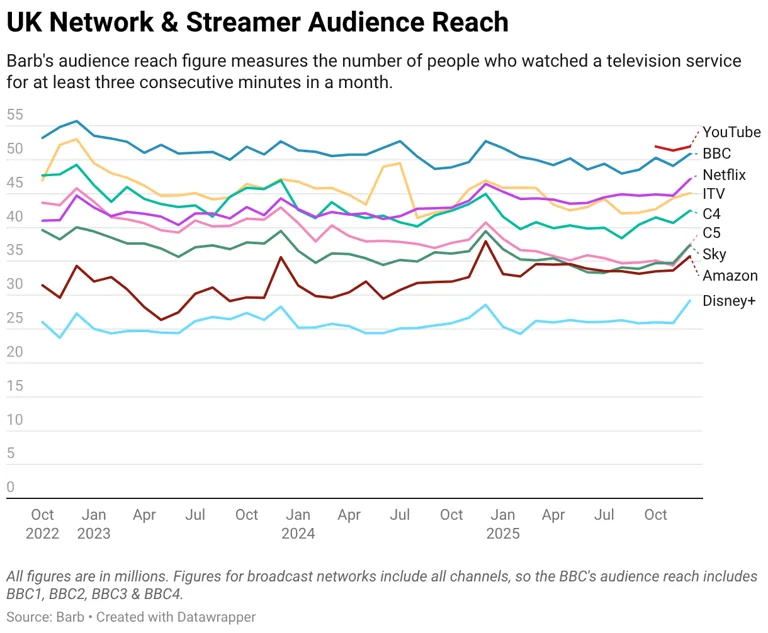
“These figures show the relentless rise of YouTube, and I should think it’s the first time [the BBC has been overtaken],” said Stephen Price, one of the UK’s most highly-regarded experts on TV viewing habits.
The headline on THE TELEGRAPH’s version of this was appropriately apocolyptic:
BBC overtaken by YouTube in end of an era for TV
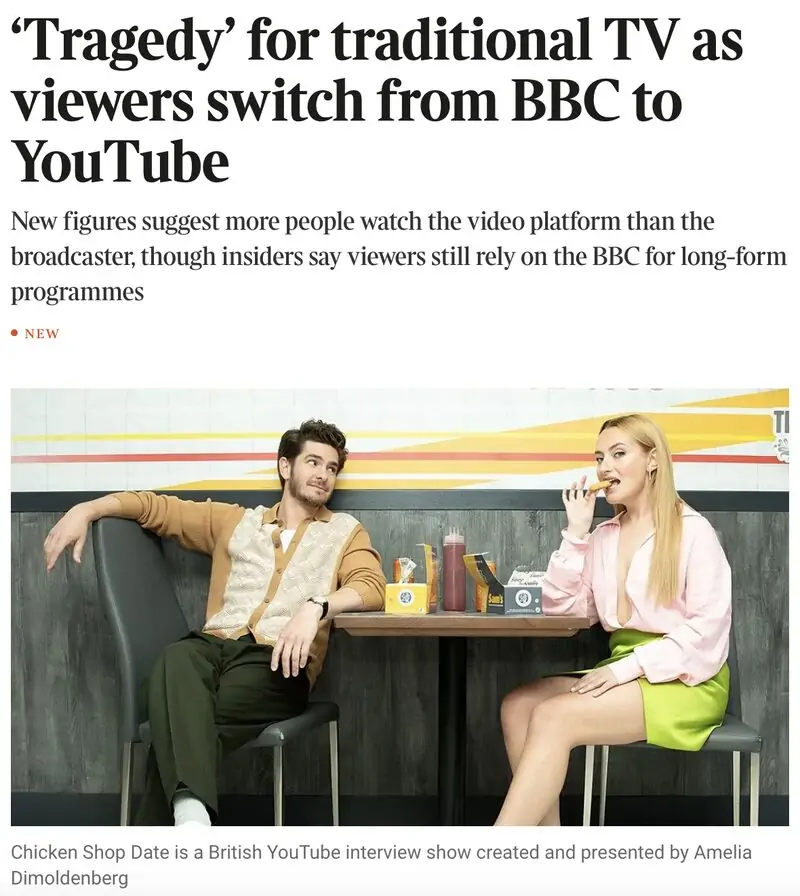 I’ll let those of you with an extra $29 to spare access the details. For the rest of us, we’ll have to deal with the kind of apologetic framing that THE DESK.net’s one-man band Matthew Keys applied in his write-up:
What people are watching on YouTube remains something of a mystery — the platform allows anyone to go from being an active viewer of user-generated videos to creating and distributing their own content. The service houses everything from short-form comedy sketches to long-form tutorials and classes, gaming clips and live news, and a variety of other media.
The BBC is more traditional in what it offers — shows, sports, movies and news. As with Nielsen, the stateside measurement company, Barb has more-granular data on what people are watching across the BBC and other traditional TV networks. And the BBC prefers to use a different methodology of audience reach, leaning on 15-minute increments rather than Barb’s three-minute period. In that sense, the BBC tops YouTube with a more-engaged audience, averaging 47 million viewers in that group, an increase from the 41 million the BBC’s channels had in 2024.
And as Kanter continued, the Beeb did its best to justify its hauty yet archaic stand:
The BBC’s position is that three-minute figures give too much weight to short-form content, with its preferred measure better reflecting how traditional TV content is consumed. Furthermore, when you isolate just TV set viewing, the BBC’s audience reach was 50M in December, 12.5M viewers ahead of YouTube’s reach of 37.5M, according to Barb. A BBC spokesperson said: “The UK watches significantly more BBC TV than that of any other provider. In 2025, UK audiences watched 351M hours on the BBC each week, which is far ahead of anyone else. When we focus on reach, we look at a minimum of 15 minutes as an appropriate measure for long-form content and by that measure the BBC continues to lead the way.”
I would merely ask said spokesman to man-splain how they sell commercial time these days. At least in this hemisphere, nary a deal of consequence is written on the viewership of a single program, or for that matter on viewers themselves. It’s all about impressions across a panoply of platforms, and in most cases it’s a roll-up of multiple brands. And as for those who choose to clutch pearls about quarter-hour thresholds as being some sort of floor to assure engagement, one might remember that’s how diaries defined it, and Nielsen’s been completely out of that business for more than seven and one-half years. Those who support commercial TV are most concerned with whether or not you’re watching for just thirty seconds, and for more than two decades as a by-product to multiple viewing stream data we’ve been eagerly providing the world with that sort of granularity.
Perhaps they should be more in line with the nuanced take that Brit-based media consultant Jo Redfern offered when she shared these details on her LinkedIn profile:
 Parking the inevitable debate, what it does show is a shift that many find uncomfortable but that can no longer be ignored nor denied – what constitutes TV (if we’re talking about video entertainment) is not what it used to be. YET most content, distribution and monetisation is built on the old TV definitions, standards and metric. And it’s slowly strangling parts of the media industry.
If 41% of in-home YouTube viewing happens on a TV set, then creators like The Sidemen, Amelia Dimoldenberg and SV2 ARE producers and media companies. They are making content with production value, runtimes and audience loyalty that look suspiciously like TV, so why are they treated as lower value, and often with downright disdain? It’s holding trad media back, constraining necessary evolution.
Meanwhile, look at the the number of daily minutes spent if you want to see a very REAL story of habit:
41 mins per day spent on YouTube (4 screens)
21 mins on TV-only
And it isn’t just BARB; Ofcom and YouTube too all show longform thriving on the platform so even to the older audiences it’s beginning to feel like the TV they know. And the younger audience, they’ve never known ANYTHING DIFFERENT – they haven’t lost their attention spans – they just don’t understand schedules, fixed durations and tired formats. Why would they?
I at least doff my derby that BARB is providing third-party competitive measurement at all. Kanter provided some actual numbers for some of YT’s competitors–and yep, they do include some actual shows:
Barb’s three-minute figures showed that Netflix had its best month on record in December, no doubt propelled by the final season of Stranger Things, which was released in three instalments. Netflix’s reach of 47.1M viewers last month means that the streamer is now consistently ahead of ITV after overtaking the UK network in April. Netflix has steadily grown its audience since October 2022, when its reach stood at 41M. Disney+ also had its best month on record, with series such as Bluey proving to be consistent draws on the service. Its reach of 29.2M in December was an outlier in what was a pretty flat year for Disney+.
That’s a lot more specificity than the fine folks at Apple TV were willing to offer up in their own victory lap story that Kanter’s colleague Dade Hayes provided the day before:
 Eddy Cue, SVP of Services at Apple, delivered a look back at 2025 Monday, anointing Pluribus as Apple TV’s “biggest series to date.” The series, created by Vince Gilligan and starring first-time Golden Globe winner Rhea Seehorn, helped drive a 36% surge in engagement in December, according to Cue’s recap. The month also saw the arrival of F1: The Movie after its blockbuster run in movie theaters, along with straight-to-streaming film The Family Plan 2 and holiday special A Charlie Brown Christmas.
As is typical for Apple, Cue’s overview leaned on superlatives and relative comparisons but lacked hard data. It also wasn’t clear how the company calculates engagement, or the exact size of the audience that grew. Since launching the service in November 2019, Apple has declined to break out subscriber numbers or viewership figures.
For those even mildly curious about such niggly details, one might have landed as I did on the dogged deep dive that 9 TO 5MAC’s Benjamin Mayo conducted that he shared with his readers last week:
Apple said that Pluribus had become the most watched TV show in the history of the Apple TV streaming service. The show has now also appeared in industry analytics firm Nielsen’s US streaming report. For the week commencing December 8, Pluribus came in at number 9 out of the top 10 streaming originals …In total, Nielsen says Pluribus recorded 360 million minutes viewed…For a comparison, in the top spot, Stranger Things topped 3 billion minutes viewed in that same period...(the) Nielsen chart covers US streaming only.
It shouldn’t take this sort of piecemeal patchwork reporting to simply get to one burning question. And if purportedly one of the last defenders of long-form content isn’t willing to offer transparency as to the superiority of their offerings, then why should we expect the youth of any nation to respect what others define as “TV” to define with what, where and for how long they choose to spend their valuable time?
 I’ll once again implore Nielsen to take better advantage of their multiple global panels and service the needs and wants of global advertisers who are putting real money and faith in the self-reported metrics of streamers to take a lead from their British counterparts and create a global Gauge that would allow those of us with less time and support as folks like Mayo have to have a handle on what’s actually happening. I’m pretty sure BARB would be more than willing to cooperate with such an alliance if asked. I for one happen to think there would be an appetite for such a report–and it wouldn’t necessarily have to be perfect at the outset. Forget the Rolling Stones and The Beatles. We once embraced the Bay City Rollers, FFS.
Until next time…