
For the past several years, save for that COVID thingy, my longest-tenured friend and I have had a standing lunch date with a far more seasoned one to celebrate the “anniversary” of when we all met. That happened to be at a taping of a network game show he was executive producing, a tale we mused about nearly four years ago. It’s a somewhat silly story that points out exactly how rambunctious and immature we were at teens and explains in part how we eventually wore out our welcomes with many of his peers in the New York production world. Fortunately for both of our careers’ sakes, many of them turned out to have especially short memories, all the more enhanced when we became executives they hoped to make a deal with.
We had our annual fress a tad earlier than usual this year on Sunday, and the lunch became a brunch. Our friend, G-d bless him, is in remarkably good health for a man in his mid-90s, his only concession to age his use of a cane. His mind is excellent, his spirit as boundless and upbeat as it was when he was a prolific producer of what in the game show world are referred as “shiny floor” shows many decades ago. You know, the ones you probably know best as WHEEL OF FORTUNE, JEOPARDY! and FAMILY FEUD–there are others still floating around, but if you have a life you probably have ignored them.
When our conversation turned to feeding his curiosity as to what was going on with the business his success allowed him to effectively exit years ago, he was amazed at how the genre has evolved to the point it’s at now–where with the exception of projects that have proven IP, a name celebrity and/or an international pedigree attached, most of the networks and platforms that are still in that business have gravitated to over-the-top “competition reality” programs whose roots all seem to be in the cutthroat world that SURVIVOR introduced us all too at the turn of the century. That’s still going strong and is heading into its 50th “season” next month and will once again occupy prime real estate on CBS, assuming the corporate mishagas doesn’t shut it all down beforehand.
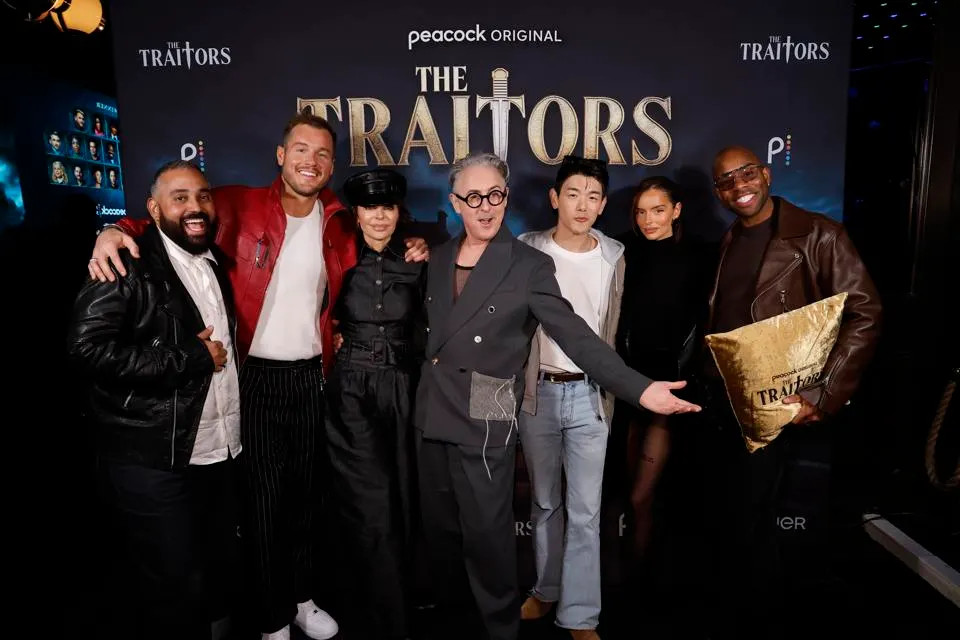 Over the past few days we’ve been inundated with premieres of several shiny examples of such, where any de facto floor has been replaced by seemingly limitless ceilings of largesse and OTF reactions of scheming and conniving contestanti carefully cast to provide rooting and booing interests to appeal to those obsessed with the dynamics of other reality unscripteds. Indeed, no less than 23 of the “best” of them have been recruited for one of them which plopped onto Peacock just in time for the platform’s push that the triple play of NFL playoffs, NBA basketball and the Milan-Cortina Olympics will (they hope and pray) give them. Another seasoned friend of mine, FORBES’ Marc Berman, brought us up to speed with that with a piece that dropped just as my other was urging us to hit the Sunday buffet up for a second helping (and yes, those of you who do watch should put up your SPOILER ALERT earmuffs):
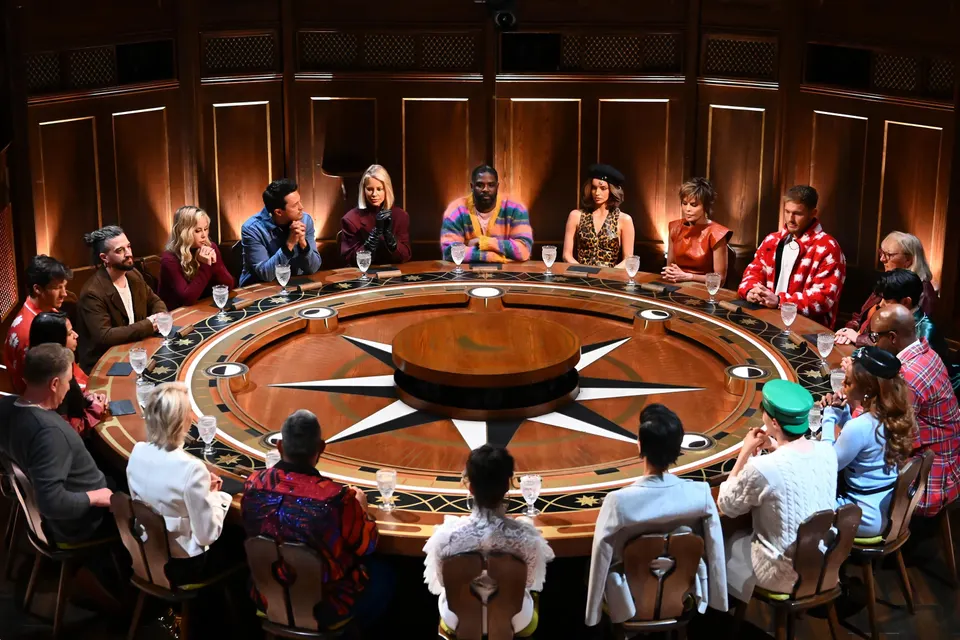 The initial competitors “killed” on this new celebrity edition of Peacock’s The Traitors are about to be revealed. Three episodes in and I’m completely hooked. The secret sauce behind The Traitors remains unchanged: a clever remix of the familiar reality-competition playbook, elevated by a constant sense of paranoia — and presided over by Alan Cumming, whose comedic, gloriously over-the-top hosting turns every roundtable into high-camp theater. It works every season. Thankfully, this celebrity edition features players who arrive with reputations and pre-existing alliances, which only ramps up the tension as mistrust inevitably seeps in. Some overplay their hands, others underestimate just how ruthless the game can be, and a few never see the dagger coming. By the time the first four competitors are “murdered,” it’s already clear: fame offers no protection in the Scottish castle — if anything, it paints a bigger target. The Traitors thrives because of its elegant simplicity: paranoia, perception, and betrayal. It’s a formula that works perfectly.
I credit Marc with a great deal of the appreciation I have for these over-the-top formats and their appeal. It’s one thing to look at the numbers and see that THE TRAITORS is far and away Peacock’s most successful original series–although since like most streamers not named Netflix the specifics are even more of a secret than what’s in the Epstein files. (There is ample evidence that the show’s OG version in the UK, which occupies solid real BBC real estate, is indeed still a huge hit across the pond). It’s another to get testimony from an unapologetic fan who clears his or her calendar when new episodes drop and will willingly engage you to discuss it practically any time of day or night. When I had my brief fling with BIG BROTHER during overnight hours in the middle of COVID paranoia and had access to real-time shenanigans going on in the faux “house” that essentially sits on a CBS soundstage Marc and I were texting as frequently and as passionately as any Gen Zer could or would. It’s the least I could do for someone I’ve known even longer than my seasoned lunch buddy.
He’s also helped me to better understand why Prime Video’s massively overpriced gambit into this world, BEAST GAMES, earned a second season renewal in the midst of a tumultuous year that saw a virtual purging of the management that greenlit the first. The first three hour-ish episodes dropped en masse last Wednesday, and it has somehow found a way to get even more garish and grand. DEXERTO’s Daisy Phillipson played SPOLIER with her recap:
Beast Games Season 2 has premiered on Prime Video, with 200 players vying to be the sole winner of a whopping $5 million. Created by MrBeast, the competition series began on YouTube with his viral video ‘$456,000 Squid Game in Real Life’. While Squid Game already has its own Netflix reality spin-off in The Challenge, MrBeast later struck a deal with Amazon to produce Beast Games. Unlike the first season, which began with 1,000 contestants, Season 2 starts with 200 players split evenly between the smartest and strongest competitors.

 We did a deep dive into the wonderful world of Jimmy Donaldson in the aftermath of Season 1’s launch, pointing out some of the more sobering facts that belie the urban myth that it’s the generationally defining addiction we were initially lead to believe. If you watch the actual show, you’ll likely recognize that Donaldson has borrowed from an awful lot of far less ambitious formats over the years. In just this troika alone, we have derivations of DEAL OR NO DEAL, MINUTE TO WIN IT and WIPEOUT! (the ABC/TBS version of this century, thank you)–and, of course, the histrionics associated with whether or not to align with your competitors for a seeming advantage. To the generation that made Donaldson the most popular content creator on Earth, this is all news to them. To mine, it’s yet another example of unabridged arrogance and fiscal foolishness. I’ll be curious to see if and when we see any sort of proof of performance this time around and how they’ll play in a room full of new players who’ve been able to find more controlled success with shows that may not have had shiny floors, but did pretty darn well with those composed of “lava”.
And speaking of prior success, those streamer wanna-bes at FOX have gone back to the future with in its original run was arguably to SURVIVOR what BEAST GAMES is now to TRAITORS. We got our first taste of it Sunday night, as ENTERTAINMENT WEEKLY’s Randall Colburn reminded:
For roughly 25 years, Fear Factor has tested gag reflexes and amplified fears of snakes, spiders, and all manner of creepy-crawlies. Though there’s been minor variations, the concept remains simple: money-hungry contestants compete in a series of physical and gross-out stunts in pursuit of a cash prize. You may think you can stare down a tarantula, but that might change when its eight legs are skittering towards your eyeballs. Fear Factor: House of Fear…will satisfy fans of the original while introducing a social element to the game.
Unlike previous iterations of Fear Factor, which featured new contestants in every episode, House of Fear will corral its 14 contestants under the same roof, Big Brother-style. House of Fear also departs from its predecessors in that there can be only one winner. Instead of a team splitting the $200,000 prize, the big money is all going to a single competitor.
 In yet another nod to the history of unscripted entertainment, the gleeful Torquemada overseeing this is one Johnny Knoxville, late of the JACKASS! franchise that helped devolve MTV from a destination of actual music programming to a dumping ground for WTF humor aimed at a generation of bro-coders. He’s a little greyer and indeed a survivor himself as Colburn further noted:
Knoxville is an inspired choice, given that his career has dealt him a broken collarbone, wrist, and rib, as well as a torn urethra, multiple herniated discs, numerous sprained ankles, and at least 16 concussions. “Johnny Knoxville is the champion of fearless entertainment,” said FOX TV President Michael Thorn in a statement. “His wild sense of humor, unmatched ability to push boundaries and take on the extreme makes him the perfect fit to lead this bold new reinvention of Fear Factor.”
Based upon the run-it-back execution I watched and knowing that its regular time slot won’t have the Philadelphia Eagles’ last gasp as NFL champions as a lead-in, Knoxville will need every bit of his appeal to draw enough bros away from everything else they could be watching anywhere else to make this a success even by FOX standards. After all, he’s filling the shoes of a prior host who seems to have every JACKASS fan far more loyal to him than practically anything else. Whatever did happen to that guy Rogan who NBC cast fresh off his unbridled success on NEWSRADIO?
We’ll give all of these grandiose attempts the benefit of the doubt until we learn whether or not their appeal falls through–well, the floor.
Until next time…