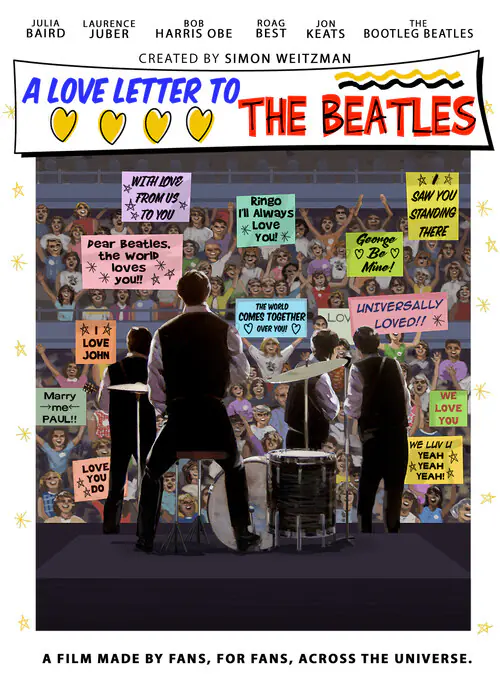
 When a passion project defies the odds of even being made let alone being released on a global streaming platform that’s reason enough for celebration in my book. When said project is one that a longtime colleague and friend gets to see to fruition it’s all the more worthy. And when it’s unabashedly upbeat as is A LOVE LETTER TO THE BEATLES, which dropped this week on Prime Video, well, grab your favorite spirit and/or herb and be prepared for a reminder that there’s still joy to be found in this otherwise troubled world.
As anybody of a certain age or with even a smidge of appreciation for music history likely knows, The Beatles arguably changed the world of music forever at a time when the world itself desperately needed it. They first came to America in February 1964, when the country was still reeling from the aftermath of John F. Kennedy’s tragic assassination and when the spectre of the Cold War was very much omnipresent. The younger generation that was growing up in the relative comfort of post-World War II boom towns and the growing permissiveness of a theretofore repressed society was shaken and stirred, all the more appropriate choices of words given that James Bond and his British eloquence was taking root. So all the more reason that the frenzy of admiration and mania that took over the otherwise staid ED SULLIVAN SHOW that month when the Fab Four made their U.S. televsiion debut was unprecedented, and more than six decades later those that were first impacted by it still carry that torch. Moreover, that passion has been successfully passed down to even today’s youngest generations because hey, the world’s climate isn’t all that much better these days.
The nearly two-hour documentary is the by-product of an experienced British creative whose biography on MAVERICK ENTERTAINMENT GROUP’s website describes him thusly:
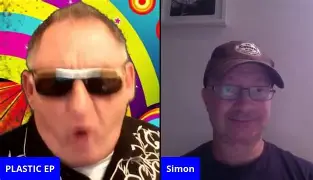 Simon Weitzman is a versatile Network TV Director, Producer, Author, and Artist, boasting a 35+year career marked by over 300 network television shows for global broadcasters such as BBC, Sky, HBO, ITV, Channel 4 (UK), Channel 5 (UK), and Disney TV. His recent focus includes directing and producing feature documentaries on iconic figures in The Beatles orbit, like Chris O’Dell and the comprehensive history of International Beatles Week. As a published author, he’s penned successful books on music and sport, while his artistic passion extends to creating large-scale recycled metal sculptures for charitable causes and championing creative endeavors for individuals with disabilities.
Which means he has undoubtedly closed a few pubs with another Simon–one for whom that’s a surname and whose first name is David. And if you know anything about me, the reason that those two crossed paths at all is directly related to how I even got an opportunity to realize some of my own dreams.
 David Simon was a rising young star in local television during the 70s and 80s, becoming an up-and-coming fresh face in his native San Francisco and eventually heading south to Los Angeles where he turned heads as an aggressive and creative head of programming for the market’s top-rated independent station KTLA. His success with milking more out of lesser-known (and cheaper) off-network series and movies than his competitors and almost anyone else around the country caught the attention of FOX when it took over the Metromedia stations whose clock he was cleaning in what they felt was their most underperforming market. They lured him to the dark side by making him head of programming for the entire group, which then included six other top ten markets and arguably the most significant buyer in the country. I was toiling for Metromedia’s distribution division as a young turk who got to make the move to FOX’s largely as a result of my relatively cheap salary and the drinking habits of the guy who had my position. That allowed me to become one of the youngest executives to head a key department at a major studio, fortunately being headed by yet another supernova under 40. My boss and Simon were corporate allies and kindred spirit, and Simon’s candid and consistent insights into what our competitors were attempting to peddle to him were invaluable. As I got to be part of this inner circle of upstarts myself, Simon and I developed our own sympatico connection.
But David had far greater wanderlust than just domestic television, and when the siren’s call from the burdgeoning team at Walt Disney Studios offered him the chance to run its International Television Production and Channels division and relocate his young family to London he eagerly accepted the opportunity. His coveted job was open, and the jockeying for it among both his subordinates and his competitors was the source of a lot of gossip around our still-vaunted commissary. In the midst of this drama, there was a memorable day where David just happened to be having a lunch with some program schlepper, taking full advantage of the amenities of the main lot that the production facility several miles East where his impressive office overlooking a urinating gold statue was housed just couldn’t offer.
I stopped by to say hi and knowing how much competitors like to gossip I seized upon the chance to pick his lunch date’s brain about one we both loathed. David supplied some additional fodder we both could use. Later that afternoon David stopped by my office in the adjacent trailer to my boss to drop off some silly presentation he had promised to share. I couldn’t help but ask if his replacement had yet been found. David smirked and said no and then, lowering his voice he smirked again and said “You know, you should go for it. Your name has come up”.
What I later learned was that, much as was the case when Simon himself had been hired, Barry Diller and Rupert Murdoch had little patience or respect for the veterans who were determined to do business the way most of the industry had been in that expansionist era where deals were cut on golf courses and in strip clubs with emotional spendthrifts who more often than not valued personal relationships over savvy deal-making. David was decidedly not from that world, and apparently I had already made an impression on Murdoch when we successfully convinced him to syndicate his own pet project A CURRENT AFFAIR rather than attempt to launch it on the then-nascent FOX network. So somehow, before the age of 30 myself, I became David’s replacement, which freed him up to go across the pond and indulge his own Beatles love with folks like Weitzman.
And even though he was a continent away David remained a source of encouragement and insight as I attempted to follow in his footsteps. At conventions he’d never fail to check in and offer advice on how to deal with some of the more uppity folks on my team and to make better use of those more accommodating and cooperative. Occasionally he’d even tell me which distributors had thinner skins, helping to make me a better negotiator and therefore more valuable to my demanding superiors.
 Hence I’m more than motivated to urge you to give this piece a chance. These days David’s CV includes membership on the board of directors of FAN FILM LIMITED, the company behind LOVE LETTER. THE GLASS ONION BEATLES JOURNAL provides the background:
This cinematic tribute captures the spirit, passion, and community that The Beatles continue to inspire more than 60 years after they first changed music forever.
Described as “a film made by fans, for fans, across the universe,” the project unites voices and performances from every corner of Beatles fandom. It showcases legendary figures and cultural icons, including Bob Harris OBE, Laurence Juber, Rod Davis, Julia Baird, Gary Evans, Andrew Edwards, Angie and Ruth McCartney, and many more.
Shot across iconic locations that defined the Beatles’ story, A Love Letter To The Beatles features The Cavern Club, International Beatles Week, The Casbah Coffee Club, Strawberry Field, The Fest For Beatles Fans, and performances by The Quarrymen, The Bootleg Beatles, MonaLisa Twins, REO Brothers, Blac Rabbit, Dea Matrona, Chris McCarty, The Black Ties, The Fab Four, among others.
More than just a film, it is a collective expression of gratitude—an invitation to relive the music, memories, and magic that continues to connect generations.
You may have seen some of these folks in past works, and you certainly know at least some of the songs. But what LOVE LETTER does is focus on those who have dedicated their lives, both those long enough to remember the actual Beatles performing them and those who rely upon makeup and cosplay to reintrepret them, often in their native languages, sometimes performing on atypical instruments, occasionally even playing guitars with their feet. It’s poignant and hopeful all at once. When the final montage featuring a couple of dozen such tribute performances of LET IT BE ranging from home video to full on concerts, intertwined by Weitzman’s clever editing, I don’t think you’ll be able to hold back either tears nor spontaneous applause. I certainly didn’t.
But I guess I was also applauding the fact that David Simon was able to make this happen and give deserved exposure to people who had theretofore not realized the dream of being recognized for their talents and passions. Much like he did for me all those years ago, when his hair was darker and mine even existed.
 Remember, we all get by with a little help from our friends.
Until next time…