
You don’t necessarily have to be a fan of the NCIS-verse to realize that it’s arguably as essential to Paramount as any IP is to any media company. Between its record 22-season run that will see its 500th episode air early next year and the now six spinoffs it has germinated over the majority of this century it’s been responsible for more than 1000 hours of enduring procedural drama with global appeal. And let’s not forget that it itself is also a spin-off (of JAG) that is a through line to the mid-90s that other than news and sports programming is more enduring than any franchise in the history of the medium.
And because it’s a wholly owned franchise it has given CBS a tremendously potent and still quite profitable night of winning television, so much so that they were able to say ta-ta to Dick Wolf and Universal and jettision two-thirds of the more than credible FBI franchise that they were leasing. More often than not, NCIS is the most-viewed scripted television series in any given week, and yes that includes streaming.
 But even the most enduring and prolific franchises’ impacts eventually start to wane, and it’s evident to me that the half-life potency of the Bellisario-verse is diminishing. And the proof is the somewhat curious direction, both creativity and strategically, it has taken with spin-off number six, NCIS: TONY AND ZIVA, which dropped on Paramount Plus late last week.
Its previous extensions were mostly geographic, extending their reach to the West (Los Angeles), South (New Orleans), the middle of the Pacific (Hawaii) and Down Under (Sydney). Last year we got a younger Jethro and Ducky in the form of NCIS: Origins, because hey, if it worked for Sheldon Cooper, why not?
But TONY AND ZIVA, nomenclature aside, is merely a storyline–one that appparently has generated enough sea legs (pun intended) to warrant its own arc. And if the testimonies of some of the more passionate writers are any indication there is apparently at least some appetite for it. COLLIDER’s Jasneet Singh at least provided some background to her POV:
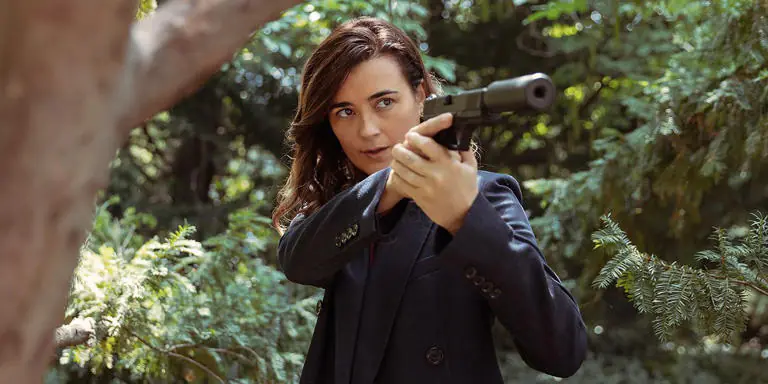 Of the many NCIS characters we have come to love over its 22-year run, one of the most iconic, yet the most failed was Ziva David (Cote de Pablo). First introduced in Season 3 as a Mossad agent, Ziva joined the ranks of NCIS and made her mark through her confident attitude and wild storylines. Of course, there was also her tantalizing romance with Tony DiNozzo (Michael Weatherly), with whom she now has a spin-off in NCIS: Tony & Ziva. But as a standalone character, Ziva’s arc eventually petered out until Season 11, where she made her abrupt exit from the series. Her development was plagued by repetitive subplots and themes, never allowing the character to truly grow as she was dragged back into misery at every turn.
When Ziva first arrived on NCIS, she replaced the late Caitlin Todd (Sasha Alexander) on the team. The transition was seamless, as the initially antagonistic Mossad agent quickly won our hearts when she killed her half-brother, who was a dangerous rogue agent. Her redemption arc slowly proved her loyalty to the team, made even more appealing through her badass skills, awkwardness around English idioms and sharp tongue. However, throughout her run on the show, she faced countless traumatic experiences that inevitably tied to her past in Israel and Mossad — it was becoming repetitive.
So to a particular demographic sector–likely younger and female–this was a dangling chad that was worthy of exploration and resolution. The series delves headfirst into that task, as US WEEKLY’s Johnni Macke gushed:
Tony & Ziva takes place in September and October 2025 – at least to start – but flashes back to 2020, a year in which NCIS fans never saw Tony nor Ziva’s life together in France. The five years between Ziva and Tony’s in-person reunion in January 2020 to solving a cyber-crime case in fall 2025 have been a mystery, until now.
During the show’s first episode, viewers see Ziva’s arrival in France via a flashback. “Hi,” Tony says after Ziva hugs Tali at the airport. “Hi. You’re crying,” she replies. “So are you, on the inside,” Tony teases. Ziva doesn’t skip a beat, telling her partner, “Yeah, well we goddamn deserve it.” She then kisses Tony after being apart for years. While the reunion is sweet, Ziva later reveals that before they left the airport, she was triggered by a canister falling on the tarmac and pulled her weapon on foreign police. The incident resulted in Ziva starting therapy, which at the start of Tony & Ziva has been going on for five years.
What we then get–at least in the first three episodes of the 10 ordered that have aired so far–is a soapy and sexually tense deep dive into these characters’ desires and fears–hardly the case of the week that a more casual NCIS–or any procedural fan–would otherwise expect. Given that’s the broad category definition that I would fit into, my own take was a lackluster combination of titillation and confusion, and I can’t say it’s top of mind on my playlist going forward.
Which to me begs the question–aside from the marketing hook that the NCIS brand may give it (and I certainly concede that putting that acronym before the colon helps its global appeal), why is this called NCIS: Tony And Ziva? These are apparently established enough characters and actors to warrant attention on their own, no?
And once I realized that Tony was none other than Weatherly–the dude that I enjoyed during his NCIS sabbatical as psychologist, trial science expert and mock jury protagonist Dr. Jason Bull on the eponymous CBS series–I was reminded of why his recasting in a role as a swashbuckling romantic could be a bit conflicting. One needs only a few mouse clicks to land on Laura Bradley’s 2018 VANITY FAIR piece that serves as a reminder for why rooting for Tony and Ziva without that NCIS “endorsement” may be somewhat difficult:
Eliza Dushku, who joined the cast of CBS’s Bull last year, received a $9.5 million settlement from the network, The New York Times reports, after telling execs that she had been repeatedly sexually harassed by the show’s star, Michael Weatherly—then written off the series in what seemed like a retaliatory move.
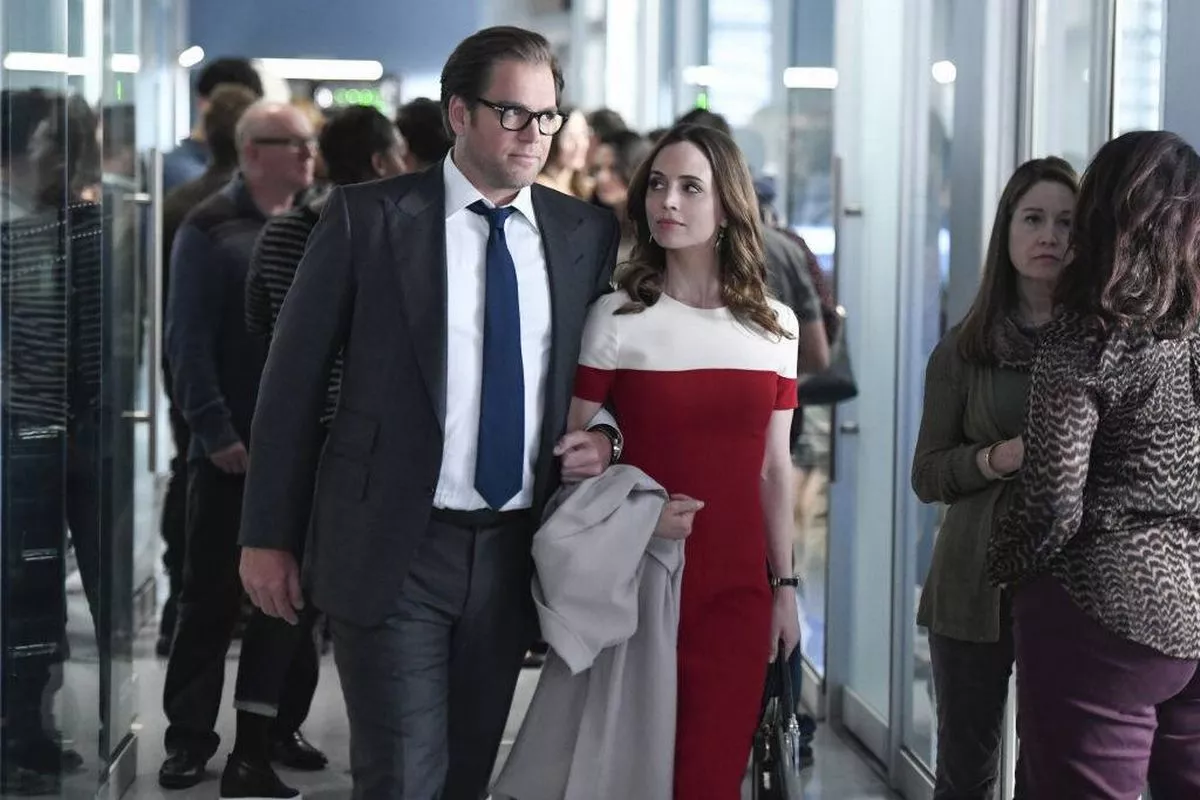 The news comes from a draft of an investigative report the Times reviewed. It was composed by the outside lawyers CBS brought in to investigate the sexual harassment claims against Les Moonves, as well as its corporate culture more broadly. That same investigation unearthed sexual misconduct claims against former 60 Minutes boss Jeff Fager, who is now contemplating a lawsuit over the leaks. This week, CBS also settled with three former employees who sued the network and Charlie Rose in connection with sexual harassment claims. (Rose said in a statement that he “always felt that I was pursuing shared feelings.”).
CBS settled with Dushku in January, just a few months after #MeToo first reached Hollywood. The agreement amounts, roughly, to what Dushku would have been paid if she had remained on the series for four seasons; it also bars Dushku from talking about her experience on the series.
That was not a fun time to be part of CBS, which I know at least some of the folks who were rising through the ranks who now control these greenlight decisions realize. And sure, the new regime is clearly of a mindset where the word of Weatherly is likely to be taken as gospel, as IRISH STAR’s John O’sullivan and Angelica Cheyenne reminded late last year:
After the settlement, Michael Weatherly personally addressed the allegations, although not delving deeply into the harassment claims. He did admit to making inappropriate remarks about Eliza, acknowledging they were neither “funny” nor “appropriate.”
 “When Eliza told me that she wasn’t comfortable with my language and attempt at humor, I was mortified to have offended her and immediately apologized,” he stated. After reflecting on this further, I better understand that what I said was both not funny and not appropriate, and I am sorry and regret the pain this caused Eliza.”
Is that enough of a mea culpa to fully forgive and forget?
It’s apparent that at least among critics the answer is “sure”. The LOS ANGELES TIMES’ veteran observer Robert Lloyd gave a qualified thumbs up:
The crime-fighting combo of a roguish guy and a no-nonsense gal is familiar from “Moonlighting” and “Castle.” Even the fact that the title joins Tony and Ziva with an ampersand and not an”and” indicates a certain lightness of tone, and when Tony, speaking of his company, says, “We try to walk that fine line between techno thriller and workplace comedy,” he is, of course, describing the very series he’s in. A strain of comedy is common to team-based procedurals, and it’s certainly part of what’s kept “NCIS” going strong all these years.
Additionally, the series…is set in Paris, where, having gone civilian, Ziva has opened a fancy language school and Tony runs a high-end security service. (Among his clients: Interpol. You can’t get more European than that.) Along with easy access to croissants and café au lait, our heroes have the benefit of not having to wax patriotic about a country in which they no longer live. It feels very 2025.
And his counterpart Kelly Lawler at USA TODAY was even more enthusiastically matter-of-fact:
There is no TV show premiering this fall that is more ridiculous than “NCIS: Tony & Ziva.” But there’s also no other show so delightedly in on its own joke. A Paramount+ spinoff of CBS’s Navy cop procedural powerhouse featuring two characters who haven’t been on the show in over a decade, set in Europe, with a preteen and without a hint of any actual “NCIS” cops about? What were they thinking? Well, whether they were thinking or not, they were certainly having fun.
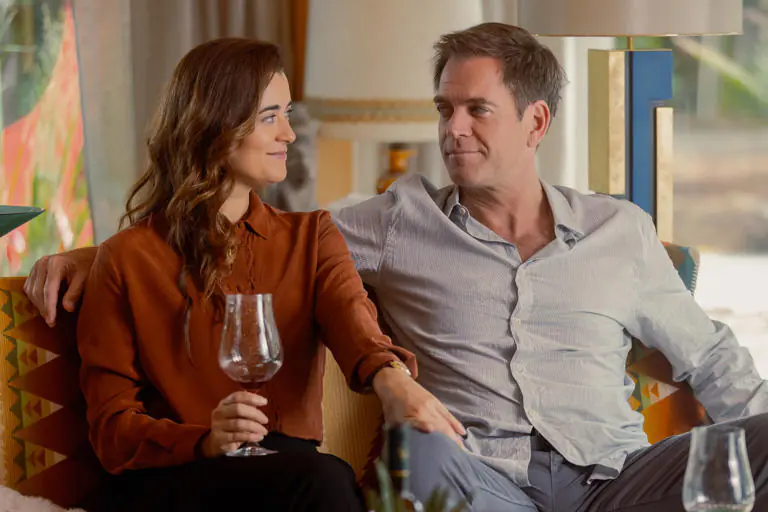 Because fun is the primary watchword in “Tony & Ziva” (streaming Thursdays on Paramount, ★★★ out of four), a silly spy-caper that manages to capture stars Michael Weatherly and Cote de Pablo’s original will they/won’t they chemistry 20 years after they first flirted in the halls of NCIS headquarters. It looks and feels nothing like “NCIS(.) Tony & Ziva” is something else, an adventure comedy that is ludicrous and unpredictable, but still grounded in banter between two actors who are exceedingly comfortable working together.
I get you, Kelly. So I’ll again ask the question: Why is this being called NCIS: Tony & Ziva? And why isn’t it airing on CBS (even as a stunt)? And why hasn’t Paramount Plus at least thrown out a relative bone touting its initial success?
Maybe it’s because it’s a wolf in sheep’s clothing? Maybe while the mothership (yes, pun intentional once more) is thriving its current iterations are coattails shows? Seen any reruns of Los Angeles or New Orleans–nearly 500 episodes of their own between them–on any zombie network lately? Nope; their appeal is long gone, and no, they’re not driving much traffic to Paramount Plus either.
We’ll eventually learn if there’s enough there there for the saga of Tony & Ziva to continue. Enough tolerance for Michael Weatherly to earn a few more million–perhaps enough to donate to some causes that counsel women who have been harassed?
For me, that’s a dramatic plot I actually care to see to conclusion. Not so much that of this series.
Until next time…