
No matter how much of a lull the media world may be in, leave it to the good folks at Nielsen to throw chum into the waters around this time every month when they release the first iteration of The Gauge, their “analysis” of media consumption that those that are still covering this beat immediately vaunt to clickbait status. The May 2025 report which was dropped earlier this week provided especially juicy fodder–enough for THE NEW YORK TIMES’ John Koblin to deliver this dramatic narrative:
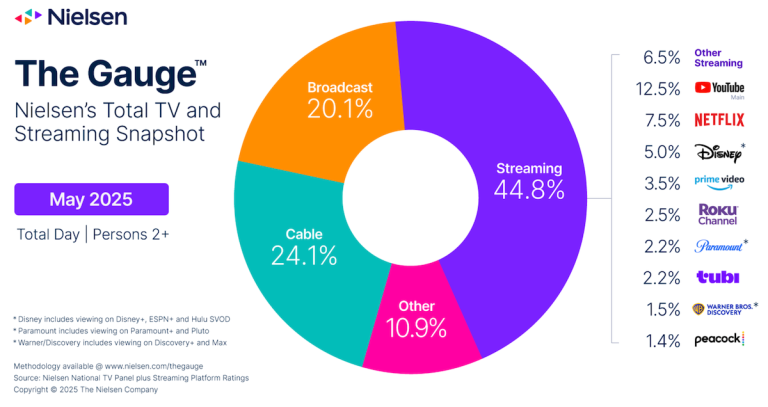 The streaming future is now the streaming present. Americans watched more television via streaming services than they did through cable and broadcast networks in the month of May, Nielsen said in a report on Tuesday. It is the first time that has happened over a full month.
ADWEEK’s Mark Mwachiro provided the words that Koblin only was able to offer in his pretty little enhanced graphic:
According to Nielsen’s Media Distributor Gauge, streaming grew by +0.5% from April to command 44.8% of TV usage in May. In the four years since Nielsen first began tracking TV consumption, streaming has grown to become the preferred TV viewing format over linear, with a +71% increase during that time. The same cannot be said for the broadcast and cable viewing formats, as they have seen declines of -21% and -39%, respectively, since May 2021.
And in those first two sentences there’s a stark reminder that this “death” has been by a thousand cuts, month-by-month movements that barely qualify as statistically significant but nevertheless represent enough movement for the less analytical among us to react in the same way we all seem to do with just about any line item–in a manner that would be right at home on either Mike Greenberg’s or Abby Phillips’ daily round-up of pundits and pontificators.
Koblin threw out a whole lot of provocative theories, aided by the gleeful torquemadas at Nielsen, for why this seismic shift is occuring. Among them were the observations that even we old farts have been dragged kicking and screaming out of analog–enough so that we’ve apparently made GUNSMOKE a retro hit a half-century since the last original episode aired. What somehow gets glossed over is that the way Nielsen calculates streaming viewing–aggregate minutes viewed to a title regardless of program length or library size–gives a distinct advantage to the show that produced 635 mostly one-hour episodes over a once-record 20 seasons. We’re also not seeing demographic breakdowns from these Gauges beyond the topline, so folks like Koblin seem to have no choice but to take Nielsen at their word.
 My faith in Koblin being able to go beyond that has been diminished by the point he makes to underscore the no-sh-t-Sherlock point that cable networks have effectively become zombies, not to mention corporate orphans:
At the same time, subscriptions to niche streaming services — like Hallmark+, BritBox and Crunchyroll — have grown sharply over the past couple of years, filling a role that used to belong to specialty cable networks.
Funny how in the midst of reporting reportable audience he pivots to subscribers as a tipping point. Heck, Netflix has already determined that subscribers are no longer worth reporting on, and that’s especially true when churn is factored in.
Fortunately, there are journalists that do seem to have the ability to raise valid questions. THE DESK’s Matthew Keys peppered his always informative LinkedIn feed with several of them yesterday:
Here is why streaming still has a long way to go…
📈 It is true that more Americans are spending time with streaming TV platforms — but Nielsen’s monthly The Gauge reports fall short of explaining what Americans are actually watching each month. A deeper dive into Nielsen’s blog published each month shows Americans are spending a lot of time with network sitcoms, sports and cable news — all shows that play out first on broadcast and cable TV, and are simulcast by some streaming platforms.
📺 Few write-ups on Nielsen’s The Gauge reports include the context that streaming platforms owned by entertainment companies like Paramount, Disney, Fox and Comcast overlap with broadcast and cable networks, because most offer simulcast of local broadcast stations and/or national sports programming, both of which still drive a large amount of interest and viewership based on Nielsen’s proprietary data that they share with paying clients.
📊 Let’s view this chart another way by counting broadcast, cable and network-owned streaming platforms together, since there’s so much overlap. If Paramount, Disney, Fox, Warner Bros Discovery and Comcast’s Peacock were counted in the same group as broadcast and cable, traditional TV would have secured 56.5 percent of all time spent with TV in May — significantly more than the 44.8 percent of time spent on pure streaming platforms like Netflix, Prime Video and The Roku Channel.
And clearly taking his cue from Keys–primarily because it’s his job to do so–we got this parochial lens on the LinkedIn feed of TVB prexy Steve Lanzano:
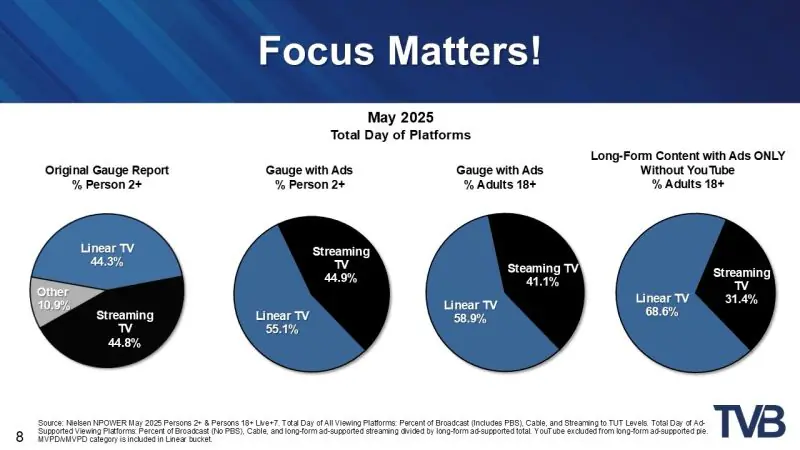 Nielsen’s May Gauge report the original includes all viewing (with or without ads) and all the headlines are talking about how streaming surpassed linear. So following Nielsen guidelines we put together the following “Ad Viewing” Gauge Report. A very different story.
Nielsen did issue a similar report based on Lanzano’s specs in advance of last month’s upfronts. They also now provide a version that was demanded by their remaining paying clients to aggregate based upon corporate umbrella. But putting out all of those iterations merely for the sake of pacifying clients desperate for a story they apparently now lack the internal chops to create on their own only seems to provide confusion and false hope, not to mention raised expectations of impatient share holders. And we know how that all turns out. Layoffs, realignments and cutbacks that produce more and more zombie networks and viewer migration.
As he so often does in his daily TOO MUCH TV newsletters, Minnesota’s favorite son Rick Ellis pointed out how some opportunistic folks have already beaten the likes of TVB to parochial conflation, and therefore how incideniary Nielsen’s approach to all of this has been:
 When you dig deeper into Nielsen’s methodology for the graphic above, you can see how complicated this framing can make things. Paramount’s viewing share number includes both Paramount+ and AVOD Pluto TV, because they are both owned by Paramount Global (and I’d love to see individual breakouts for those two services). But Tubi – Pluto’s main rival – is listed as a standalone because while it’s owned by Fox Corporation, Fox’s broadcast network is part of “broadcast.” Even though a fair amount of Tubi’s viewing numbers come from people watching Fox TV programming.
And then there is the way that vMVPDs such as Hulu Live and YouTube TV are included in the data. It’s a bit complicated, but here is how it’s described in The Gauge FAQ: Linear streaming via vMVPD apps (e.g., Hulu Live, YouTube TV) are excluded from the streaming category. ‘Hulu SVOD’ and ‘YouTube Main’ within the streaming category refer to the platforms’ usage without the inclusion of linear streaming. Linear streaming (as defined by the aggregation of viewing to vMVPD/MVPD apps) is excluded from the streaming category as the broadcast and cable content viewed through these apps credits to its respective category.
Ellis then called for an approach that would slice this data in what he perceives to be a more valuable manner:
1) YouTube (because this is a video business, but it’s not TV and shouldn’t be compared to it. Believe me, I have strong opinions about this).
2) Subscription-supported viewing
3) Subscription-supported viewing with ads
4) Free, ad-supported platforms
That would be a start. I’d also throw in that the very least basic demographic breakdowns be included–and in millions, so we can all see audience composition. Nothing fancy. Sixty years ago Nielsen was breaking out 2-11s, 12-17s, 18-34s, 35-49s and 50-plus. Since Fuhrer seems so focused on Medicare-eligible I’d add we should break out 50-64s as well–that would certainly help differentiate all of tbose news networks and platforms.
If nothing else, it’s a shame that the current approach Nielsen has is to be self-congratulatory and non-commital, as THE WRAP’s Lucas Manfredi shared:
“It’s fitting that this inflection point coincides with the four-year anniversary of Nielsen’s The Gauge, which has become the gold standard for streaming TV measurement,” Nielsen CEO Karthik Rao said in a statement. “It’s also a credit to media companies, who have deftly adapted their programming strategies to meet their viewers where they are watching TV — whether it’s on streaming or linear platforms.”
While streaming exceeding traditional TV viewership is expected to continue in the near future, Nielsen emphasized that it is “almost certainly” not permanent.
“This trend could continue into the summer months, but the balance will likely shift back — at least temporarily — as football kicks off and a new broadcast season returns,” the firm said.
Sure. More false hope and olive branches–all in the quest of creating enough demand for enough different reports to goose the declining Nielsen bottom line. Putting further pressure on the operations flailing for a story to pony up to get them. Tightening the existing budgets all that much more. And once the apparently inevitable decline still arises, something’s gotta give. And in all but the most extreme exceptions (bless you, WBD board), it’s not the CEO that’s going down.
It doesn’t necessarily have to be that way. Folks like Keys and Ellis prove that the skill sets are out there. Some of us who aren’t quite as successful as they are with their platforms can at the very least consult. There’s plenty of us out there blogging and posting that can prove it. You’re reading only one such example. And we aren’t necessarily all that cost-prohibitive. After all, there’s only so much GUNSMOKE any of us can stomach.
Until next time…