
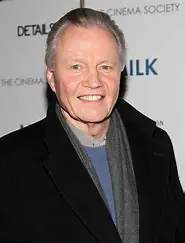
 Let’s be clear: To me, Jon Voight seems like a decent hang. He’s had a remarkably lengthy and influential career as an actor, one that dates back to 1969 when he was among the first cast members of an X-rated movie to be nominated for Academy Awards. No, he didn’t get nekked or engage in what we now associate with such a label, at least while cameras were rolling. But in 1969 the mere allusion to sexually deviant behavior was enough to earn MIDNIGHT COWBOY that badge of honor. And while it was Dustin Hoffman’s typically layered portrayal of the ailing con man Ratso Rizzo that brought me to viewing it it was Voight’s equally complex and compelling portrayal of the naive male prostitute Joe Buck that left so many otherwise prim and pristine voters impressed–myself included when I watched an original version years later as part of a film appreciation class. I also happento be a fan of Showtime’s RAY DONOVAN, one of his more enduring and rare TV show castings later in life.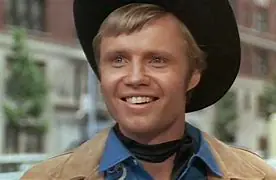
And if that degree of longevity and talent weren’t enough, let me remind you that his DNA helped create Angelina Jolie. For that alone I’d welcome the chance to share a beer with him.
So the fact that he’s somehow fallen into the circle of trust of our country’s leader doesn’t immediately make me want to scream “traitor”. He can cast his vote however the hell he chooses–at least he opted to vote at all. And unlike his fellow “special ambassadors” Sylvester Stallone and Mel Gibson, he at least took the initiative to put together some thoughts on how to save Hollywood at a time where it clearly needs some sort of creative thinking, and this weekend he and his management team were given the chance to share them amidst the gilded and overstuffed toilets of Mar-A-Lago.
And of course, like most things that the putz who makes the most use of said toilets comes into contact with, he yet again chose to be a digital version of a midnight cowboy by “truthing” out a decree while most balanced citizens slept, prompting the likes of THE WRAP’s Jeremy Fuster to send out an instant analysis early yesterday morning:
President Donald Trump’s bombshell announcement that he would implement 100% tariffs on films shot outside the U.S. was met with “pure confusion” and deep skepticism, industry insiders told TheWrap after 24 hours of frantic questioning behind the scenes and total silence from major studios in public.
“The entire entertainment industry spent the whole day trying to figure out how their business could be dramatically changed by a Sunday night social media post,” said Jonathan Handel, entertainment attorney at Feig Finkel LLP. “This is the last thing anyone needs right now.”
And it provided ample fodder for America’s most whiny daytime divas to riff on, as TV INSIDER’s Amanda Bell reported:
Another day, another Donald Trump outrage for The View‘s cohosts to talk about… After reviewing footage of Voight describing his meeting with Trump and the suggestions he made, Whoopi Goldberg, who’s been a central figure in Hollywood since the ’80s and is one of its rare EGOT winners, weighed in.
 “You can’t do that because what that equates to is you’re going to tell me how to write the story I want to write,” she said, explaining that if she wants a story to take place in Europe, “You’re going to charge me for that?” With an air of exhaustion and a growled sigh, she then demanded, “Could you please lower the price of eggs before you start this?!”
But when INDIE WIRE’s Brian Welk picked up the details on his paywall-less site, the story became somewhat more balanced that the first wave of overreaction.
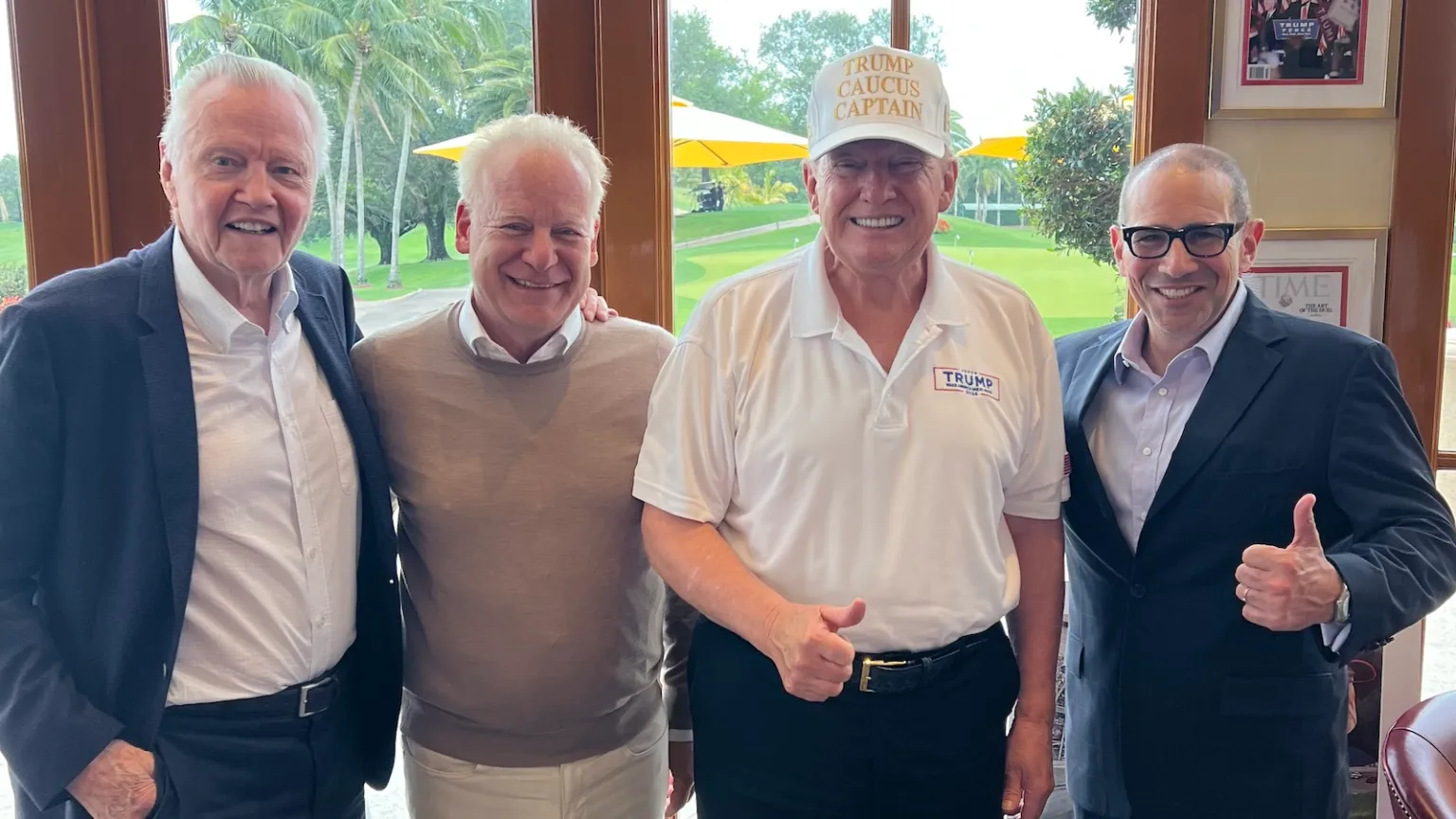 Voight along with his manager and producer Steven Paul and SP Media Group and Atlas Comics President Scott Karol submitted a comprehensive plan to President Trump after several months of meeting with several dozen film and TV organizations and leaders across Hollywood about how to increase domestic film production.
Per a release, the proposal includes “federal tax incentives, significant changes to several tax codes, the establishment of co-production treaties with foreign countries, and infrastructure subsidies for theater owners, film and television production companies, and post-production companies.” But in addition to saying Voight’s proposal has a focus on job training, it also only suggests “tariffs in certain limited circumstances.”
And when the dynamic DEADLINE duo of Dominic Patten and Anthony D’Alessandro were able to obtain the full manifesto from Team Voight, as it turns out there were a lot more points being addressed than simply the dreaded T-word that Fat Orange Jesus seems as addicted to as Diet Coke or adderall. When you’re dealing with someone with limited attention span and capacity to grasp complex concepts, that’s almost to be expected.
Among the more intriguing ones were these that at least attempt to address issues that have most of Hollywood spooked and a substantial amount of those impacted scrambling to keep their Uber gigs amidst the growing popularities of Waymo and Seemo:
Off the top, the Midnight Cowboy star seeks a 10%-20% federal tax credit that would be “stackable” on what states like California (which takes a drubbing in Voight’s document), Georgia and New York already provide. On the flip side, there’s a hammer that will come down. If a U.S.-based production “could have been produced in the U.S., but the producer elects to produce in a foreign country and receives a production tax incentive therefor, a tariff will be placed on that production equal to 120% of the value of the foreign incentive received,” the proposal given to Trump exclaims.
Outside of direct incentives, Voight’s proposal has a bombshell for streamers. In the proposal, he pitches a significant ownership shift between streamers like Netflix and producers. To that, a return to the shuttered Financial Interest and Syndication Rule is suggested with the hope to overturn what Voight calls “Draconian licensing terms.” In subjective terms similar to measures used in the UK and Canada, Voight and team want eligible productions to “meet a minimum threshold AMERICAN “Cultural Test”.
And I’m sorry to say to those of you who immediately want to reject the entire concept because it’s something associated with Trump, Team Voight does have a couple of very valid points.
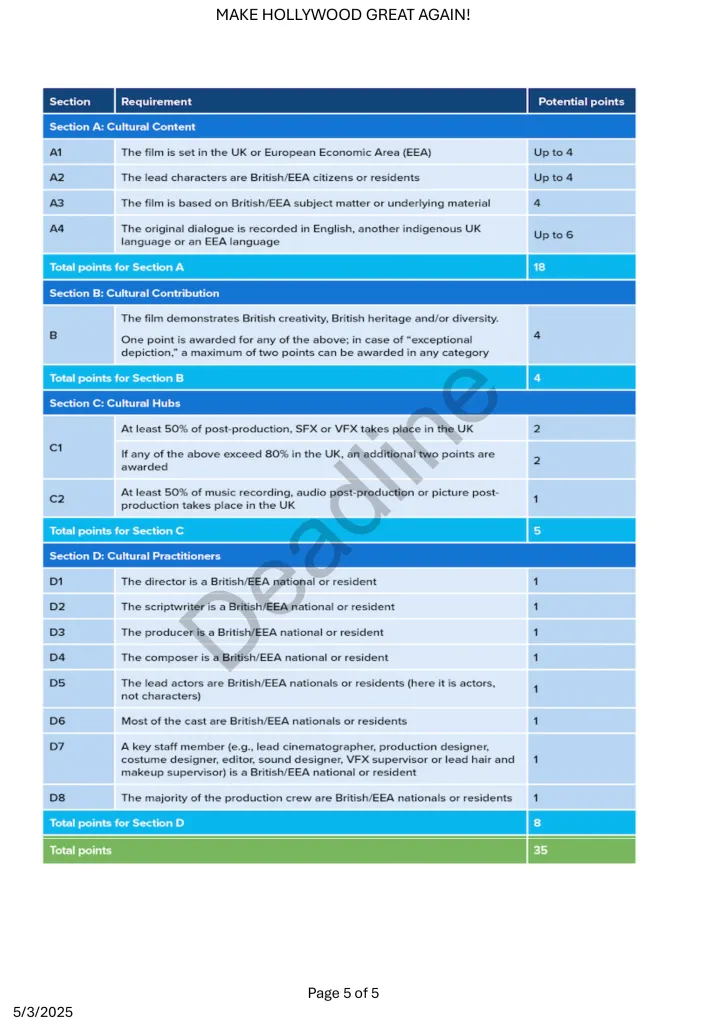 As someone who is familiar with the UK specifics which Team Voight cheerfully supplied a summary of that allowed numerous global series at Sony to actually get made and who participated in several Canadian co-productions where cast and crew were required to have Canadian citizenship in order to take advantage of substantial cost savings, the concept of requiring similar assurances and gives isn’t as outrageous as the likes of Goldberg might have thought. It’s not merely jingoism; it’s at least a noble attempt to try and provide more jobs.
And addressing the issue where it seems that the deciding factor in whether a show gets picked up or renewed by the network is the studio of origin, let alone who gets to market it in success, is an equally valid point worth exploration. CBS’ fall schedule being quietly announced in private meetings reflects cancellations of succcessful series from Sony and Warner Brothers as well as pickups exclusively from CBS Studios. The fate of NBC’s NIGHT COURT, another Warner Brothers property that has delivered ratings at least on par with its network stablemates from Universal TV is also still up in the air less than a week before Comcast kicks off the traditional upfront week.
 I can also speak with some authority about how much more competitive it was when networks and platforms didn’t automatically become the agents of sale. I worked for a company that specialized in threading that needle at a time when the Fin-Syn rules were just being implemented and the networks weren’t quite set up to take on the complex role of domestic distribution on their own. In three consecutive years MTM Enterprises, desperately trying to preserve a semblance of being a provider of network series, acquired the rights to the modestly successful RESCUE 911, AMERICA’S FUNNIEST HOME VIDEOS and DR. QUINN, MEDICINE WOMAN. I developed marketing plans and market-by-market presentations for all of them. They kept me gainfully employed at yet another time of life transitions. No, they didn’t blow away ratings expectations–QUINN in particular underdelivered on mid-sized Big Three affiliates who bought into our narrative that it was a desirable alternative to the wave of trashy talk shows that were proliferating afternoon time slots around the country at the time. But a whole bunch of less reputable shows also failed to work, and we at least could hold our heads high by proudly representing a quality failure.
And much like our ill-fated syndication efforts that preceded the eventual sale of MTM’s parent company to FOX, the Team Voight presentation does fall short when put under a more reflective microscope. Yet again the scrutiny of TOO MUCH TV’s Rick Ellis revealed many flaws, specifically in the arena which the farter-in-chief particularly obsesses on. Here’s what Ellis shared in last night’s newsletter:
It was made very clear to me that the tariff idea was unworkable on a number of levels. The law that the Trump Administration is citing in order to roll out its various tariff proposals has a specific carve-out for items such as motion pictures, which would mean the White House would have to figure out a way to impose the tariffs under a different method. There are also existing deals with the World Trade Organization that at least in theory would prohibit the United States from imposing tariffs in this fashion.
Then there are just the logistical challenges in imposing such a tariff. The Voight plan seeks to create some guidelines for co-productions, but the consensus from the people I spoke with this evening is that it doesn’t clear up the inherent unworkability of the tariff idea.
There’s also the reality check that the job crisis in California isn’t likely to benefit from this:
“This proposal has several infrastructure tax breaks, incentive plans, and other ideas which won’t directly boost production in the United States,” one source explained to me this evening. “The proposal allows companies to be reimbursed for spending they will likely do anyway. And it would encourage studios to build new facilities outside California, where wages and the overall cost structure are more favorable to their bottom line. None of that will necessarily lead to increased production in the U.S.”
So I suppose that can be construed as yet another finger in the Eye to that bad, bad Democrat Gavin Newsom, and yet another politically petty strategy. But I’d also offer that even the red states aren’t necessarily going to see significant turnarounds, either.
What the early days of the pandemic and the 2023 strikes reminded everyone–especially the shareholders of these private companies–is that we can somehow survive without the glut of production that defined the clearly dying off “peak TV” era. With such a vast array of choices and a fixed amount of time to devote to consuming it, networks and platforms don’t necessarily need the amount of product they initially believed they did. And even movie theatres aren’t exactly clamoring for the kinds of less grandiose productions that the Voight visions would seem to support. You gotta blow people away to expect them to drop $50 on a watered down cocktail and fried mac-and-cheese bites. Not even Whoopi can do that these days.
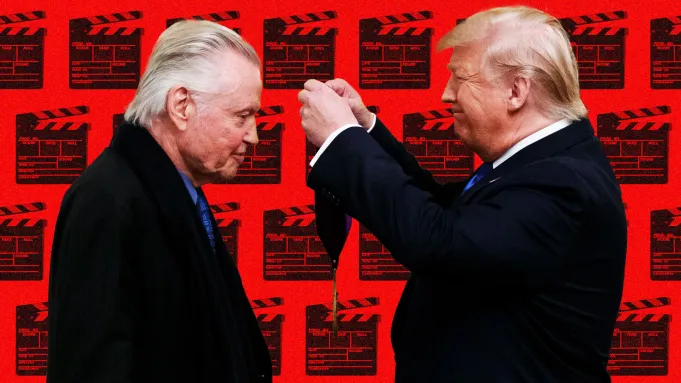 I sure didn’t expect Fat Orange Jesus to have such attention to detail. But given the background of those that were working with Voight, my bar for them was raised. Paul is a friend since childhood with a friend and esteemed business colleague of mine that did a lot of the same kind of detail-oriented work that I did for decades. Karol knows quite well the challenges of being an independent upstart in a world dominated by corporate monoliths such as DC and Marvel. Surely they would have been able to address the issues that Ellis’ sources raised. Something as simple as a minimum amount of production commitments in order to qualify for tax breaks could have been tossed in. At least put the carrot in front of people desperate for work that enough will be produced to make them sit up and take notice. Think of how many voters might have been swayed by that alone.
In fairness, perhaps those points were addressed. We are largely getting an emotional and piecemeal narrative on all of this. If and when the full statement is addressed and debated with those sources and Team Voight in the same room we need to at least leave the door open for such possibilities. A Congressional inquiry could certainly be forthcoming. And I suppose we should welcome that possibility. We’re gonna need something new to watch if it gets too damn expensive to produce anything, right?
Until next time…