
It’s both reassuring and daunting to realize that I’m often not alone when it comes to media musings that, in the immortal words of that noted Quahog 5 commentator Peter Griffin, “really grind my gears”. Richard Rushfield does that regularly as one of the founding fathers of THE ANKLER, and TOO MUCH TV’s Rick Ellis happened to pick up on an item from the newsletter he dropped yesterday, throwing in some additional snark to point out Rushfield’s in far better financial shape than he is. I can identify on both counts.
And I’ll further kick myself for not picking up sooner on what drove R and R to consternation yesterday, as I indeed did take notice of it when it originally went down at the end of last month. Even ENTERTAINMENT WEEKLY’s Kristin Baldwin found it uplifting enough to report on:
 Grab your bonnet and lunch pail, Little House on the Prairie fans, because it’s time to go back to Walnut Grove. Netflix revealed Wednesday that it has ordered a LHOP reboot, which will be based on the third book in Laura Ingalls Wilder’s series of autobiographical novels. Deadline first reported the news. According to Deadline, the Netflix series will follow the Ingalls family — Charles, his wife Caroline, and their children Laura and Mary — as well as characters from the Osage tribe the Ingalls family encounters in Kansas.
Trip Friendly, son of original LHOP producer Ed Friendly, has been working for years to get this reboot off the ground. “It was something that I talked with my father about before he passed in 2007. I really felt it would be exciting to reboot the material,” he told Entertainment Weekly in 2020. “Fans are eager to see Little House on the Prairie come back to the screen, and we agree the time is right. We feel optimistic that this will happen.” Friendly is an executive producer on the Netflix reboot, while Rebecca Sonnenshine (The Boys, The Vampire Diaries) will serve as executive producer and showrunner.
That’s probably why I initially dusted this under the rug. At first blush, it’s yet another nepobaby looking to cash in on legacy IP and bringing in a showrunner whose resume screams anything but family-friendly. Plus, the OG version aired during a time when I lived in New York, and there’s nary a prairie within driving distance of where I lived. So, no, I’m not a fan.
But upon further review it’s worth noting that that initial run did last more for a decade between 1974 and 1983, which during that era was anything but common for NBC. And it also reminded me that when I started out in this business the reruns were consistent, advertiser-approved performers that found their way into a number of quality afternoon time periods at a time when fewer comedies were being produced and released, It wasn’t MAGNUM, P.I., but it was a lot more cost-effective, consistent and sellable.
So I probably should also have noticed, and therefore less surprised than many others, when Baldwin dropped this nugget into her announcement:
The news of Netflix’s reboot comes on the heels of a Nielsen study that crowned LHOP as the top “legacy” series on streaming in 2024, with 13.3 billion (!) minutes viewed.
Rushfield’s reaction to this pretty much echoed mine, again no surprise since he’s clearly not the type to willingly seek out a prairie himself:
A couple of weeks ago, Nielsen announced its streaming numbers for 2024. One astounding point leaped out at me: Little House on the Prairie, a show that went off the air 40 years ago, before anyone in “the demo” was born, got people watching 13 billion minutes of its catalog last year. On Peacock, which barely exists in the great streaming game’s viewership. Thirteen billion. That is, I believe, more than any current show on TV. It’s more than mega-hits Moana or Super Mario Bros. Yes, it’s got a bigger catalog, but still! It’s been off the air for 40 years.
Well, that prompted moi to sift through the Nielsen spin that accompanied the announcement, a hokey accolade they called the ARTEYs, with this incredulously self-serving description:
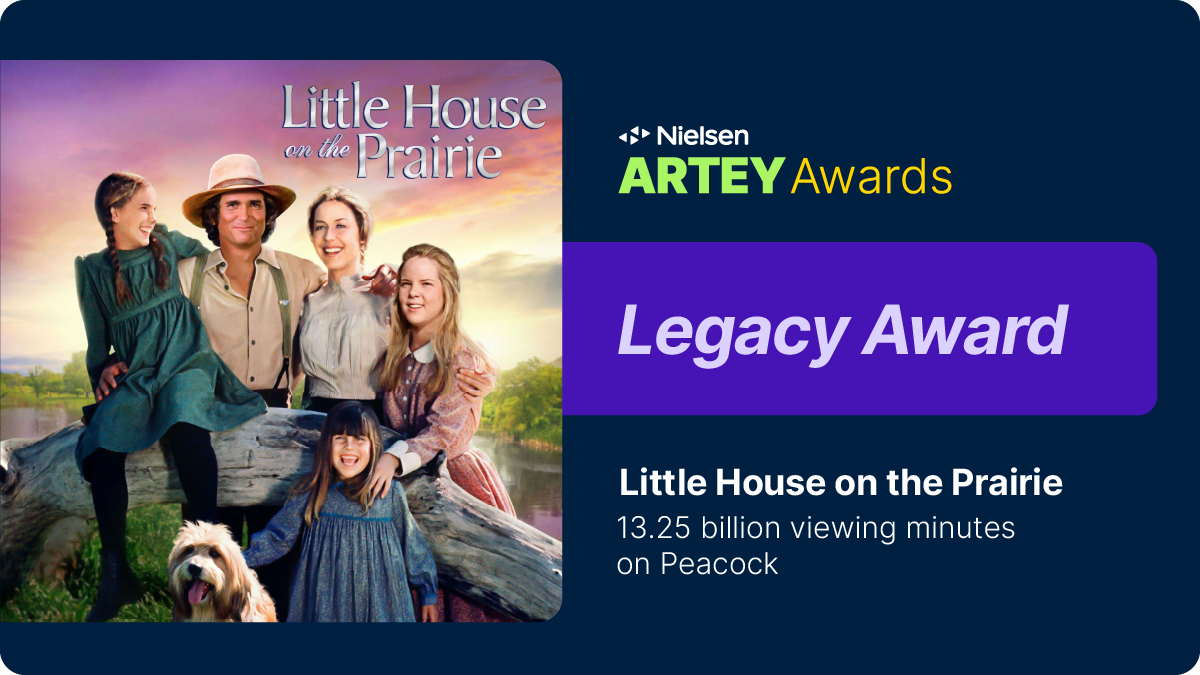 To help the media industry better understand the key trends driving streaming’s growth, Nielsen has released our annual “Streaming Unwrapped” report sharing yearly streaming viewership since 2020. This year, we’re expanding the report to include additional viewing categories, and renaming it the ARTEY Awards. Named for Nielsen’s founder, Arthur C. Nielsen, and an acronym for “Audience Rated Television Entertainment of the Year,” we’re recognizing the year’s most-watched TV shows and movies.
It’s nice to know that a venerable Chicago market researcher is now in the same category as Oscar Pierce and Antoinette Perry. If Rushfield had found his way to the end of that release, he would have come across a handy table that ranked those current series and been able to more accurately say that LITTLE HOUSE would have ranked a still competitive fourth, behind BRIDGERTON, LOVE IS BLIND and THE BOYS but ahead of THE LINCOLN LAWYER. Considering how relative little sex appeal Melissa Gilbert, Alison Arngrim, Karen Grassle and Melissa Sue Anderson packed in that era, that 13B-ish figure is all the more astounding.
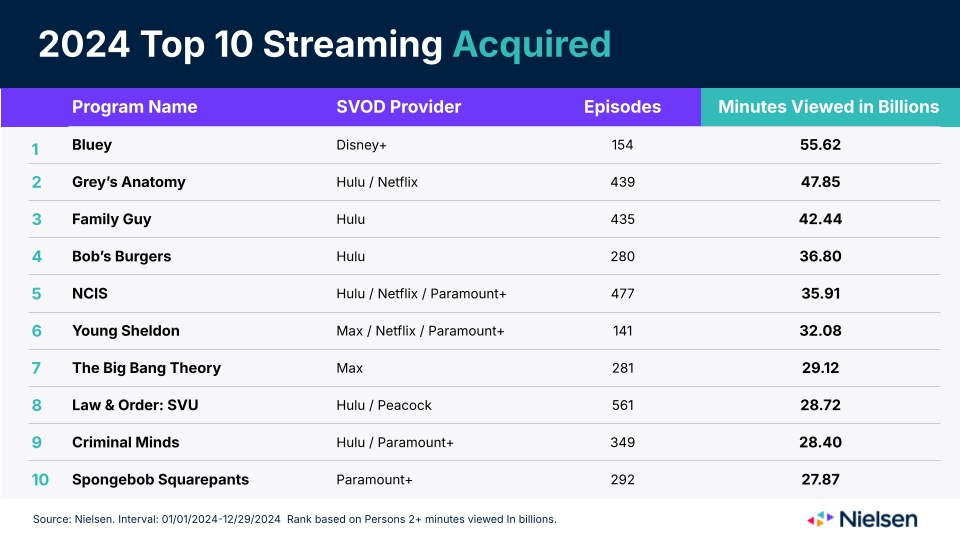 I couldn’t help but put it into further context when contrasting it with the deliveries of other acquired series, which ARTEY and team also provided a Top 10 list for. LITTLE HOUSE’s total is less than half of #10 SPONGEBOB SQUARE PANTS, but the more noteworthy column is the number of episodes that the top performers have available. LITTLE HOUSE produced a mere 204 episodes (some 90 minutes, to be sure). Do the math. On a per-episode basis, LITTLE HOUSE was seen in 2024 for approximately 20% more minutes than LAW AND ORDER–a show that’s still successfully producing original episodes.
Even more stunning were Nielsen’s nuggets about LITTLE HOUSE’s demography:
Adults 35-64 accounted for 63% of Little House’s overall viewing total, and it over-indexed among Black viewers, which comprised over 17% of its total viewership.
The show often didn’t hit such advertiser-coveted targets in its linear deployment.
So I’m right up there with Rushfield’s flabbergasted take as to how something as clearly successful and top-of-mind as this somehow wound up somewhere else–especially the big, bad monolith of Netflix:
I’m sure there was some very good reason for Peacock to let the rights to its megahit — one of NBC’s signature classics — get away. The bidding got out of hand. The numbers didn’t add up. Maybe Peacock is going to remake the show based on the rights to the series and feels it doesn’t need the books.
I kind of don’t want to know, because whatever the good reason was, it’s not good enough. Ankler Rule #1: This is a business of hits. Peacock has been waiting for one for years now, and it had this, a show that is at the core of the whole NBC brand, and they let it — or even some piece of it — slip away.
NBCU has certainly noticed what Netflix had done for SUITS–heck, they’ve practically devoted their entire promotional schedule for 2025 to date for the impending premiere of the SUITS LA spinoff that finally debuts this coming Sunday night. I can’t imagine the economics of SUITS being produced in LA are any more advantageous than what could be done with something like LITTLE HOUSE, which practically screams being shot in a right-to-work state. Maybe their protagonists aren’t as hot as those in BRIDGERTON and LOVE IS BLIND, but ten years on NBC versus nine on USA should have still counted for something.
 I’ll even add my own Rushfield-ian take that Peacock’s not the only short-sighted streaming “competitor” to Netflix in this case. As Baldwin noted, (t)he long-gestating project from CBS Studios and Anonymous Content was first announced in 2020. CBS’ participation comes from the fact that they inherited distribution rights from their long-ago absorption of the show’s original syndicator, Worldvision. 2020 was also when CBS was launching Paramount+. But that was also a time when they were happily licensing Peacock rights to other shows, a point Rushfield forcefully delivers as a coda to his rant:
Paramount, of course, made a similar decision when it licensed out Yellowstone instead of developing it on its own service, a short-sighted decision that doomed Paramount+ in its cradle. For want of Yellowstone, a service floundered for years. And for want of a competitive streamer, did the whole company die? Is it possible that with Yellowstone, P+ might have launched with rocket fuel, and the situation for the company might have looked very different? Instead, Paramount decided to take the cash and rent it out . . . to Peacock! Which apparently learned nothing from the deal.
It’s not like either of these platforms has been averse to taking fliers on recapturing long-ago “ratings” glory with familiar titles. Peacock, in particular, has trotted out reboots of PUNKY BREWSTER and a drama-centric BEL AIR, and has FRIDAY NIGHT LIGHTS teed up for revival soon. Paramount+ tried and failed with FRASIER and resurrected CRIMINAL MINDS after its impressive library performance .
Oh, and considering the mindset of the country as a whole these days? Can any so-called strategic expert at either of these companies hell-bent on what they contend is a “brand fit” look at the compelling evidence of LITTLE HOUSE’s performance and say “naaah, it’s not the right time”?
And even if one adopts Rushfield’s dismissive conclusion that Peacock is basically biding time until it merges with HBO (or, for that matter, Paramount+), wouldn’t a refortified service have benefitted by at least making sure that its arch-rival didn’t have a quiver like LITTLE HOUSE in their bow?
His parting shot on all of this was particularly delicious:
A huge mistake, and another example of how all our studios are sleepwalking towards the cliff’s edge here.
I couldn’t have said it any better myself. Which was pretty much Ellis’ conclusion. So I guess in that light I’m no more of an original thinker than they are. But at least we’re all running circles around the braintrust at Peacock and Paramount.
Until next time…