
4. COMCAST. WARNER BROTHERS DISCOVERY. PARAMOUNT GLOBAL. AT LEAST ONE OF THESE WON’T EXIST AS WE KNOW IT TODAY A YEAR FROM NOW.
 Despite all of the predictions and wishes that I’ve mused about over these last ten days of 2024 I’m obviously not the only nor hardly the most auspiced pundit offering them, especially in the world of media. Alex Sherman, the ubiquitous CNBC business reporter and de facto water boy of the summer Sun Valley shindigs where the seeds of these predictions are sown, took to both his print and video pulpit just before Christmas to offer his version of what he’s heard around the hydrogen-infused virtual water cooler:
 In honor of the 12 days of Christmas, we give you 12 predictions from some of the most powerful media and entertainment executives in the world, weighing in on the condition of anonymity so they can speak candidly about their visions of the year ahead. And then, because we have holiday cheer, we give you a bonus one. A baker’s dozen!
And right off the top is perhaps the lowest-hanging fruit of all, all the more credible because it just happens to involve his current employer:
Executive 1: Comcast will acquire the studio and streaming assets of Warner Bros. Discovery and merge them with NBCUniversal
Second time’s the charm! Warner Bros. Discovery is separating its linear assets from the rest of the company. Comcast is spinning out most of its cable networks. It has to mean something, right?
It certainly does to Sherman’s NEW YORK TIMES counterpartsBenjamin Mullin and Lauren Hirsch, who earlier this month framed the upcoming year with ominous clarity:
The people in charge of the world’s biggest media companies are setting the stage for a flurry of deal making. The starting gun went off in October, when Comcast’s president, Michael Cavanagh, said the company was exploring a spinout of its cable networks, which include SyFy, USA and MSNBC, into a new company. Analysts expect the as-yet-unnamed company to go on a shopping spree, buying up smaller cable networks and peeling off channels from rivals.
On Thursday, Warner Bros. Discovery announced it was planning to reorganize its company into two big divisions, lumping its traditional TV networks into one group and its streaming and studio businesses into another. In its announcement about the change, the company said it would increase its “strategic flexibility,” corporate argot for creating options to buy and sell things. The company’s shares spiked 15 percent on the news, with investors expecting some kind of transaction.
The move was intended as a signal to potential suitors that the company was willing to entertain deal discussions, according to two people with knowledge of the company’s strategy.
And the impressive REUTERS troika of Dawn Chmielewski, Deborah Mary Sophia and Aditya Soni reinforced that likelihood with news of a thumbs up from one of the more influential and savvy observers I happen to know personally:
 Bank of America research analyst Jessica Reif Ehrlich wrote that Warner Bros Discovery’s cable television assets are a “very logical partner” for Comcast’s new spin-off company. “We strongly believe there is potential for fairly sizable synergies if WBD’s linear networks were combined with Comcast SpinCo,” wrote Ehrlich, using the industry term for traditional television. “Further, we believe WBD’s standalone streaming and studio assets would be an attractive takeover target.”
If this sounds like some deja vu for our dear friend Yosemite Zas, that’s because just about a year ago he was literally romancing the stone–er, the mountain, as CORD CUTTERS NEWS’ Luke Bouma reminded his readers last month:
Paramount Global engaged in extensive merger discussions with Warner Bros. Discovery (WBD) for months before ultimately abandoning the talks and agreeing to a deal with Skydance Media, according to a regulatory filing released Monday. Paramount’s then-CEO Bob Bakish and WBD CEO David Zaslav initiated merger discussions in December. However, by late February, Paramount’s board decided to cease sharing financial information with WBD due to the lack of a concrete offer.
Despite Zaslav’s continued interest, talks with National Amusements Inc., the Redstone family holding company that controls Paramount, indicated that WBD would need to pay a premium in cash, making a deal “challenging.” Discussions continued into April, but WBD remained unwilling to offer cash consideration to shareholders.
And it’s not as if Comcast wasn’t also exploring a dalliance of their own with the same suitee, as Bouma continued:
 Paramount also held discussions with Comcast and, at one point, was an early leader for a merger deal. Comcast CEO Brian Roberts initially expressed interest in licensing content and later proposed a joint venture between Peacock and Paramount+, with Comcast retaining majority control. This would have seen both companies remain as independent companies with a joint streaming service with shared ownership.
So considering that history, as well as the prevailing perception that the incoming administration will be far more open to megamergers, why not at least consider the possibility that all three struggling media entities find some way to play out their own version of TRANSFORMERS and come together?
Indeed, as the TIMES duo reported, our BFF Yosemite Zas is already sending out dogwhistles to that effect:
David Zaslav, the chief executive of Warner Bros. Discovery, told analysts on an earnings call in November that he was optimistic about prospects under the new administration.
“It may offer a pace of change and an opportunity for consolidation that may be quite different, that would provide a real positive and accelerated impact on this industry that’s needed,” Mr. Zaslav said.
Sure, there would be potential legal and political hurdles, a point that Mullin and Hirsch underscored:
Mr. Trump’s picks to lead the antitrust agencies, Gail Slater as assistant attorney general at the Justice Department and Andrew Ferguson at the Federal Trade Commission, have so far largely reassured deal makers. Still,…some antitrust experts say that Ms. Slater and Mr. Ferguson could apply greater scrutiny to media companies that they believe have a liberal bias.
But a combination that would ultimately put MSNBC, CBS NEWS and CNN under the same umbrella, at least on paper, would potentially neuter three of his more irritating “fake news” outlets who would be muzzled by their parents to tone down the rhetoric to curry favor. And who’s to say that the eventual owner of this mashup would necessary be any of the existing puppeteers? For example, Mullin and Hirsch offered up their own Exhibit A: Antenna, a media company that owns a stake in the Saudi broadcaster MBC, has been exploring deals for English-language media companies. And, of course, there’s a fairly aggressive tire-kicker right down the hall from him as an extended holiday house guest.
If indeed a side goal of this incoming administration is to eliminate dissenting voices, the precedent of three flailing media companies for one last hurrah is out there. And because I know the boyhood home of its Leader was on the same paper route as mine, and I suspect he may have the same fleeting memory of the World Journal Tribune that I do–maybe more, since he has more than a few years on me–he might actually support a megamegamerget of the whole schmeer.
As Wikipedia tersely recapped:
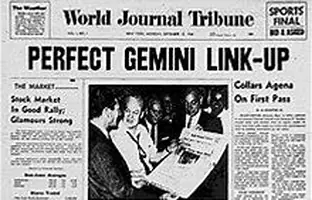 The World Journal Tribune represented an attempt to save the heritages of several historic New York City newspapers by merging the city’s three mid-market papers (the Journal-American, the World-Telegram and Sun and the Herald Tribune) together into a consolidated newspaper. In April 1966, in an attempt to avoid closing down, the Scripps-Howard owned New York World-Telegram and Sun merged with Hearst’s New York Journal-American and the New York Herald Tribune to become the New York World Journal Tribune, an evening broadsheet newspaper which would rely on newsstand sales to survive.[1] The management of the merged paper told their employees that to succeed the new enterprise would need concessions from the unions, but the unions, upset that several thousand workers were planned to be laid-off, demanded their own concessions from management.[1] The result of the impasse was a 140-day strike[2] which delayed the debut of the new paper until September 12, 1966.[3]
We were a newspaper household and when the WJT finally hit the streets the same company that was delivering the more local LONG ISLAND PRESS that I (well, in reality my dad) was delivering evening papers for offered the WJT for a free six-week trial and a ridiculously low price as an add-on. My mom especially loved their Sunday edition, which included NEW YORK magazine as an insert and whose logo was frequently splashed in color in the outside wrapping which contrasted nicely with the comics of the SUNDAY NEWS and the mundane grey lady look of the TIMES.
But, alas, the idea of stuffing three pounds of crap into a one-pound bag was no more viable then then it portends to be now. As Wikipedia concluded:
The World Journal Tribune never became economically viable, and it ceased publication eight months later, on May 5, 1967.[4] During its short life, the paper never opened a Washington bureau, and did not have any foreign correspondents on its staff,[2] relying instead on the Los Angeles Times–Washington Post News Service for foreign coverage.[1]
 NEW YORK magazine survived, and I know the Leader knows a lot about that. So maybe he’ll have a soft spot for that reason alone, not to mention the delicious possibility of again accelerating the demise of several outdated and ineffectively run media companies looking to make an eventual exit?
I suppose this may be a little far-fetched at some level, and perhaps with the Ellison clan just coming in they sort of have a due diligence to at least try to run Paramount Global more effectively. But who knows how much rope and patience they really have? Considering where Paramount+–their stated focus business–currently sits on the streaming food chain, it might be roughly the same amount that Hearst and Scripps had nearly six decades ago.
So maybe this dramatic iteration, much like my previous prediction/wish for Netflix to have a Sunday afternoon football package and a Super Bowl, is a tad premature. But I would be willing to bet you a nickel that at least one of the components of it finds a path to cashing out and laying their problem children off on someone else in the next 12 months.
And believe me when I look at my current bank account, that nickel represents as proportionate a gamble as anyone would be willing to take on any of these wacky ideas.
Until next time…