
In a minefield where multiple struggling streamers are rolling out expensive and buzzy “prestige” series as the window for Golden Globes nominations is fast closing, it’s easy to overlook the fact that over the course of five October days three examples of what fall premieres used to be are in the midst of being rolled out to the ever-shrinking sector of America that still knows what a broadcast network and a four-camera situation comedy are.
It takes a venerable observer like the LOS ANGELES TIMES’ Robert Lloyd to connect these dots and summarize for his readers (almost assuredly folks who belong to said sector) the assumptions that those that fiercely buck the trends of the times employ. As he wrote earlier this week:
If there is one form that immediately screams “television,” it’s the multi-camera situation comedy — filmed, taped or digitally recorded before a live audience, or at least giving the impression that it was. It has gone in and out of fashion over the years, vying with single-camera comedies — first with laugh tracks, now without — but continues to thrive, in all its anti-cinematic, brightly lit, deep-focus, three-walled, theatrical, long-take glory.
(I)t’s an accommodating form, a democratic form, that adapts to all sorts of settings and players, regardless of race, creed, color, class, age, sex, gender, period, or what have you. Sometimes there is drama, and often there is sentiment, and even, at judiciously spaced intervals, a little bit of heartbreak. There will be tonal differences, with series leaning more or less fantastic or realistic. But the main brief is to construct a friendly if chaotic place to visit weekly, with a grab bag of characters in whose lives you might invest — a place where you know everybody’s name and nod in recognition even as you laugh in surprise.
Lloyd’s quioxtic ode to the form did leave out the fact that compared to single-camera comedies production costs are anywhere from 30 to 50 per cent cheaper, as well as the fact that comedy talents both in front of and behind the camera tend to thrive on the energy and immediate feedback of a live audience. Keeping costs down and keeping talent happy are two strongly motivating factors behind what we’ve seen so far.
 CBS got this party started Thursday night with the debut of GEORGIE AND MANDY’S FIRST MARRIAGE, the second spinoff from perhaps the last mass-appeal, high-volume, ever-rerunable half-hour we may ever see, THE BIG BANG THEORY. It occupies the Thursday at 8 ET time slot which its immediate predecessor and direct source for casting YOUNG SHELDON dutifully filled for a serviceable seven seasons, continuing a stretch which BBT began in 2010 and was one of CBS’ more inspired strategic moves of the past few decades, reclaiming a turf for “must-see TV” which NBC foolishly eschewed. Indeed, in the opening scene of the pilot, set in the mid-90s immediately after the origins story of Sheldon Cooper concluded, Georgie, the oldest and by admission least bright Cooper sibling, and his in-laws are tuned to a classic episode of FRASIER. As Lloyd noted, this pearl of wisdom from Montana Jordan’s winsome title character pretty much sums up its raison d’etre:
“‘Frasier’s’ a laughing show,” says Georgie, meaning the laugh track. “I like laughing shows. … ‘Wonder Years,’ no one’s laughing. Is it funny? We’ll never know.”
The fact that a teenager in rural Texas was watching a so-called “urban” sitcom in the same room with older family members is in itself a sign of how times and tastes have changed. And it’s clear from that scene on that despite the fact that this returns the Cooper-verse to its multicam roots it’s being based around a character who for the first time does not have the counterbalance of his younger brother to play off, and it’s also the first time any iteration of this series doesn’t have a Sheldon as its lead. Uberfans of BBT are familiar with how the George Cooper, Jr. character evolves–we saw him being portrayed by Jerry O’Connell as a egomaniacal, hugely successful car dealer who was established as a source of torture that overshadowed his occasional attempts at emotional connectivity. This spinoff seems to attempt to explore the roots of that character as he is given a job in his father-in-law’s garage despite not having a high school diploma–a fact that his mother-in-law is quick to point out to her daughter, the lovely but naive Emily Osment. But there’s a granddaughter in the mix, which sets up the premise that these “wacky kids” are at least being supported enough to have a roof over their heads while they try to establish their lives.
Jordan’s version of Georgie, which evolved in the last year of YOUNG SHELDON as the storyline involving his March-June fling (he lied his way up from 17 and she her way down from 29 to produce a hookup that gave us daughter Cee Cee), is both corny and endearing, especially so in scenes alone with his father-in-law, played by the low-key and endearing Will Sasso. We’re reminded that for all of his flaws he’s also a young man who suddenly lost his father at a much too early age, and his intense devotion to his new family produces the roots of his determination that we know will give him his later success. That’s probably reason enough to stick around for me.
 Meanwhile, NBC is going back in time in its own way by doubling down in its investment with Reba McEntire. Her WB sitcom existed for six seasons as a true outlier on a network that was obsessed with promoting to a younger, upscale audience with the likes of GILMORE GIRLS, DAWSON’S CREEK ONE TREE HILL and has found a new generation of viewers and potential, as USA TODAY’s Bryan Alexander observed in his effusive preview that dropped yesterday:
So just how is country legend Reba McEntire dominating TV screens as “The Voice” coach two nights a week (now in her third season) as she anchors her sitcom return in NBC’s “Happy’s Place”? And all while juggling her McEmpires (the clothing line, the entertainment company) with the songwriting, the concert appearances? It’s all about location, location, location. NBC’s “Happy’s Place,” (Fridays, 8 EDT/PDT), is ever so conveniently shot at Universal Studios, just across from “The Voice(.)”
Whatever it takes to get the McEntire back in the sitcom world with fellow executive producer Kevin Abbott, with whom the Queen of Country collaborated on the WB comedy “Reba.” That sitcom ended its six-season run in 2007 but is seeing a resurgence thanks to Netflix. “It’s like a whole new generation for a show that started in 2001,” she says. “I’m just thrilled to death.”
McEntire, seen in her world as a Nashvillian answer to Lucille Ball (it used to be Roseanne Barr, but times have indeed changed) , has once again called upon her answer to Vivian Vance, the engaging Melissa Peterman, as a comic foil, but her de facto co-star in HAPPY’S PLACE is young Latina actress Belissa Escobedo. Alexander sets up this series’ premise:
In “Happy’s Place,” Peterman plays the untamed bartender at the tavern Bobbie (McEntire) inherits from her once-estranged and now-deceased father. There’s a comedic catch, of course, as Bobbie discovers she has a half-sister, Isabella (Belissa Escobedo), who thus becomes the bar’s half-owner. Bobbie adjusts to her new life as McEntire wields her grumbling everywoman sitcom humor once again.
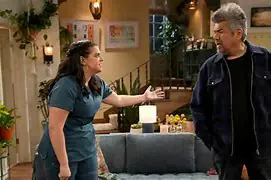 It’s clear that Escobedo’s presence is in part meant to appeal to the established audience of its Friday night companion piece LOPEZ VS. LOPEZ, itself a descendant of a successful outlier early oughts sitcom, THE GEORGE LOPEZ SHOW. Purportedly due to strong digital numbers with a multicultural audience, that returned for a third season last night right after HAPPY’S PLACE. I’m absolutely not a fan of Lopez’s, but I am willing to give HAPPY’S PLACE more of a shot than, say, THE HOLLYWOOD REPORTER’s Daniel Feinberg, who was decidedly negative in his review from yesterday:
(W)hen I say that Reba McEntire’s new NBC series Happy’s Place is not worthy of Reba McEntire’s talents … well … get in line, Happy’s Place. As bar-set NBC sitcoms go, Happy’s Place is no Cheers, in the two episodes sent to critics…(P)erhaps that isn’t a fair comparison, either. The Cheers pilot is perhaps the best sitcom pilot ever made, and that’s without getting into the subsequent 274 episodes. Then again, Happy’s Place is also no Undateable or Abby’s, two subsequent bar-set NBC sitcoms that set the bar – so to speak – much, much, much lower.
But it is a damn sight better than LOPEZ VS. LOPEZ. Which gives it a shot in my book.
The third of this mini-renaissance premieres Monday night and brings back yet another talent from a previous generation, IN LIVING COLOR’s Damon Wayans, and his eponymous son late of NEW GIRL, providing CBS what LeBron and Bronny James are providing to the Los Angeles Lakers–a father-son duo. POPPA’S PLACE will launch Monday night as a companion piece to its relatively long-running THE NEIGHBORHOOD. I’ve not yet seen it, but Lloyd has, and if nothing else he’s realistic:
To judge only by the pilot, “Poppa’s House” will be a lightweight show, the lightest of these three. There are repeating jokes about the size of Poppa’s head. But the Wayanses are having an evident good time working together, as underscored by the bloopers that run under the closing credits — and what more do you want from them, really?
What POPPA’S HOUSE has going for it is an adjacent, established like-minded show, to promote off of and draw audience from. GEORGIE AND MANDY’S FIRST MARRIAGE inexplicably has the current CBS regime’s pet project GHOSTS as its partner. Neverthless, per DEADLINE’s intrepid Nellie Andreeva, it found an initial following:
Georgie & Mandy’s First Marriage is picking up where predecessors The Big Bang Theory and Young Sheldon left off — as the most watched program on broadcast Thursday night.
The Young Sheldon spinoff opened with 6.563 million total viewers in Live+Same day linear ratings Oct. 17 in the Thursday 8 PM slot previously occupied by BBT and Young Sheldon, according to Nielsen data. That was the high mark for the night, which featured Thursday Night Football and two baseball playoffs games on cable/streaming as well as some of the most popular broadcast series, led by the top breakout of the season so far, CBS’ Matlock.
And that was nearly a million more viewers than GHOSTS.
 Which yet again begs this question in my mind–with an equally inspired reworking of 90s talent and IP such as FRASIER languishing in short-order obscurity on Paramount Plus–why is CBS so reluctant to at least try and deploy it in a broader and more receptive environment than the harsh world of streaming?
After all, if it’s good enough for Georgie Cooper and his family to go out of their way to watch, shouldn’t it appeal to today’s version of them?
Until next time…